
March 18, 2024
IV. From “teach the controversy” to “intellectual diversity”: efforts to insist on a “both sides now” approach to science education
Lewis Powell and the Collegiate Conservative Counter-Revolution:
The conservative movement in the U.S. has morphed tremendously from Barry Goldwater to Donald Trump, from small-government libertarianism to self-absorbed populism and Christian nationalism. But one constant during the past half-century is the perception that conservatives are continually victimized by liberal institutions: the media, higher education, libraries, K-12 education, social media, and “intellectual elites.”
Counter-attacks aimed primarily at higher education began in earnest with a private memo written for the U.S. Chamber of Commerce in 1971 by the soon-to-be-Supreme-Court-Justice Lewis Powell. Powell singled out “The Campus” as “the single most dynamic source” of the “Attack on American Free Enterprise System.” He urged the development of conservative scholars and speakers to bring balance to university faculty, the suggestion of new courses to teach, and the evaluation of textbooks to assure “fair and factual treatment of our system of government and our enterprise system, its accomplishments, its basic relationship to individual rights and freedoms, and comparisons with the systems of socialism, fascism and communism.”
Powell’s memo was very influential. It has led over decades to a “Collegiate Conservative Counter-Revolution” described in Forbes magazine by Richard Vedder. According to Vedder: “This movement takes at least four forms: entire schools where conservative or traditional values dominate campus life, national organizations promoting conservative ideas, foundations which support conservative or libertarian enclaves on campus, and non-university think tanks and research centers which provide conservative analysis of the world outside the traditional Ivory Tower.” The alternative higher education schools include Hillsdale College in Michigan, Liberty University in Virginia, and Brigham Young University in Utah, all founded on religious principles. Privately funded think tanks promoting conservative ideas have adjoined themselves to “liberal” universities, for example, the Hoover Institution at Stanford University, the Ludwig von Mises Institute at Auburn University, and the Center for Strategic and International Studies at Georgetown University. Funding from conservative families, such as the Koch brothers, has transformed some schools at universities into bastions of conservative, libertarian thought, for example, the Antonin Scalia Law School and Mercatus Center for public policy research at George Mason University. And we have described in previous posts the numerous conservative foundations and “astroturf” think tanks around the country that are unafilliated with universities but systematically oppose all forms of government regulation, even when that opposition relies centrally on science denial.
Educational gag order bills:
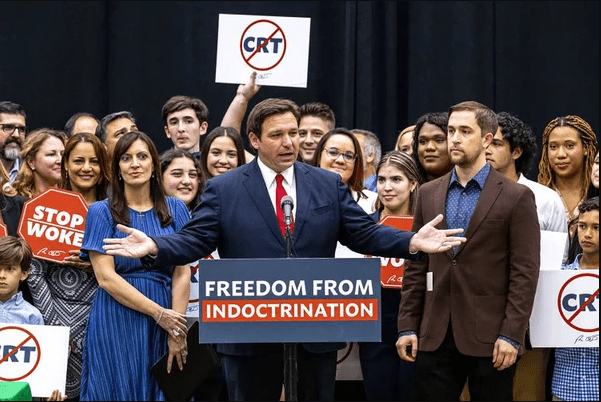
But the balance introduced by that counter-revolution has not been enough to assuage the continued feeling of victimization from many conservatives. They have now moved from insistence on balance toward censorship. With leadership from Christopher Rufo and many Christian Nationalists there has been a vigorous national campaign over the past few years to combat what they perceive as “wokeness” in education. With Rufo’s advice and support, Florida Governor Ron DeSantis has become a leader in this movement (see Fig. IV.1). Part of this campaign has been the overzealous efforts to ban library books promoting ideas deviating, even in benign ways, from traditional Christian ideals, as we have described in a previous post. But another part is manifested in a recent explosion of “educational gag order” bills – tracked and categorized by PEN America — introduced, and sometimes passed, in Republican-controlled state legislatures around the country.
The template for these was set by Florida’s “don’t say gay or trans” bill (HB1557) in 2022, which “prohibits public schools from offering any classroom instruction related to sexual orientation or gender identity prior to grade 3, or in grades thereafter in a manner ‘that is not age appropriate or developmentally appropriate for students in accordance with state standards.’” This bill also established the empowerment of individual parents and citizens to file complaints or sue schools whom they judge to have violated the restriction. The Florida law was expanded in 2023 by HB1069, which requires that “All ‘materials’ used by public K-12 schools to teach reproductive health, which may only take place in grades 6-12, must be approved by the Department of Education. This instruction must exclusively teach that sex is biological, stable, and determined at birth.” The latter bill blurs the scientific (not “woke,” not liberal) distinction between sex and gender, and completely ignores intersex conditions, all of which we have covered in detail in a previous post.
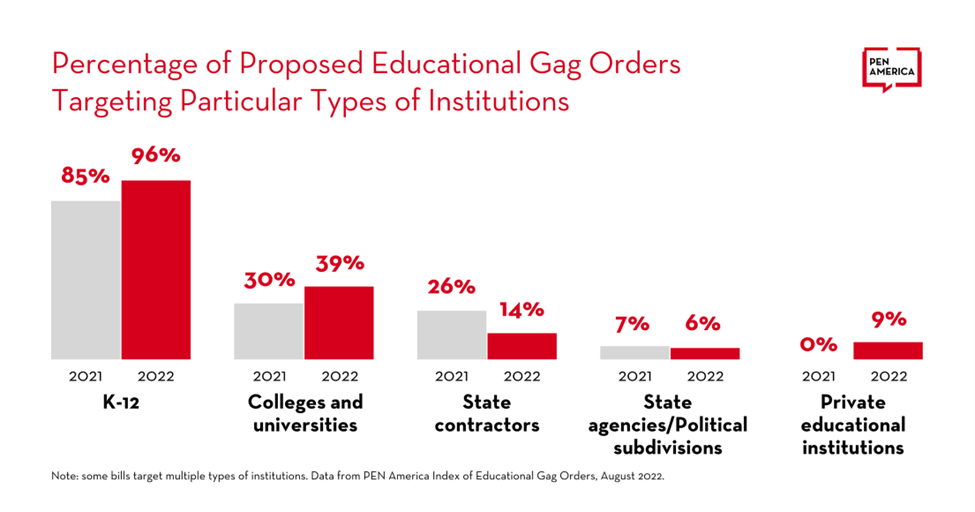
In 2022 legislatures in 36 different states introduced 137 educational gag order bills. All but one of these were sponsored by Republican legislators. Most deal with restricting the teaching of issues surrounding race, sexuality and gender. The majority deal with K-12 education in public schools, but some 30-40% are aimed at limiting course content, academic freedom, and Diversity, Equity and Inclusion (DEI) programs in public universities (see Fig. IV.2).
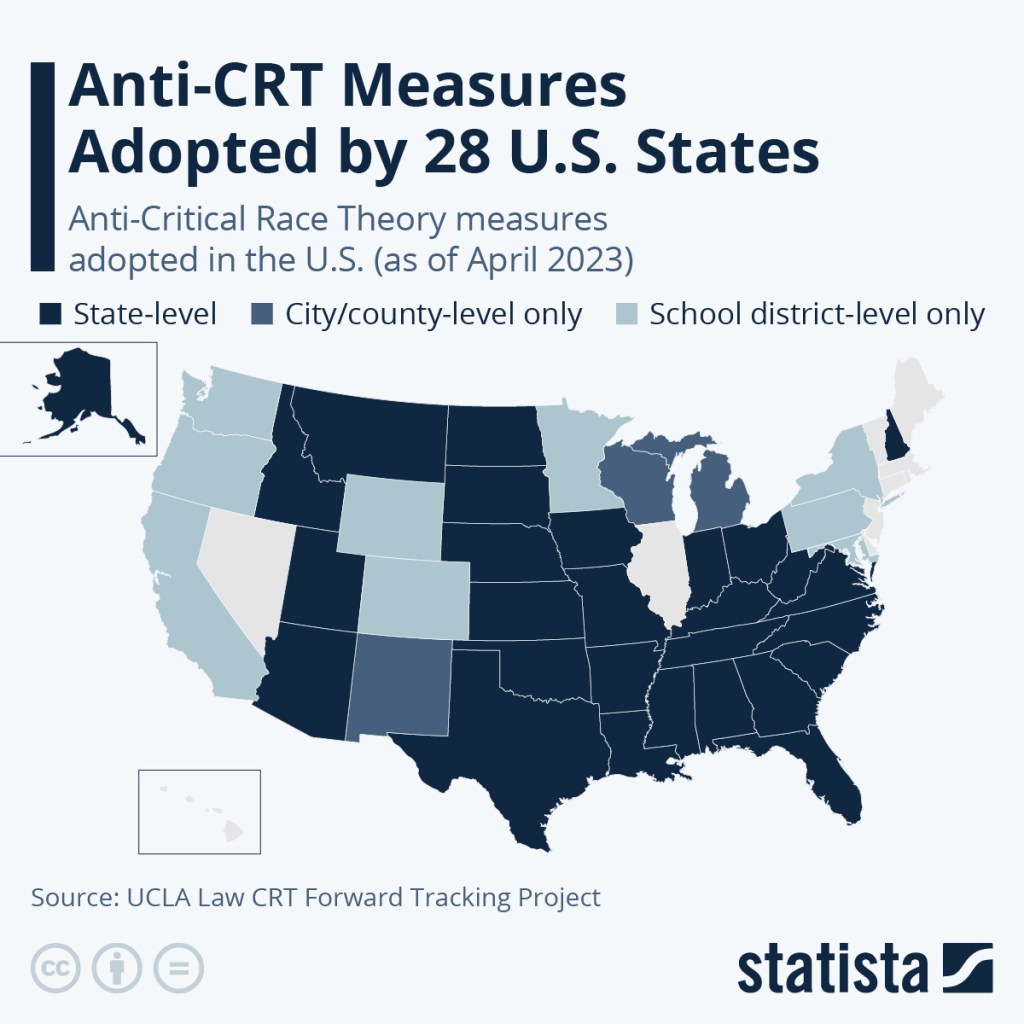
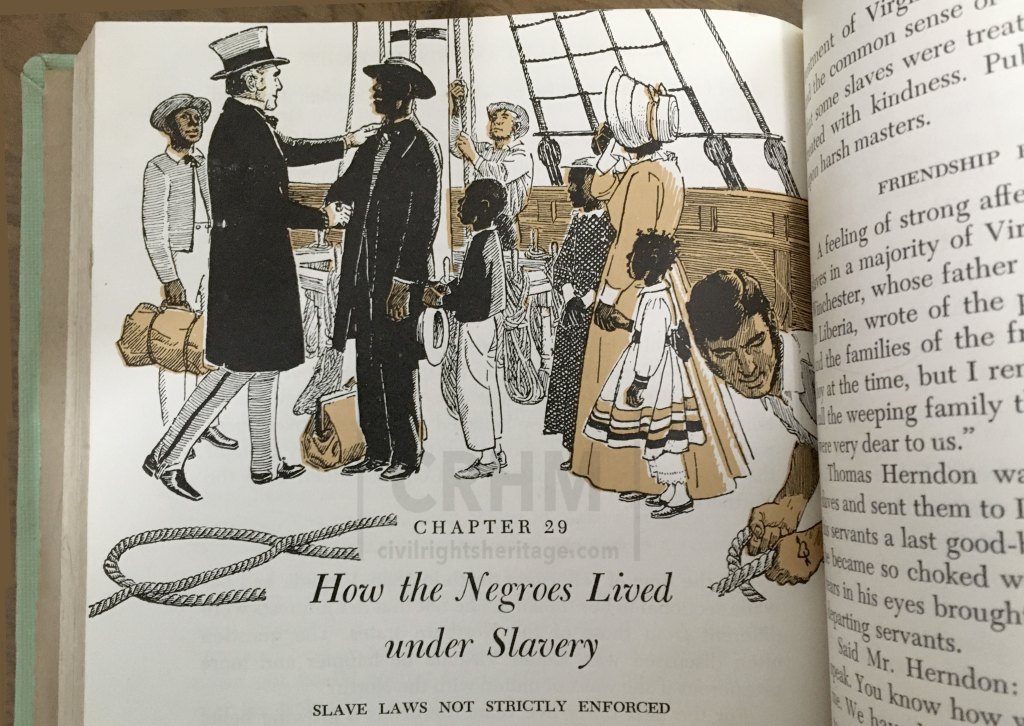
There is a good deal of similarity among the bills passed into law in different states. Among K-12 laws Kentucky’s SB1 is a good example; it “requires public K–12 schools to provide instruction that is ‘consistent’ with ideas related to race, sex, US history and society, and human nature, including the idea that ‘defining racial disparities solely on the legacy of [slavery] is destructive to the unification of our nation.’ Any instruction about ‘current, controversial topics related to public policy or social affairs’ must be ‘relevant, objective, nondiscriminatory, and respectful to the differing perspectives of students.’” Many of these bills were advertised publicly as “anti-CRT” laws (see Fig. IV.3), where CRT stands for Critical Race Theory, a theory of systemic racial inequality that is typically taught only in graduate courses on law or philosophy. However, many of the politicians pushing the bills were found wanting when asked in interviews to explain what CRT is. So many of the education gag order bills invoke instead convoluted language in describing banned race coverage. This led to a ridiculous extreme in a failed Oklahoma bill (HB2988) that would have prohibited teaching that one race “is the unique oppressor in the institution of slavery” while another is its “unique victim.” That characterization passes over from fighting liberal indoctrination to rewriting American history. Of course, there is a rich history of revisionism about slavery in American education, illustrated in Fig. IV.4 by a 7th grade history textbook used in Virginia in the 1960s and 1970s, which described the slaves as living “happy, cheerful, and prosperous” lives.
Among higher education laws, Tennessee’s HB2670 is typical; it “prohibits public colleges and universities from conducting any mandatory student or employee training that includes ideas from a list of ‘divisive concepts’ related to race, sex, religion, creed, nonviolent political affiliation, social class, or any other ‘class of people,’ or that ‘promotes resentment’ of any such group.” In the hopes of staving off lawsuits against its questionable constitutionality, the Tennessee law includes language insisting “that it is not to be interpreted to infringe on an individual’s academic freedom or First Amendment rights.” In fact, most of the laws restricting teaching in colleges and universities are, indeed, in jeopardy of violating the spirit of the Supreme Court’s 1957 ruling in Sweezy v. New Hampshire, where the Court affirmed that academic freedom is protected by the Constitution and outlined “four essential freedoms” of a university: “to determine for itself on academic grounds who may teach, what may be taught, how it shall be taught, and who may be admitted to study.” In that decision, Chief Justice Earl Warren wrote that “To impose any strait jacket upon the intellectual leaders in our colleges and universities would imperil the future of our Nation.”
Most of the educational gag order bills seem aimed primarily and initially at the teaching of civics, humanities, sex education, and social science courses. None of them yet directly attacks the teaching of natural sciences. But sciences are certainly impacted indirectly. For example, sexuality and gender are scientific issues. As we have covered in our post on Sex, Gender, Genome, and Hormones, there are well researched biological and neurological differences between sex and gender, which the Christian nationalist movement wants to suppress. And given conservative pushback on the science of climate change, and religious unease with evolution and cosmology, it is reasonable to expect that attempts to restrict the teaching of science will come next. As it has been on the “anti-woke” agenda, Florida may well lead an anti-science charge. The state’s Chief Medical Officer Joseph Ladapo, whom we have discussed in our earlier post on America’s Frontline Quacks, is certainly leading that charge with his debunked comment that mRNA COVID vaccines can alter people’s DNA and his recent advice, in the middle of a measles epidemic in the state, that parents should decide for themselves whether to send their measles-infected child to school.
A 2017 state law in Florida greatly expanded the ability of residents to challenge and petition for removal of textbooks and other teaching materials chosen by their school districts. Among the early challenges were the following: four Collier Country residents objected “to 18 science textbooks, primarily on how they presented evolution, the weather, and climate change;” five residents of Martin County requested that textbooks be changed in order to “develop curriculum that presents an objective case both for and against evolution;” a Nassau County resident challenged three textbooks whose coverage of evolution he found “inflammatory to every Christian.” None of these particular challenges were adopted by the school boards, but they each came close.
“Teach the Controversy”:
Attempts to eliminate or restrict the teaching of evolution in U.S. schools goes back more than a century. We have outlined the history of such campaigns in our earlier post on evolution. State laws banning the teaching of evolution were tested in various court cases, beginning with the infamous 1925 Scopes “Monkey” Trial in Tennessee. In Epperson v. Arkansas the U.S. Supreme Court ruled in 1968 that an Arkansas anti-evolution law represented an unconstitutional violation of the Establishment Clause of the First Amendment, which prohibits the establishment of a state religion. That decision led several states to adopt “balanced treatment” laws, which required that when evolutionary science was taught in public schools, so-called “creation science” had to be taught as a scientific alternative.
An Arkansas “balanced treatment” law was again found to be unconstitutional in the 1982 case McLean v. Arkansas Board of Education. Judge William Overton ruled for a U.S. district court that “creation science” was, in fact, religion and failed to meet what he set out as the essential characteristics of any science: (1) it is guided by natural law; (2) it has to be explanatory by reference to natural law; (3) it is testable against the empirical world; (4) its conclusions are tentative, i.e., are not necessarily the final word; and (5) it is falsifiable. In other words, Overton supported the scientific method. He also provided a quotation we use as a footer on our blog site.
A national standard was set by the Supreme Court in the 1987 case Edwards v. Aguillard, which ruled that Louisiana’s balanced treatment law still represented an unconstitutional infringement on the Establishment Clause. However, the ruling written by Justice William Brennan did leave a loophole through which creationists have since tried to wriggle: “We do not imply that a legislature could never require that scientific critiques of prevailing scientific theories be taught. . . . Teaching a variety of scientific theories about the origins of humankind to schoolchildren might be validly done with the clear secular intent of enhancing the effectiveness of science instruction.”
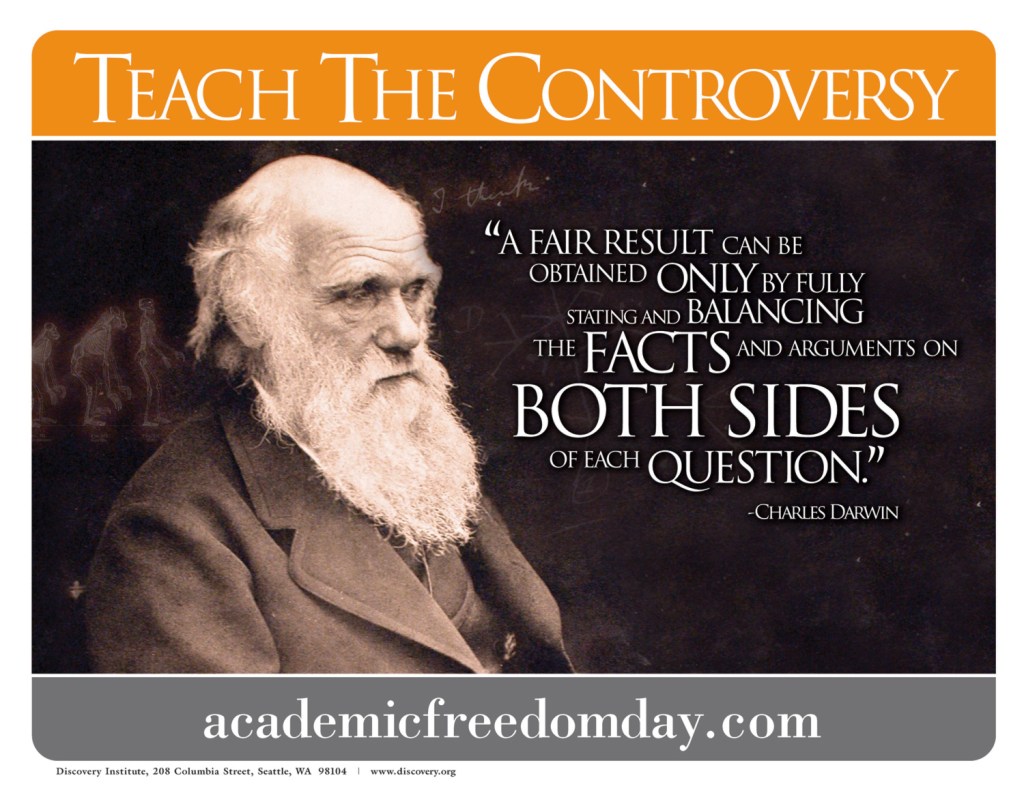
In the wake of the Edwards v. Aguillard decision, creation science got relabeled as Intelligent Design (ID), dropping explicit reference to God as Creator. The Discovery Institute under the leadership of Philip E. Johnson launched a national campaign to “Teach the Controversy,” exploiting Justice Brennan’s “loophole” in the Edwards v. Aguillard decision. This represented an early attempt by opponents of liberal education to adopt a seemingly unobjectionable label for their highly objectionable goals to undermine science education. The campaign involved stacking municipal, county, and state school boards with ID proponents and urging school boards to adopt curricula that presented ID as a viable alternative to evolution. The goal was to generate a public demand for exposing the flaws of evolutionary theory. As illustrated in Fig. IV.5, the campaign even tried to use Charles Darwin’s own words to promote “teaching the controversy,” although they had to obfuscate the scientific meaning of the word “facts.” The campaign succeeded in getting U.S. Senator Rick Santorum of Pennsylvania to introduce a “Teach the Controversy” amendment to the 2001 No Child Left Behind education act. Although the amendment was passed by the U.S. Senate, it was omitted from the final law.
A 2004 attempt by the Dover Area School District School Board in York County, Pennsylvania, to amend the district’s science curriculum via adoption of a textbook Of Pandas and People, designed to promote Intelligent Design, was negated in the 2005 lawsuit Kitzmiller v. Dover Area School District. Judge John E. Jones ruled in that case that “ID is nothing less than the progeny of creationism” and has no place in science classes. Jones furthermore described “Teach the Controversy” as “at best disingenuous, and at worst a canard.”
The Kitzmiller decision did not stop creationists, but only led them to relabel their efforts once again as Critical Analysis of Evolution, drafting course curricula that featured “the great evolution debate.” A centerpiece of the ongoing attempts to create a scientific controversy where none exists was the introduction of the concept of “irreducible complexity.” As we have pointed out in our previous post on irreducible complexity, its proponents (prominently, Michael Behe) have as yet failed to find any biological system or function whose evolution cannot be explained via multi-step natural selection, often involving the repurposing of genes originally developed for different functions.
This is not to say that there are no issues worth debating within the science of evolution. Some of these have been pointed out in an op-ed written in 2005 by evolutionary biologists Richard Dawkins and Jerry Coyne opposing the “Teach the Controversy” campaign. But they also point out that “The call for balance, by the way, [should be] always tempered by the maxim, ‘When two opposite points of view are expressed with equal intensity, the truth does not necessarily lie exactly half way between. It is possible for one side simply to be wrong.’” Intelligent Design is not science, and to force discussion of it in science classes as a viable alternative to evolution would weaken the value of scientific research. Undaunted by the Discovery Institute’s failures, however, Philip Johnson responded: “If the public school educators will not “teach the controversy,” our informal network can do the job for them. In time, the educators will be running to catch up.” Educators aren’t running yet, but we should be prepared for state legislators trying to force them to.
“Intellectual Diversity”:
In the most recent spate of educational gag orders, legislators seem to have begun worrying about losing lawsuits on First Amendment grounds when they specify their intended teaching restrictions in too much detail. Hence, they have started to adapt the Discovery Institute’s approach of using a vague, seemingly unobjectionable label for the restrictions they want to impose: they mandate “intellectual diversity.” But the very vagueness of this term invites problematic interpretations. For example, in response to a 2021 Texas law mandating that educators present “diverse and contending perspectives” on controversial topics, an administrator training Texas teachers how to accommodate the law said “And make sure that if you have a book on the Holocaust that you have one that has an opposing [view], that has other perspectives.” Controversy is often in the eye of the beholder. When individual citizens or politicians can register complaints about a lack of “intellectual diversity,” they can demand equal time for their favorite conspiracy theory.
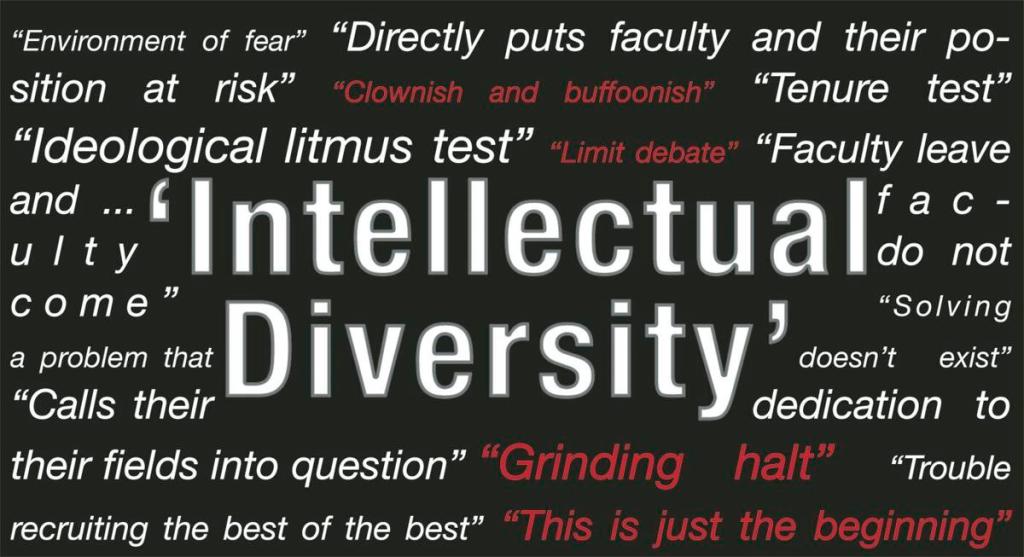
And that brings us to Indiana Senate bill 202, which has now passed the state legislature and been signed into law by the Governor. The bill’s language mandates that state universities teach with “intellectual diversity,” defining that term to mean “multiple, divergent, and varied scholarly perspectives on an extensive range of public policy issues.” The bill threatens state university faculty who fail to live up to this standard with denial or revocation of tenure. The poster in Fig. IV.6, from a story on SB202 in the Purdue Exponent student newspaper, contains excerpts from some comments illustrating faculty interpretations of the bill’s “intellectual diversity.”
Within the language of SB202, who is to decide what issues are “scholarly” and which issues are “public policy issues”? In light of the proliferation of educational gag order bills around the country, all teaching issues become public policy issues. Does the list of scholarly sources include the Bible, astroturf think tanks, and partisan media personalities? According to SB202, when students or parents file complaints, the ultimate arbiters are not scholars but a Board of Trustees on which 7 of 8 members (excluding one student member) would be political appointees. Given the recent history of right-wing “bogeymen,” this policy would likely lead in the end to many “witch hunts” and lawsuits, triggered by political rather than scholarly differences of opinion, and chilling and ultimately eroding academic freedom.
We belong to a group of Concerned Scientists @ IU, which does not represent Indiana University, but does represent more than 1,000 faculty, students and supporters of science in south, central Indiana. That group has sent letters opposing SB202 to state legislators and the Governor. In those letters we point out that despite SB202’s possible immediate target on the humanities and social sciences, “we feel that the legislation would have an equally chilling effect on research and education in science and engineering. There is not a topic in the history of science—plate tectonics, the heliocentric solar system, geologic time, the theory of relativity, evolution, or the development of vaccines—that was not at some time considered controversial to some members of the broader community.” Controversies within scientific fields are decided within the framework of the scientific method by letting evidence decide. “SB202 purports to improve ‘intellectual diversity,’ yet it never once mentions the essential role of evidence.”
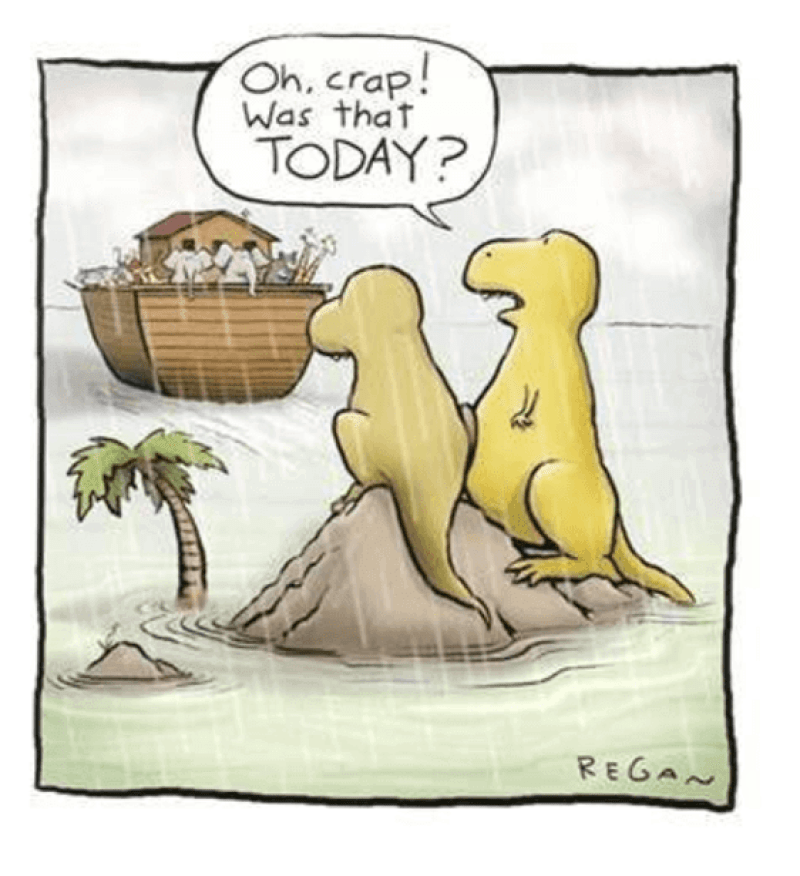
So, let’s contemplate some issues that SB202 might require to be taught in college classes, depending on who’s doing the judging of “intellectual diversity.” Would science classes have to spend as much time covering climate change denial as they do on the ample evidence for the role of humans in ongoing climate change? Heaven knows the Heartland Institute has devoted enormous effort in trying to misinform science teachers about the climate, as we have debunked here and here. Would biology courses for pre-med students have to expose students to claims that vaccines kill more people than they save, just because a few people with advanced degrees have written books claiming that is so, despite enormous evidence to the contrary? Would Intelligent Design get a second life despite all the negative court decisions? Would science courses be required to devote significant time to Bible-inspired claims that the Earth and the universe are only 6,000 years old, despite enormous amounts of cosmological, astronomical, geologic, paleontological, and even archaeological evidence to the contrary? After all, young Earth creationists disregard evidence that the dinosaurs underwent extinction 66 million years ago. Instead, they claim that the dinosaurs just weren’t fast enough to outrun the Great Flood. Or perhaps, as suggested in Fig. IV.7, they just missed the boat.
Would political science courses have to devote time to all the debunked, evidence-free claims that the 2020 Presidential election was stolen? Would they be required to cover socialism, communism, and fascism among governing philosophies? And if so, how would that be handled with State Attorney General Todd Rokita’s new portal for citizens to “snitch” on teachers who include “examples of socialist indoctrination” in their courses? Would Critical Race Theory become a required topic? How about the 1619 Project putting slavery near the center of the founding principles of the U.S.? Would courses in biology or genetics be required to cover the evidence showing biological differences between sex and gender, in addition to more standard material regarding X and Y chromosomes? Would courses covering demographics be required to discuss the relative advantages of immigration versus, say, contraception bans (currently advocated by some Christian Nationalists) as methods to ameliorate the dwindling future work force implied by falling fertility rates. Would this blog site debunking science denial be an accepted template for an “intellectually diverse” course?
As illustrated by just this partial list, the phrase “intellectual diversity,” as used in SB202, is unconstitutionally vague. Its interpretation is left to the eyes of diverse beholders. The bill violates the protected concept of academic freedom for political ends that will become the subject of many lawsuits. It does not advance education in any meaningful way. And it will threaten adherence to the scientific method in higher education natural science courses.
V. conclusions
The goal of the natural sciences is to understand what makes Nature tick. How did we end up with a universe and a planet that supports life forms? How have species on Earth evolved over billions of years? How do human bodies and brains function? What causes the various kinds of natural disasters and how might we detect them ahead of time? How can we prevent and treat human and animal diseases? These are a few of the basic questions that have been illuminated brilliantly over centuries by applying the scientific method, a method anchored by reproducible, quantitative experimental or observational results. Those results can inform the development of models and theories that provide predictive power for phenomena that will occur or be tested in the future. The crucial aspect of the scientific method that sets it apart from “other ways of knowing” is its self-correctability: models and theories can be updated or replaced when the experimental evidence demands or when new phenomena are observed. The history of science is replete with examples of such change.
The efforts we have described to corrupt science education range from misguided to nefarious. Laudable motives to recognize the historic harm done to indigenous groups from centuries of colonialism, often fueled by weapons exploiting scientific understanding, are nonetheless leading to misguided efforts to treat spiritual and mystical indigenous ways of seeing Nature as an equivalent form of science in education. The indigenous ways of knowing, like religious faith, are not falsifiable; they do not demand the rigorous evidentiary trail that science does and they are highly unlikely to welcome revision. Indigenous insights and practices can certainly bring new questions and new intuition to be tested by the scientific method, but they cannot replace the scientific method. Those that claim they are equivalent to science are confusing science and culture. Teaching students that these other ways of knowing are other forms of science will only confuse students and encourage subjectivity in all forms. Although these attacks come from the political left, they will end up supporting one of the primary goals of the contemporary political right in teaching that anyone’s version of reality is just as valid as anyone else’s.
Attacks on science education from the political right are more sinister in intent. They are aimed at undermining knowledge gained by the scientific method that overturns or casts doubt on their preferred religious, political, or economic perspectives. Since past attempts to replace the teaching of science have failed, contemporary attacks focus on demanding the teaching of “both sides now.” Christian groups that are concerned that the science of evolution and a multi-billion year old universe will weaken the authority of the Bible have demanded to “Teach the Controversy” in science classes, even though Biblical versions have no scientific evidence in their favor. “Anti-woke” groups trying to maintain revisionist versions of race history and outdated understanding of sex and gender are combining with opponents of government regulation to demand “intellectual diversity” in teaching. The goal is precisely to confuse students so that they end up believing that anyone’s version of reality is just as valid as the scientific view. For example, the attackers want students to believe that self-serving claims that global warming doesn’t exist or that it is not caused by human activities are just as valid as the findings of climate science.
The natural sciences have produced profound advances in our understanding of Nature over the past couple of centuries, by applying and refining the scientific method. Those advances in understanding have led to the development of amazing new technologies. The fact that some of those technologies have been exploited for unsavory ends does not negate the importance of the understanding that fueled them. Efforts to undermine or water down the teaching of the scientific method by including “other ways of knowing” or “both sides now” will only serve to muddy the understanding already gained and slow down future advances in understanding Nature. Nature does not care what any individual or group believes or wants to be true.
references:
DebunkingDenial, Evolution, Part I: Concepts and Controversy
DebunkingDenial, Young Earth Creationism, Part I
DebunkingDenial, Ten False Narratives of Climate Change Deniers, Part I
DebunkingDenial, The Ozone Layer Controversy
DebunkingDenial, Epidemiology Busters: Scientists for Hire to Defend Toxic Products
DebunkingDenial, The EPA’s War Against Science
DebunkingDenial, The Disinformation Dozen Source of Lies About Covid Vaccines
L. Stamato, The Launch of the Long Game, Inside Higher Ed, May 9, 2023, https://www.insidehighered.com/opinion/views/2023/05/09/launch-long-game
J.C. Young and J. Freedman, America’s Censored Classrooms, PEN America, Aug. 17, 2022, https://pen.org/report/americas-censored-classrooms/
Indiana State Senate Bill 202, 2024
Topic Arrangements of the Next Generation Science Standards, Sept. 2017
Foundations of Science Under Attack in U.S. K-12 Education, Feb. 19, 2024
A Framework for K-12 Science Education: Practices, Crosscutting Concepts, and Core Ideas (National Academies Press, 2012)
Wikipedia, Scientific Method
Wikipedia, Maori People
The Coming of the Maori; The Creation of Man, New Zealand Electronic Text Collection, https://nzetc.victoria.ac.nz/tm/scholarly/tei-BucTheC-t1-g1-t4-body1-d2-d6.html
Wikipedia, Listener Letter on Science
Teara.nz.gov, Death Rates and Life Expectancy for Maori under Colonial Rule, https://teara.govt.nz/en/death-rates-and-life-expectancy/page-4
Maori Medicine (Rongoa Maori), https://www.tepapa.govt.nz/discover-collections/read-watch-play/maori/maori-medicine
DebunkingDenial, Homeopathy
J. Montgomerie, Leprosy in New Zealand, Journal of the Polynesian Society 97, 115 (1988), https://www.jstor.org/stable/pdf/20706177.pdf?refreqid=fastly-default%3A1ebb66b90d6324ff989b6946af1d5005&ab_segments=&origin=&initiator=&acceptTC=1
World Health Organization, Leprosy, https://www.who.int/news-room/fact-sheets/detail/leprosy
Jerry Coyne, The U.S. Follows New Zealand: Let’s Teach Indigenous “Ways of Knowing” in the Science Classroom!, Why Evolution is True, Feb. 11, 2024, https://whyevolutionistrue.com/2024/02/11/us-follows-new-zealand-lets-teach-indigenous-knowledge-in-the-classroom/
Debunking Denial, The Desperation of Book Bans
Dina Lupin, Decolonizing Science Means Taking Indigenous Knowledge Seriously, Prosocial World, Feb 6, 2024, https://www.prosocial.world/posts/decolonizing-science-means-taking-indigenous-knowledge-seriously
C. Trisos, J. Auerbach and N. Katti, Decoloniality and Anti-oppressive Practices for a More Ethical Ecology, Nat Ecol Evol 5, 1205 (2021), https://www.nature.com/articles/s41559-021-01460-w
Antoinette Burton and R. Mawani, eds. Animalia: An Anti-Imperial Bestiary For Our Times (Duke University Press, 2020), https://www.dukeupress.edu/animalia
G. Pohlhaus, Jr., Epistemic Agency Under Oppression, Philosophical Papers 49, 233 (2020), https://www.tandfonline.com/doi/full/10.1080/05568641.2020.1780149
K. Vernes and R. Rajaratam, Tall Tales Misrepresent the Real Story Behind Bhutan’s High Altitude Tigers, The Conversation.com, Aug. 23, 2012, https://theconversation.com/tall-tales-misrepresent-the-real-story-behind-bhutans-high-altitude-tigers-8963
Leah Asmelash, Nearly 80 Bird Species Names With Racist Roots Are About to be Changed, CNN, Nov. 2, 2023, https://www.cnn.com/2023/11/02/us/bird-species-names-changing-scn-cec/index.html
https://birdnamesforbirds.wordpress.com
Bird Names for Birds, William Alexander Hammond, https://birdnamesforbirds.wordpress.com/historical-profiles/profiles-a-z/hammond-william-alexander/
Wikipedia, John James Audubon
RationalWiki, Other Ways of Knowing
R. Vedder, The Collegiate Conservative Counter-Revolution, Forbes, Jan. 6, 2020, https://www.forbes.com/sites/richardvedder/2020/01/06/the-collegiate-conservative-counter-revolution/?sh=69cdb85a111c
Hillsdale College, https://www.hillsdale.edu/
Liberty University, https://www.liberty.edu/
Brigham Young University, https://www.byu.edu/
Hoover Institution, https://www.hoover.org/
Ludwig von Mises Institute, https://mises.org/
Center for Strategic and International Studies, https://www.csis.org/
Antonin Scalia Law School, https://www.law.gmu.edu/
Mercatus Center, https://www.mercatus.org/
DebunkingDenial, Profiles in Denial: Introduction
Wikipedia, Christopher Rufo
National Education Association, What You Need to Know About Florida’s “Don’t Say Gay” and “Don’t Say They” Laws, Book Bans, and Other Curricular Restrictions, https://www.nea.org/sites/default/files/2023-06/30424-know-your-rights_web_v4.pdf
Civil Rights Heritage, “Happy Slaves” Described in 7th Grade Virginia Textbook Used for 20 Years, https://civilrightsheritage.com/2018/04/16/happy-slaves-described-in-7th-grade-virginia-textbook-used-for-20-yrs/
Wikipedia, Sweezy v. New Hampshire
DebunkingDenial, Sex, Gender, Genome, and Hormones
DebunkingDenial, America’s Frontline Quacks
E. Hutto, Paul Offit Debunks Florida Surgeon General’s Anti-Vax Warning, Medpage Today, Jan. 5, 2024, https://www.medpagetoday.com/infectiousdisease/covid19vaccine/108145
L.S. Wen, Florida’s Measles Outbreak is a Devastating – and Preventable – Tragedy, Washington Post, March 5, 2024, https://www.washingtonpost.com/opinions/2024/03/05/florida-measles-outbreak-surgeon-general-ladapo/
S. Sawchuk, Coming Soon to Florida: More Challenges for Districts’ Science Curricula?, Education Week, Dec. 7, 2018, https://www.edweek.org/teaching-learning/coming-soon-to-florida-more-challenges-for-districts-science-curricula/2018/12
Wikipedia, Scopes Trial
Wikipedia, Epperson v. Arkansas
Wikipedia, McLean v. Arkansas
Wikipedia, Edwards v. Aguillard
Justia, Edwards v. Aguillard
Discovery Institute, https://www.discovery.org/
DebunkingDenial, Philip E. Johnson, Evolution Denier
Wikipedia, Teach the Controversy
Wikipedia, No Child Left Behind Act
Wikipedia, Of Pandas and People
Wikipedia, Kitzmiller v. Dover Area School District
DebunkingDenial, Evolution, Part IV: Irreducible Complexity Reduced
DebunkingDenial, Michael Behe, Evolution Denier
R. Dawkins and J. Coyne, One Side Can Be Wrong, The Guardian, Sept. 1, 2005, https://www.theguardian.com/science/2005/sep/01/schools.research
P.E. Johnson, Passing the Torch, https://www.arn.org/docs/pjweekly/pj_weekly_020409.htm
S. Romero, When Schools Require the Teaching of “Opposing” Viewpoints, Wheelock College, Oct. 21, 2021, https://www.bu.edu/wheelock/news/articles/2021/when-schools-require-the-teaching-of-opposing-viewpoints/
Indiana State Senate Bill 202, https://iga.in.gov/legislative/2024/bills/senate/202/details
V. Lin, Tenure Bill Passes House Despite Pushback, Purdue Exponent, Feb. 28, 2024, https://www.purdueexponent.org/campus/article_3943db7e-d67b-11ee-9c40-cb105fc4784a.html
DebunkingDenial, The Heartland Institute Strikes Again
DebunkingDenial, Still Deniers After All These Years: A Review of the Heartland Institute’s ‘Climate at a Glance’
DebunkingDenial, Robert F. Kennedy, Jr., Conspiracy Theorist
T. Dickinson, Indiana Attorney General Sets Up Website for Snitching on ‘Socialist’ Teachers, Rolling Stone, Feb. 22, 2024, https://www.rollingstone.com/politics/politics-features/indiana-attorney-general-eyes-on-education-snitch-socialist-teachers-rokita-1234973031/
The 1619 Project, New York Times Magazine, Aug. 14, 2019, https://www.nytimes.com/interactive/2019/08/14/magazine/1619-america-slavery.html
DebunkingDenial, Ramifications of the Accelerating Worldwide Baby Bust
 Debunking Denial