
Addendum Jan. 17, 2025: Indigenous ‘Ways of Knowing’ and the Kauri Tree
This is an Addendum to our March, 2024 post on attacks on science education. Section III of the following post discusses efforts to incorporate “other ways of knowing” into science, or to replace the traditional methods of science with efforts to “improve” science by removing what are claimed to be elements of white supremacy, racism or colonialism contained within science. In addition, it is often suggested that various other aspects be added to conventional science in order to ‘improve’ it. Our post reviewed at some length efforts by the New Zealand government to incorporate elements of Mātauranga Māori (Māori philosophy) into traditional science education courses taught to high school students in that country. The argument is that a number of accomplishments of Pacific islands peoples (e.g., the vast sea voyages undertaken, which resulted in the population of New Zealand in the 14th century, identification of herbal remedies such as quinine for disease, and methods of farming) constitute “science,” are equal or superior to conventional science, and need to be taught to young New Zealanders.
We have no criticism of teaching New Zealand youth about the history and culture of the aboriginal settlers of that country. However, we feel that it should be taught as culture or history rather than being merged with science education. As impressive as the accomplishments by indigenous New Zealand tribes may be, Mātauranga Māori includes along with its technical developments a number of myths and legends, including creation myths. These should certainly not be included as parts of ‘science’ education, particularly since a number of the indigenous myths contain elements that conflict with current scientific understanding. For example, a Māori creation myth states that the first humans arose roughly 1,400 years ago. More than that, the Māori legends cannot be perceived as subject to skepticism and possibly falsified, as are elements of science. The Māori legends need to be accepted without question. Thus, incorporating Mātauranga Māori instruction into the traditional science curriculum invites confusion: the current science curriculum emphasizes that all scientific results are to be seen as provisional and subject to testing and possible falsification; while philosophical aspects of Mātauranga Māori are not to be challenged. Furthermore, students will be exposed to completely contradictory claims such as competing descriptions of cosmology.
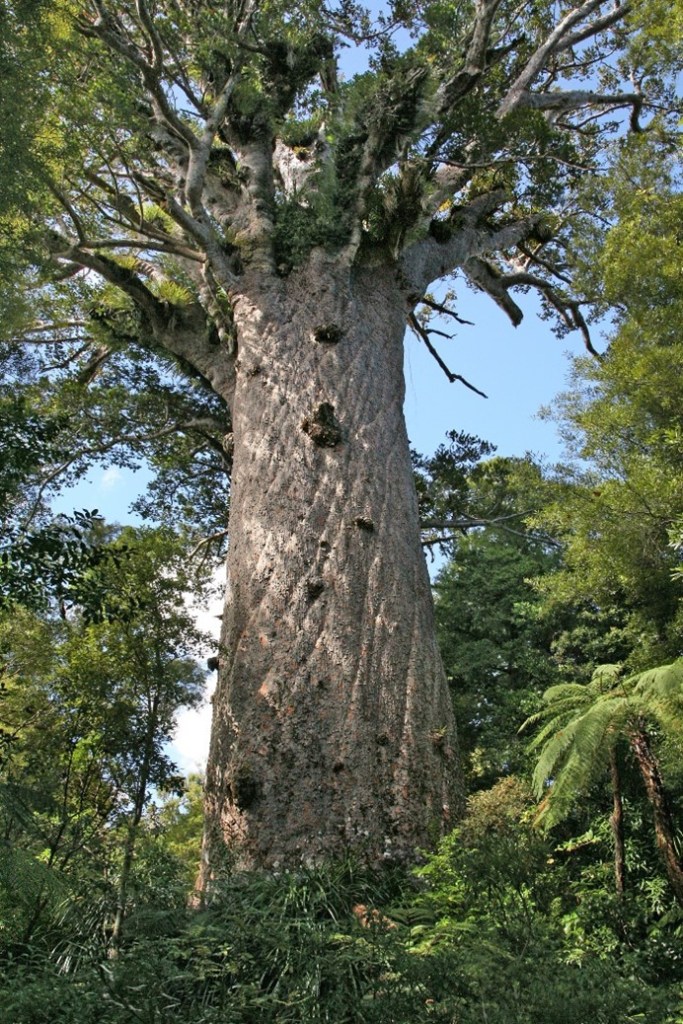
Biologist Jerry Coyne, who authors the blog Why Evolution Is True, has followed the controversy over the science curriculum in New Zealand, and he has highlighted how the issue of indigenous science is playing out in that country. Coyne was alerted to a recent issue that centered on the kauri tree (Agathis australis), one of the largest of New Zealand trees. Figure 1 shows a kauri tree in New Zealand that is over 50 meters high with a circumference of 14 meters, and it is estimated to be between 1,250 and 2,500 years old. At present it is the country’s largest kauri and its Māori name is Tāne Mathua (“God of the forest”). The kauri is currently threatened by a condition known as kauri dieback disease. It is caused by a fungus-like substance, the oomycete Phytophthora agathidicida. This causes extensive damage to the kauri trees that often ends in the death of the tree.
It is believed that human activity is primarily responsible for the spread of kauri dieback. One clue is that in the Waitākere Ranges 71% of all affected kauri trees are within 50 meters of public walking tracks. It is also suspected that feral pigs may transport the fungus over larger distances. The New Zealand government has closed many of the public reserves while the kauri are being treated. There are currently three different treatments being applied to affected kauri trees. These span a large spectrum; the first are “scientific” treatments that generally involve either broad-spectrum treatments such as copper sulfate, or injections of phosphite (this second treatment is currently being investigated in trial studies). A second ‘alternative’ treatment uses homeopathic methods. This is described on the Website Ecogrape that is curated by Andreas Welte. It appears from that Website that Welte’s methods are supported by the Auckland NZ Council.
Let us review Welte’s suggested homeopathic ‘regimen’ for treating kauri dieback disease. He recommends spraying four different homeopathic liquid ‘compounds’ on the roots of affected trees. First, after the winter solstice a groundwork application of a liquid containing Carbo vegetabilis (charcoal); this is claimed to “put an activating foundation in the soil to rebalance the distorted root activity and ease the tree’s metabolism.” Second, at the beginning of spring spray on a few applications of a Belladonna mixture. Later in spring applications of Dulcamara (Bittersweet). And finally in summer apply doses of Natrium sulphuricum (Glauber salt). Look at our assessment of homeopathy in an earlier blog post.
All four of these homeopathic ‘remedies’ are to be prepared in a dilution of 30 C. That means you first dilute 1 part of the ‘active ingredient’ with 100 parts of distilled water. You then repeat this dilution 30 times on the successive mixtures from each iteration. You can easily calculate that the eventual solution includes 1 molecule of the active ingredient to every 1060 molecules of water, which is more water than exists on Earth. Homeopathy was developed before the atomic theory of substances was known, and also prior to identification of the germ theory of disease. We can easily calculate that a small bottle of a homeopathic liquid will contain less than 1023 molecules. Consequently, there will be zero molecules of the ‘active ingredient’ remaining in the liquid – that is, the homeopathic liquid will be 100% distilled water. The ‘theory’ of homeopathy is that the greater the dilution, the greater the ‘potency’ of the remaining liquid. We know of no physical process by which this could occur. It is also claimed that the preparation of these liquids changes the water in profound but unobservable ways; the resulting water is claimed to ‘remember’ the presence of the active ingredient. Once again, there is absolutely no scientific evidence that these claims are true. Scientists believe that whatever effects humans get from homeopathic products are due to the placebo effect; we know of no valid studies of homeopathy that obtain positive results greater than the placebo effect. As far as we know, plants do not experience the placebo effect; therefore, our expectation is that treatment of affected kauri trees with homeopathic liquids will have no positive results.
A second ‘alternative science’ method for treating kauri dieback disease is being led by indigenous Māori healers. This is described as utilizing ihirangaranga, which involves the use of vibrations and frequencies on kauri forests to “construct a sonic tapestry of rejuvenation and well-being.” Exactly how is this carried out? Well, it involves playing whale songs to infected trees and dousing them with whale oil (no, we are not kidding). The Oranga Website states that “the soundscape is a layered composition, intricately woven with sonic samples of healthy kauri within its untouched habitat, the whale song of its cetacean kin the tohora [sperm whale], inlayed with the healing sounds of taonga puoro, takutaku, and karakia, representing profound layers of ancient wisdom and knowledge, deeply ingrained in the very fabric of the soundscape.”
According to Māori myths, whales used to be land-dwelling creatures, lived in kauri forests and communicated with the trees. Thus, the indigenous community believes that the kauri will recover from dieback disease if their roots are treated with a paste that contains whale oil and ground whale bones. Prayers are offered up to the trees and sounds of a ‘healthy forest’ are played in the area of dying kauri trees. We don’t know of any reputable scientific data showing that playing certain sound frequencies will cure an ailing kauri. This project was funded by a New Zealand government project the National Science Challenges. Here is a link that describes the general idea that the kauri trees and the forests in which they live can be healed by this series of steps.
And here is a post by Māori spokesperson Tohe Ashby that provides a detailed description of the treatment regimen for diseased kauri trees during the three years of this initiative. An indigenous elder describes the process of mixing pieces of whale bone and whale oil with soil. This is then distributed around the base of a diseased tree.
This video does not mention playing specific sound frequencies to the trees. However, the spokesperson claims to have treated seven diseased kauri trees with this method, and that he achieved 100% success – all of the trees returned to health. This is a rather amazing claim, as conventional scientific treatments have a rather low success rate.
Note that these three radically different treatments for kauri dieback disease could be easily compared, and we could assess their success rates in a very straightforward test. We would identify three different forest areas where kauri were suffering from dieback disease. Each separate forest plot would be treated by one of these methods and their results compared. We find it hard to imagine that the homeopathic treatment would obtain positive results. If the indigenous method is producing positive results comparable to, or superior to, the conventional scientific treatment, then scientists should take this treatment regimen very seriously. However, if the indigenous methods produce results dramatically inferior to the conventional treatment, this would provide a strong incentive to prefer the conventional technique. Rigorous scientific tests should also be applied when comparing indigenous treatments of human disease with mainstream scientific procedures.
Unfortunately, it seems unlikely that these indigenous methods will be subjected to sound scientific tests of their efficacy. This is because when these programs were initiated, one demand was that Mātauranga Māori practices must remain under Māori control. We interpret this as saying that outsiders, e.g., non-indigenous people, cannot use scientific testing to determine whether their methods are in fact effective. In debates over the effectiveness of these indigenous practices, Māori spokespersons invariably bring up the assertion that non-indigenous people need to show “humility” in dealing with their practices. Presumably, testing a Māori treatment method (and possibly showing that it has almost zero effectiveness) displays a lack of humility. This seems a shame, as these practices cry out for scientific scrutiny. Previously, such scrutiny has been applied to many indigenous treatments of disease. Substances such as quinine were shown to be effective, while other folk remedies turned out to be ineffective. Perhaps it is worth mentioning that the cause of kauri dieback disease, a fungus-like substance was identified using conventional scientific techniques.
March 18, 2024
I. introduction
The natural sciences at their best provide a rigorous, evidence-based, self-correcting, and objective way to understand the world around us, independent of religion, politics, myth, and mysticism. But as we have elaborated in many posts on this site, scientific findings are not always to the liking of those whose worldviews are based on religion, politics, myth, profit motives, or conspiracy theories. Hence, there is often pressure from such groups to restrict the teaching of science, to downplay the scientific method, or at least to demand equal time for “other ways of knowing” in science courses. Such pressure is currently reaching a crescendo driven by political partisans worldwide. The efforts we will describe in this post are all misguided and they threaten to undermine the objective approach that has produced innumerable profound insights, breakthroughs and technological advances over the past few centuries.
Attacks currently are coming from partisan groups on both the left and the right. From the left, pressures to increase diversity within academia have led to calls to include “other ways of knowing,” specifically indigenous practices, as alternative ways of doing science. Individuals raised on such other ways of knowing can potentially bring unique insights, intuition, and practices that can be tested via traditional scientific approaches, but substituting them, even in part, for the scientific method – which we will explain in Section II — would undermine the reliability and the value of science.
Attacks on science education from the political right have been going on for well over a century now, ever since Charles Darwin’s theory of evolution by natural selection became based in genetics and widely accepted. People who interpret the Judaeo-Christian Bible as a literal account of our origins object strongly to both evolutionary theory and what we have learned from science about the origin and age of the universe and the Earth. Other attacks come from Libertarians and industrialists who oppose all government regulation, particularly those efforts resulting from scientific study of climate change, the stratospheric ozone layer, product toxicity, and air and water pollution.
Right-wing attacks on science education are just one aspect of a half-century long effort by conservatives in the U.S. to counterbalance or eliminate what they see as “liberal indoctrination” in U.S. schools and colleges. The latest chapter in those efforts has seen the introduction over the past two years of hundreds of “educational gag order” bills (see Fig. I.1) in Republican-controlled state legislatures around the U.S., which purport to combat “wokeness” surrounding multiple issues, particularly teaching and books about race, sexuality and gender. This post is inspired by our efforts to fight specifically against Indiana State Senate bill 202, which has just passed the state legislature and been signed into law by the Governor on March 13, 2024. This law now incorporates the latest twist in anti-wokeness bills by threatening the tenure and academic freedom of university professors who don’t promote “intellectual diversity,” as judged ultimately by political appointees.

The rapid development of mRNA vaccines in 2020-21 to ameliorate the COVID-19 pandemic has not only spared many human lives but also given new life to an anti-vaccination, hence anti-science, movement that comes from individuals on both the left and right sides of the political spectrum. The anti-vaxxers are currently focused mostly on spreading misinformation, fear and slander. But attacks on science education may be the next stage of their approach.
It is not our intention in this post to promote science education as unassailable. Many students find science courses too challenging and sometimes off-putting. So science education is continually in need of upgrades to make the material more engaging, more relevant to students’ lives, and more centered on a smaller number of central concepts, copiously illustrated by analogies with phenomena familiar to students. But emphasizing concepts should not come at the expense of sacrificing mathematical rigor or the need for quantitative measurement and calculation. Courses on different science fields should be made more coherent. Teachers should be better trained and better paid, and exposed to periodic updates on the most recent important developments in the fields they teach. But the most coherent aspect of the different fields is the underlying scientific method, showing how scientists evaluate evidence and think about solving problems. Efforts to dilute reliance on the scientific method and at least some quantitative applications are not helpful.
II. What is the “scientific method” and why does it matter?
Science is not capable of addressing all questions. But in addressing the questions relevant to them, scientists adhere to guidelines that demand obtaining observational evidence to find a road toward truth. The “scientific method” is a set of guidelines describing the symbiotic relationship of observations and explanations in advancing toward a more complete understanding of the natural world, including our own bodies and brains. It is not meant to provide an inviolate “recipe” for how science is to be done, but rather a set of ideal standards to which it should be subjected. We identify the critical components of the modern scientific method as follows:
- Reproducible experiments: Scientific facts are determined by experimental results that are successfully replicated by independent teams using independent methods.
- Experimental uncertainties: Experimental results, in order to be useful, should be quantitative and include quantitative estimates of their uncertainty. These can include statistical uncertainties arising from finite sample sizes and systematic errors – in the language of former U.S. Defense Secretary Donald Rumsfeld, “known unknowns” – that reflect the experimenters’ understanding of how much incompletely controlled aspects of the experiment, or imperfect assumptions underlying the method, could potentially skew the results. “Replicated” results should agree within their respective uncertainties.
- Models: Hypotheses can be introduced to aid the interpretation of experimental results, to provide a possible explanation for patterns observed among various results, or to guide further experimental tests. In some cases, these hypotheses can underlie quantitative models capable, with some approximations and adjustable parameters, of quantitatively fitting an ensemble of experimental results.
- Theories: Models can eventually be incorporated within theories when a diverse array of experimental results can be accounted for on the basis of a very small set of postulates or assumptions and a small number of parameters (beyond those whose values may be fixed by the postulates). For a theory to be useful, it should have predictive power. It should be capable of predicting new phenomena or new types of observables that can subsequently be subjected to experimental tests. While experimental results provide the “facts,” models and theories provide the “understanding” of why those facts are the way they are.
- Computer simulations: To get quantitative predictions from models and theories often requires sophisticated computer simulations, incorporating the elements of the models or theories and adapting them to details of the apparatus that will be used to put those predictions to experimental tests.
- Falsifiability: There should be some predictions of a viable theory that are so fundamental to the truth of its postulates that reproducible experiments which invalidate such predictions indicate that the theory needs to be modified or replaced.
- Extraordinary claims require extraordinary evidence: New experimental results that deviate widely from the predictions of a well-established theory or are inconsistent with trends established by previous reproducible experimental results should be treated with skepticism. They can be accepted as upsets to what scientists thought they knew only after extensive vetting of the experimental techniques used and replication of the results by other teams and other techniques. In this sense, the scientific method is conservative. But healthy skepticism cannot be allowed to harden into unyielding denial.
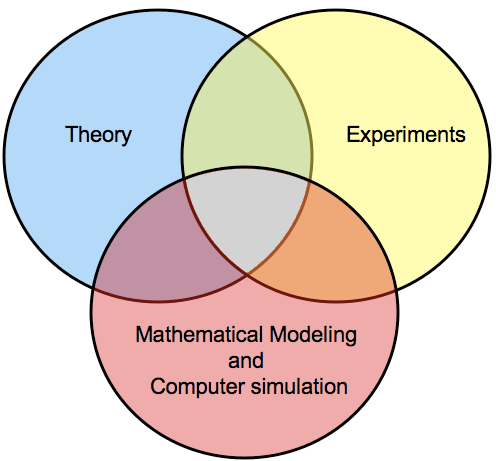
The overlapping roles of experiments, theories, and model simulations is suggested in Fig. II.1.
Note that a theory, according to the scientific method, is the highest form of explanation in a given subfield, in contrast to the vernacular understanding of “theory” as a type of “guess.” But there are many instances in the history of science where a successful theory had to undergo significant modifications when confronted with new types or techniques of measurement or new levels of experimental precision. For example, in physics classical theories of mechanics and of gravity (Newton’s Laws of Motion and of Universal Gravitation – note that “laws” are aspects of theories) that had been accepted for centuries had to be modified in the early years of the 20th century by Einstein’s Theories of Special and General Relativity. At atomic and subatomic levels, Newton’s Laws gave way to Quantum Mechanics.
There is no unique prescription for how a field of study should begin within the experiment-theory loop. The best scientists often have a form of intuition that allows them to make educated guesses about what questions to ask, what new techniques to try, or what approach to take in formulating a model or a theory. But that intuition only guides entry into the experiment-theory loop. Occasionally a theory will spring not from attempts to explain existing experimental results, but rather from pure mathematical considerations or from deep, novel thought experiments. Such theories become useful if they are consistent with any relevant earlier experiments and they successfully predict future experimental results. Some experiments are curiosity-driven to learn how things react in Nature, without pre-existing theoretical guidance for where to look, while other experiments are generated to test specific hypotheses or predictions of a theory.
Occasionally, important new experimental results show up as a serendipitous background to a measurement intended for a different purpose and can only be explained by reference to a new or pre-existing theory. An example is the accidental discovery in 1964 of the Cosmic Microwave Background radiation by Bell Labs researchers Arno Penzias and Robert Wilson, who were testing receivers for radio astronomy and satellite communications. Penzias and Wilson were not quite sure what their background was until Princeton physicist Robert Dicke connected it for them with earlier theories about the Big Bang origin of the universe. Some scientific disciplines are more driven by experiments, never really generating comprehensive theories, while other, more mature fields, are driven by the quest to attain ever more fundamental theories.
We can illustrate some of the concepts within the scientific method by the development of climate change science. There is clear, reproducible experimental evidence that the globe is warming and that the average rate of warming closely tracks the independently measured concentration of carbon dioxide in the atmosphere. The CO2 concentration, in turn, appears to follow the rate of emissions from human burning of fossil fuels. But understanding of these correlations is provided by the theory of infrared absorption and re-radiation from greenhouse gas molecules in the atmosphere. However, predictive power for future climate changes comes for now only from a number of models embedded in complex computer simulations, which must make many assumptions and approximations and use a significant number of parameters to simulate the complex interactions of Earth and atmosphere. Different models make different assumptions and approximations. A full theory of climate interactions may never be obtained because it would involve so many disparate, interacting elements.
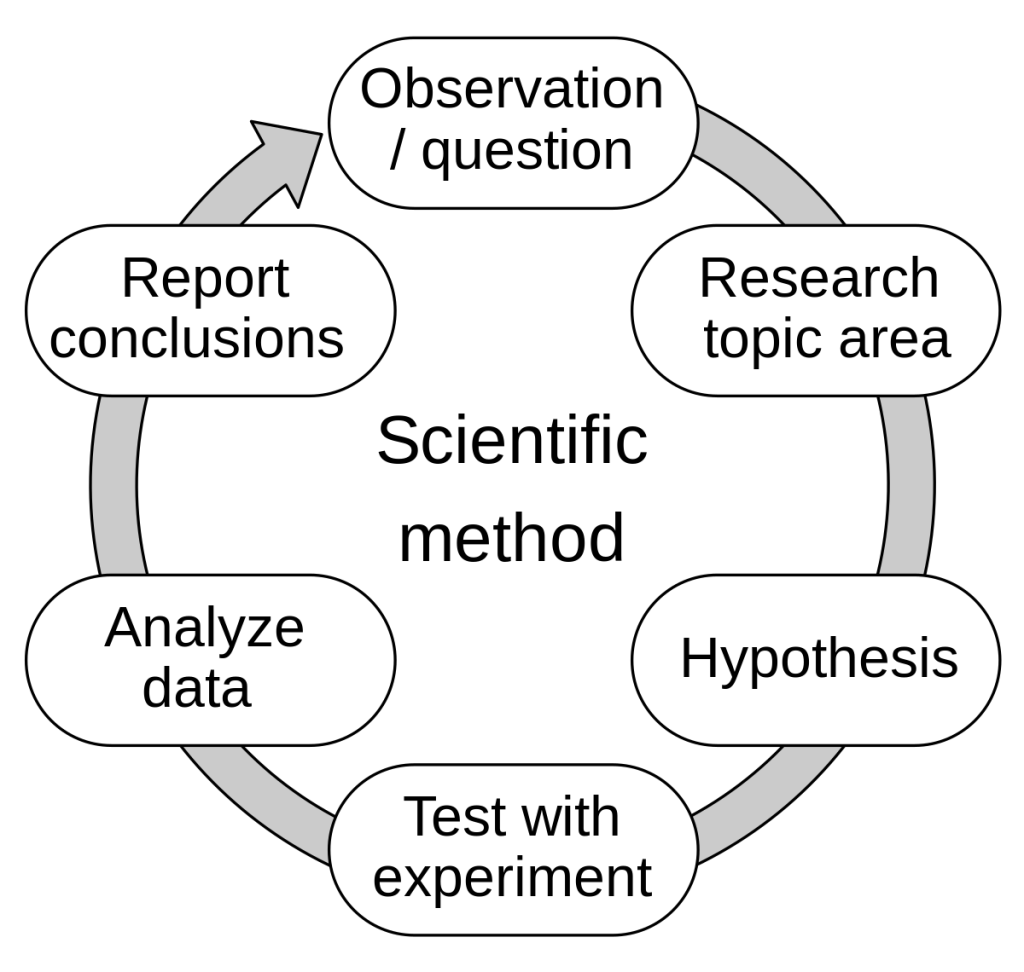
We should emphasize that the modern scientific method as we have outlined it here is not the same as the reductive and overly prescriptive method of Fig. II.2, which has traditionally been taught in K-12 science classes. Nearly all U.S. states have very recently adopted a new set of standards for K-12 science education that downplay the prescriptive aspect of Fig. II.2, but in doing so, manage to throw the baby out with the bath water. These Next Generation Science Standards (NGSS) are based on a 2012 document entitled A Framework for K-12 Science Education: Practices, Crosscutting Concepts, and Core Ideas. The Framework asserts that “… the notion that there is a single scientific method of observation, hypothesis, deduction, and conclusion—a myth perpetuated to this day by many textbooks—is fundamentally wrong,” and instead emphasizes scientific practices that are “… not rote procedures or a ritualized “scientific method.” It is certainly correct that there are not “rote procedures,” but the Framework and the NGSS miss the opportunity to make the natural sciences coherent for students by emphasizing that research in all of them have as underpinning the modern scientific method we have outlined above. The scientific method may well have been mistaught in the past, but that does not mean it doesn’t exist.
Why is the scientific method central to our understanding of the natural world? For one thing, it provides an agreed-upon arbitration approach for scientific disagreements. It is a way of minimizing the influence of bias or individual preferences in conducting, analyzing, and interpreting experiments and testing hypotheses, models, and theories. It allows one to debunk science denial, to unveil scientific fraud, and sometimes to expose important, overlooked confounding variables when an experiment’s results cannot be successfully replicated by other teams. It makes science self-correcting: theories get updated or replaced, some outlier experimental results get rejected, and experimental precision improves as techniques are improved. The self-correction allows an iterative approach that tends asymptotically toward scientific truth. But because scientists never actually arrive at absolutely certain truth, science tends to come into conflict with belief systems (e.g., organized religion, mysticism, political affiliation, financial bottom line, or conspiracy theory cults) that are convinced of their own absolute truth or supremacy, without a comparably rigorous evidentiary trail. The scientific method provides a well-described and very well-tested way of knowing, but it comes into conflict with more mystical or more self-serving ways of “knowing.” It is these conflicts that drive attacks on science education.
iii. “other ways of knowing”: efforts to dilute or replace the scientific method
In addition to attacks on science education from the political right, which we will discuss in Section IV, science is also under pressure from the left. A number of leftist groups claim that science is only one way of determining the truth of propositions. Other methods of establishing truth, claimed to be equally valid, are referred to as “other ways of knowing.” Frequently, this refers to indigenous philosophies. Indigenous people are lauded for what is claimed as their superior respect for natural ecosystems, and their cultural and spiritual practices. In this Section, we will focus on one specific controversy, namely the teaching of science in New Zealand. The government of New Zealand has embarked on a program to educate all middle school students in that country on their heritage from their indigenous Māori people. As we will show, this otherwise laudable effort has led to a bitter controversy involving New Zealand scientists who are under attack from the government and university administrations.
Teaching Science in New Zealand Schools:
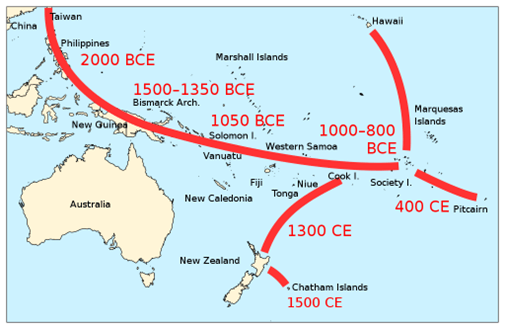
In February 2020, the New Zealand Cabinet proposed changes to the secondary school National Certificate of Achievement (NCEA). The government wanted to instruct school children about the history and accomplishments of the Māoris, the indigenous people of that country. Between about 1320 and 1350, settlers from eastern Polynesia arrived by canoes on the previously uninhabited (by humans) islands of New Zealand. Figure III.1 shows a number of the ocean voyages that resulted in human colonization of South Pacific island chains, and the approximate dates when various islands were inhabited. Since they were isolated from other cultures by the large distances over the ocean, the Māoris developed their own culture and worldview. The Māori had developed the ability to undertake the long sea journeys necessary to reach New Zealand. And their society also had a number of impressive accomplishments. The Māoris developed methods of sustainable agriculture and fishing that could provide useful lessons for Western societies. They also developed a Māori lunar calendar. In general, the aim of teaching all New Zealand schoolchildren about the history and achievements of their country’s indigenous people was an admirable one.
Unfortunately, the government has decided that the way to incorporate this instruction is to include Māori culture and philosophy into science classes, on the grounds that Mātauranga, the knowledge system of the Māori people, is a “way of knowing” that is a “compatible” form of science, and as such is as valid as the scientific method. This is creating a considerable controversy over the aims and methods of such instruction. To a scientist, it certainly appears that instruction about Māori practices would be wholly appropriate in a history or culture course, or perhaps in cultural anthropology. However, in addition to their many technical accomplishments, Māori culture is embedded in a spiritual framework that is at odds with the scientific method. And by “science,” we mean the scientific method as outlined in Section II of this post.
For example, the Māori have a myth that describes the origin and propagation of the human race. A primordial male Tane, the god of the forest and the Māori equivalent of Adam, married his daughter Hinetitama. They produced a daughter who married (not sure where her husband originated), and they produced successive generations of Māori. In much the same way that Biblical scholars count the generations since Adam, the Māori count 28 generations from Tane to the present. If one carries out that calculation, one arrives at the year 600 CE for the first human. This is a date that is obviously much later than the origin of the first homo sapiens, estimated to be 200,000 to 300,000 years ago by archaeology using dating techniques validated by the scientific method. And unlike Western science, the Māori creation myth is not something that one can approach and question with a skeptical outlook. Like other Māori stories of gods and legends, or indeed literal readings of the Judaeo-Christian Bible, these stories must be accepted as true. As one example, the Māoris believed that rain was the tears of the goddess Papatuanuku.
To see the conflict with modern science, we can examine Māori medical practices. Māori medicine, or Rongoa Māori, incorporates several different elements. It includes incantations and other spiritual practices, in addition to massage and medicinal plants. These practices were limited to experts who guarded this as secret knowledge. Like all indigenous societies, the Māori experimented with plants in an attempt to determine those plants that were efficacious against various diseases and ailments. One good example of an indigenous medicine is quinine. Quinine is one of many substances used by indigenous societies to treat various ailments. Scientists now understand the effectiveness of quinine against malaria; controlled, double-blind studies were carried out and proved that quinine is actually effective. The Māori compiled a list of plants that were believed to have medicinal benefits or that were used for food. Figure III.2 shows examples of such plants in a forest. Like other lists produced by indigenous cultures, these lists contain substances now known to be medically effective, but also substances that apparently have no beneficial effects. The lists were compiled using trial and error together with observations of the rate of recovery of the patient. A good example of the limitations of these trial and error methods is the pseudoscience homeopathy (see our post on this topic). This quack ‘medicine’ was developed when false hypotheses were ‘validated’ by observing that patients improved after taking homeopathic nostrums.
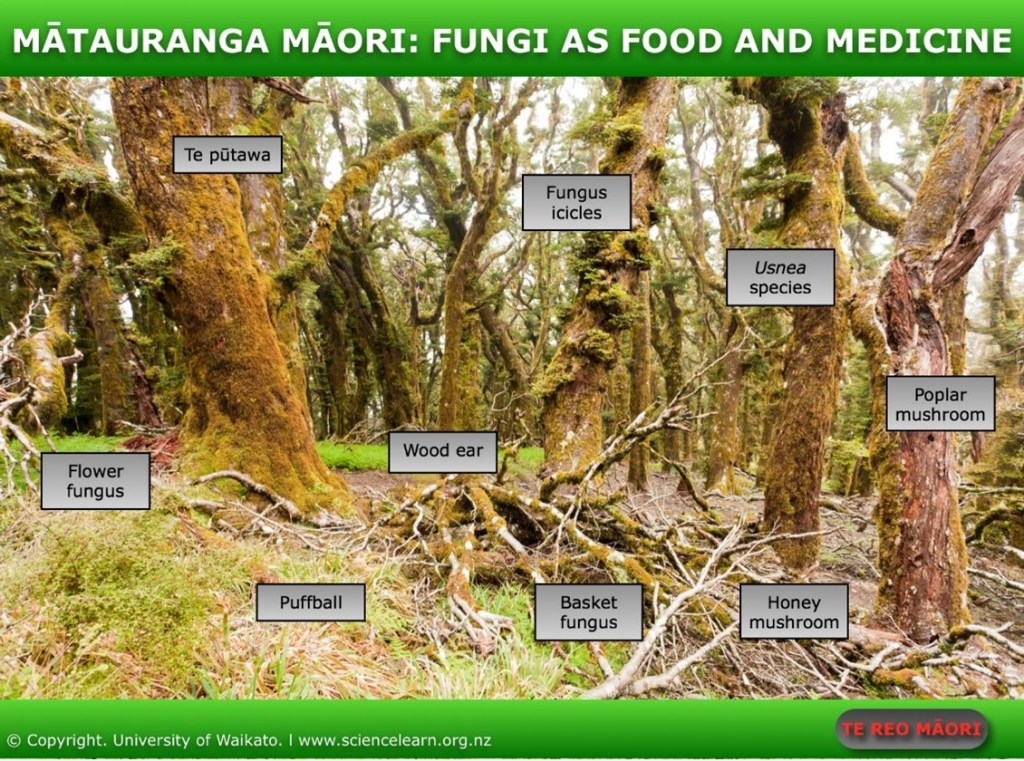
If we use scientific testing of substances that were used in indigenous medical practices, we find that some of them are effective. Others can be harmful, and in many other cases the plants used by indigenous people are ineffective. Note that we make these determinations regarding the efficacy of these substances by using the scientific method. Before contact with Europeans, the main contagious diseases that affected the Māoris were leprosy and tuberculosis. Let’s take leprosy as an example. The Māoris described groups of people who suffered from a condition they called Ngerengere. This was a condition where extremities, particularly fingers and toes, often blackened and when the condition progressed, would frequently fall off. The Māori considered that the disease could spread in three ways: by heredity, through infection, or by witchcraft. Since accounts of the early appearance of the disease were through stories of the illness, it is not entirely clear that the disease was leprosy, or whether the disease had appeared before the first contact with Europeans. However, later in the 19th century there seem to be clear cases of leprosy. Figure III.3 shows the hands of a person with leprosy.

Nowadays, through ‘Western science,’ leprosy (now called Hansen’s Disease) is a curable disease. The current treatment for leprosy consists of a regimen of three drugs: dapsone, rifampicin and clofazimine, a multi-drug therapy called MDT. The treatment of leprosy by Māori medicine involved two different regimens. The first was external treatment by herbs, while the second involved intervention by elders against witchcraft. Since neither of these ‘holistic’ treatments would cure leprosy, we clearly prefer the ‘Western medicine’ treatment to the indigenous practices.
In July 2021, seven professors at the University of Auckland published a letter titled “In Defence of Science” in the magazine New Zealand Listener. The letter claimed that the indigenous philosophy Mātauranga Māori “falls far short of what can be defined as science itself.” The letter, shown in Fig. III.4, also criticized two of the claims in the NCEA report advocating for the scientific method and Māori philosophy to be taught as co-equal, compatible ways of knowing. Biologist Jerry Coyne has written at length about this controversy. First, the letter writers disagreed with the claim “that science has been used to support the domination of Eurocentric views including colonialism and the suppression of Māori knowledge.” Second, the authors disputed the claim “that science is a Western European invention and itself evidence of domination over Māori and other indigenous peoples.” The authors of the letter emphasized that science is universal. Even its origins represented contributions from many different cultures, e.g., from Egypt, Mesopotamia, Greece and India. They pointed out that Muslim scholars had made seminal contributions to science and math, and that those contributions were absorbed and expanded by Europeans; today, the scientific method is practiced all over the world. The authors of this letter claimed that, rather than a tool of colonialism, science was neutral and was currently being applied to “global issues such as the COVID-19 pandemic, climate change, pollution, biodiversity loss, and environmental degradation.”
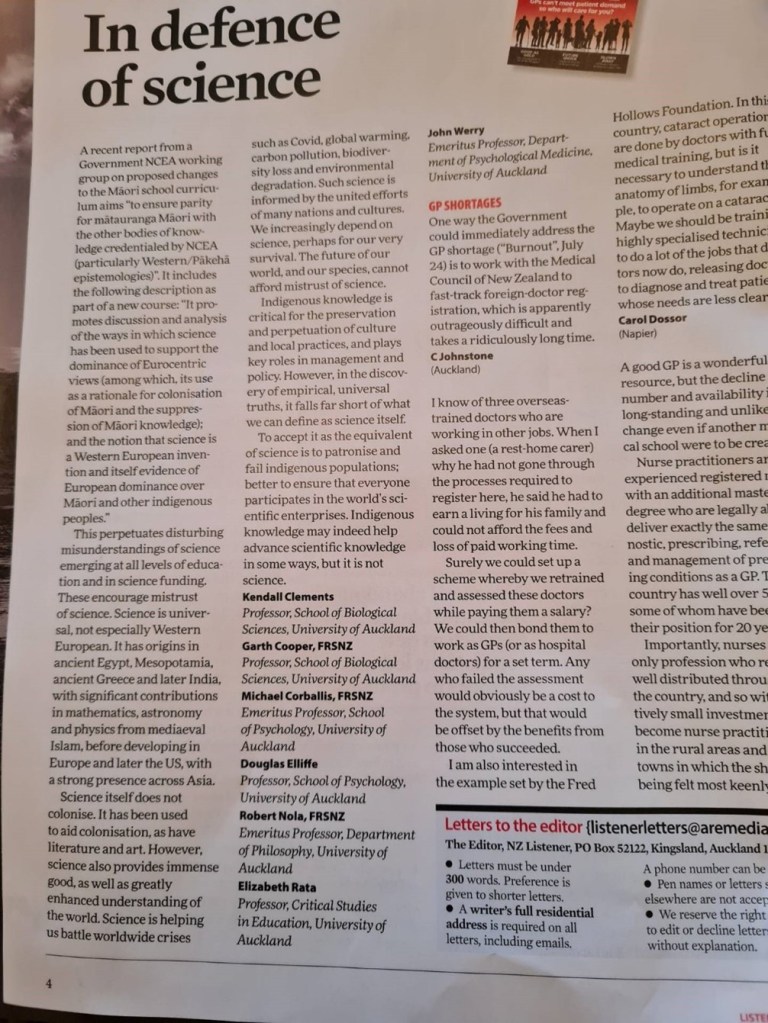
The response to the Listener Letter was immediate and fierce. The letter writers were strongly criticized by Dawn Freshwater, the Vice-Chancellor of the University of Auckland, who asserted that the letter “caused considerable hurt and dismay among our staff, students and alumni.” A letter condemning the “Listener Seven” gathered 2,000 signatures from New Zealand academics. There was also strong criticism from the New Zealand Royal Society Te Aparangi. Because two of the Listener Seven authors were members of the Royal Society, that organization began an investigation into those authors, who were accused of racism and of insulting Māoris. At first, it appeared that a likely result would be expulsion of those two from the New Zealand Royal Society; however, a strong defense was mounted by members of that body, and the Royal Society investigation was roundly criticized by scientific groups around the world.
We can try to unpack the motives behind the reaction to the Listener Letter from seven scientists at the University of Auckland. First, the Māoris and their supporters were indignant that the letter writers had stated that Mātauranga Māori fell “far short of what can be defined as science.” Those supporting “Māori science” pointed out that travel to New Zealand by seafaring canoes represented a significant accomplishment that required impressive advances in ocean travel, the ability to determine direction and time, and survival at sea. Advocates for the Māori claimed that such sea voyages demonstrated that the Polynesian people had mastered elements of “science” in order to be able to complete these journeys.
Clearly, these indigenous people had impressive accomplishments that deserve to be celebrated. Yet, the statement that Mātauranga Māori falls short of science refers to the spiritual baggage that is an integral part of the Māori philosophy. For example, surely it would be confusing and harmful for students to be simultaneously taught in their science curriculum that the first humans appeared 1,400 years ago, and at the same time presented with the scientific history of the origin of hominids, supported by many fossil discoveries. The inescapable implication of such teaching would be to cast doubt among generations of New Zealanders on the objectivity of the scientific method. The claim by advocates that the Mātauranga Māori myth of the origin of humans and the “Western science” theory of evolution are “compatible” is dubious. It is conceivable that Māori students who are exposed to their cultural legends may be better prepared to accept ‘Western science.’ But what science topics would be improved for students of European extraction who would devote 50% of their time to Māori legends and myths, and the other 50% to a standard science curriculum? If Mātauranga Māori was taught as history or culture, surely it would be possible to imbue a sense of pride in the accomplishments of the Māori.
A second prong of the attack on the Auckland scientists comes from people who argue that indigenous science is superior to ‘Western science.’ This results from a series of arguments regarding the scientific method. These arguments generally come from leftist ‘culture warriors,’ and involve one or more of the following claims. First, the claim is made that Western science was developed by White males and is therefore sexist and racist. That claim is factually incorrect – Muslims and Africans (Egyptians) played a major role in the development of science, math and medicine. It is indeed true that early scientists were almost entirely male, though counter-examples such as Marie Curie arose by the late 19th century, when female education expanded. However, today the scientific method is employed universally, by people of all genders and races, because it provides an objective and testable way to understand nature.
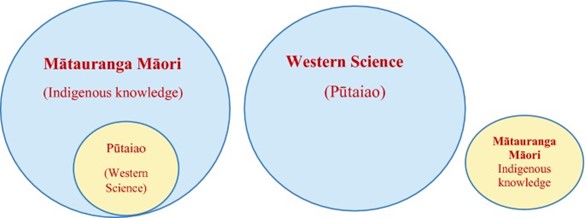
In the cartoon on the left in Fig. III.5, Western science is claimed to be a subset of indigenous knowledge. This relies on the claim that indigenous ‘science’ is compatible with Western science. Indigenous science includes some of what is called Western science, but it also contains spiritual elements that are an integral part of indigenous belief systems. It is simply not true that Mātauranga Māori is compatible with modern science. The spiritual elements of indigenous systems contain myths that have been disproven by science; for example,the Māori story of the origin of humans. A second reason why Western science and indigenous knowledge are incompatible is that the scientific method is universal – science is practiced in identical ways throughout the globe. Indigenous spiritual cultures are not universal; each culture has its own myths, and those differ from one another. For example, several Native American groups maintain that their tribes have existed in North America since the beginning of time, whereas science shows that Native Amerindians first arrived in North America from Asia via the Bering land bridge between 12,000 and 30,000 years ago. Note that science has disproved the human origin stories of both the Māori and the Native Americans, and that the two origin stories contradict each other.
Many culture warriors deny that ‘science’ is universal. This is accomplished by defining indigenous philosophies as scientific; in that case, the definition of ‘science’ must be expanded to include these indigenous practices, as in the left-hand cartoon in Fig. III.5. As we have shown, the spiritual elements and practices make indigenous belief systems in conflict with the scientific method. So we need to separate indigenous belief systems from science. The scientific method is practiced all over the world, and those who use the scientific method employ the same techniques in China as in Germany. It seems bizarre to claim that a scientist from the Ivory Coast is practicing ‘Western science.’ A crucial feature of the scientific method is that it is able to detect hypotheses that turn out to be incorrect. This provides a unique “correction mechanism” for scientific theories. This accounts for the fact that applied science has advanced tremendously in the past few centuries, in contrast with indigenous belief systems and practices, which have been rather static.
Advocates of indigenous science assert that their spiritual values made native people superior to their colonial counterparts. It is claimed that Western science is by its nature a culture of domination, while indigenous practices are collaborative and sustainable. We emphasize that Western science was not itself responsible for the practices of colonialism. Certainly, Western technology, including guns and cannons, was used by colonial powers to subjugate indigenous people, but so were Western religions. Also, the characterization of indigenous practices as collaborative and sustainable results from a highly selective depiction of native cultures. For example, after the Māori arrived in New Zealand a number of native flora and fauna such as the nine native species of the moa became extinct, contrary to the portrayal of the Māori as enlightened defenders of the ecosystem. Furthermore, the Māori burned a tremendous fraction of the forest cover in New Zealand. This is shown in Figure III.6. The left picture shows the forest cover in New Zealand prior to any human settlement; the middle picture depicts the forest cover remaining after being burned by the Māori, but before the arrival of Europeans – the Māori reduced the forest cover from 80% to about 15%; the right figure shows the forest cover circa 1990. Finally, it is alleged that Māori warriors may have eaten and/or enslaved people whom they defeated in battle.

It is fair to ask advocates of indigenous practices to give examples of cases where traditional practices are superior to modern scientific applications. In such debates, one finds that the word ‘holistic’ tends to prevail; also, the goal of ‘Western science’ is claimed to ‘dominate’ Nature, while indigenous practices feature ‘collaboration.’ This is basically a cultural argument, not a scientific one. There are differences in attitude toward Nature between Western cultures and indigenous ones, but the goal of science is simply to understand Nature. There are many questionable ways in which that understanding has been exploited, but those applications do not invalidate the scientific method used to gain the understanding.
One area where traditional practices may lead to practical improvements is agriculture. Modern agricultural practices have relied heavily on the application of large amounts of fertilizer and herbicides. In the long run, indigenous practices may prove more sustainable than treatment with fertilizer and herbicides. It is worthwhile to interrogate these indigenous practices to study their efficacy by the scientific method. However, advocates of Mātauranga Māori practices have not provided many examples of situations where middle school students would benefit from a combination of indigenous and ‘Western’ scientific principles.
In general, indigenous peoples fared poorly when they were first conquered and absorbed in colonial regimes. In many countries, a large number of indigenous people were killed in battles with European conquerors. Many others died from European diseases against which they had no immunity. At the time of first exposure of the Māori to Europeans in 1769, it is estimated that the Māori population numbered about 100,000 people. At its lowest point in 1896 there were an estimated 42,000 Māori. European settlers had developed immunity to infectious diseases such as measles, mumps and whooping cough, but Māoris had no immunity to those diseases. And in contrast to their effects on European peoples, those infectious diseases affected both infant and adult Māori populations. By the 1890s, 25% of Māori girls died before they reached 9 months of age, and 50% died before their 7th birthday. During the global influenza pandemic of 1918, the death rate for Māori was eight times that of European New Zealanders (called Pakeha by the Māori). Like many indigenous people, the Māori have suffered greatly, and continue to suffer, from the effects of alcohol and drug addiction.
Clearly, colonialism had many adverse effects on indigenous groups such as the Māori. New Zealanders today need to determine whether reparations, in the form of either land transfers back to the Māori or financial reparations, are appropriate remedies for the harm suffered by the indigenous population. However, we do not believe that Western science per se was responsible for these colonial practices. In fact, living conditions for Māori improved greatly when they were treated with Western medicine. Deaths of Māori children from infectious diseases decreased dramatically when the children were vaccinated. The death rate from tuberculosis, a major cause of early death for Māoris, decreased dramatically after several public-health initiatives were undertaken. There are still health discrepancies between Māoris and Pakeha in New Zealand – in 2013 the life expectancy of Māoris was 77 for women and 73 for men, compared to 84 for non-Māori women and 80 for men. However, life expectancy and general public health for Māori has improved greatly in the past 50 years.
Another feature of the science teaching conflict in New Zealand is a struggle for financial support. Now that Mātauranga Māori has been declared to be as valid as ‘Western science,’ one can expect its advocates to lobby for greater funding for ‘Māori science.’ One area where this will likely surface is in support for biomedical research – it is quite likely that there will be demands for a significant portion (as much as 50%?) of funding for medical research to be diverted to ‘Māori medical sciences.’ It is uncertain what Māori medical research would look like. One could research the extent to which herbs used by the Māori are effective against various diseases, although surely the best way to determine this is to employ modern scientific techniques to study their efficacy. One hopes that no funds now used for medical research would be diverted to train “gurus” to employ spells protecting against transmission of disease.
Efforts to ‘Decolonize’ Science:
Recently there is a concerted effort to ‘decolonize’ science. The idea is to promote a better understanding of the accomplishments of indigenous peoples. Clearly, the process of colonization resulted in considerable harm to indigenous populations. Their populations were decimated by diseases carried by some of the colonizers. Their natural resources were extracted, often with little regard to the ecosystems, and many indigenous people worked for colonial masters under brutal conditions. Their accomplishments were minimized, and their intelligence was systematically undervalued. They were often discouraged or prevented from using or passing on their native languages. So attempts to decolonize scientific practices arise from an effort to treat indigenous people with respect, and simultaneously to address some of the damage carried out by colonial powers over the past centuries.
One way that this is being carried out is in re-naming efforts. Here we will address the recent practice of re-naming bird species. The number of bird species whose Latin binomial names derive from European surnames “highlight the extent to which Indigenous knowledge in countries outside of Europe has been all but disappeared by colonial ecological taxonomies.” Burton and Mawani argue that “imperial authorities used the study and classification of animals to reinforce colonial ideology and the idea that colonization was itself both natural and inevitable.” They assert that indigenous people continue to be marginalized and excluded, and they claim that marginalized groups need to be recognized and included in decisions. In Nov. 2023, the American Ornithological Society announced that all common English-language names of bird species named after people would be changed. This would affect 70-80 species of birds in North America.
This change came about after politicking by a group called Bird Names for Birds, who claim that the honorific names that many birds have “remember people (mainly white men) who often have objectively horrible pasts and do not uphold the morals and standards the bird community should memorialize.” One of the birds that will be affected by these changes is Hammond’s Flycatcher, shown in Figure III.7. Hammond was Surgeon General of the U.S. during the Civil War. He collected the skins of birds, including the Hammond’s Flycatcher. As Surgeon General, Hammond introduced a number of useful medical practices. However, he was drawn into controversies between slave-holding and abolitionist states, and he described enslaved Negroes as “Little elevated in mental or physical faculties above the monkey of an organ grinder.”

A similar motivation has caused a number of chapters of the National Audubon Society to change their name, as the naturalist John James Audubon was a slaveowner who disapproved of the British government emancipating slaves in its West Indian colonies. The National Audubon Society has resisted pressure to change its name but announced that it would spend $25 million over a five-year period to fund diversity initiatives. Are these renaming efforts a positive step that will lead to better social justice? Or are they more an example of ‘virtue signaling,’ a visible demonstration of the moral correctness of one’s positions?
We found that the Nature paper Decoloniality and Anti-Oppressive Practices for a More Ethical Ecology by Trisos, Auerbach and Katti provided useful suggestions for ‘decolonizing’ science, specifically for their field of ecology. The authors urged researchers to take a series of steps to include and understand the needs of historically marginalized groups. First, they urged decolonizing of access. They point out that many artifacts and materials from the Global South are currently housed in the Global North, making it hard for marginalized people to use them. Also, many research papers are now behind a paywall, making access difficult. Next, they recommend that researchers include people from the developing world in all aspects of research, including setting the research agenda and directly involving marginalized people in research groups. Finally, they urge ecology researchers to clearly identify those groups that will benefit from this research – e.g., corporations involved in extracting resources, or the people who will be directly affected by the research? For the most part, the steps proposed by Trisos et al. have the potential to include people from the Global South in ecology efforts, without compromising the centrality of the scientific method in assessing issues that are amenable to the scientific method.
One common demand by ”decolonizers” is to recognize “diverse knowledge systems and sources of expertise.” What this means in practice is less clear. As we have pointed out in the preceding section on science in New Zealand, indigenous groups often have “knowledge systems” that include spiritual and mythic elements. It would be appropriate to acknowledge the accomplishments of indigenous groups – in the preceding section we referred to the impressive feats of seafaring by groups who populated island chains in the South Pacific. However, it is not appropriate to include these belief systems as part of “science,” since as we have pointed out the scientific method does not include spiritual elements or myths that cannot be challenged or falsified. We refer here to the quotation from Judge William Overton in the footer on this page, explaining that those who claim to be pursuing scientific inquiry “cannot properly describe the methodology as scientific, if they start with the conclusion and refuse to change it regardless of the evidence developed during the course of the investigation.”
Advocates of decolonizing science further claim that practices of inclusion can also have epistemically unjust consequences. They assert that even when indigenous peoples are included in research, they “are not treated as full participants in an epistemic exchange but as mere sources of data or information.” They are said to be “subjected to practices of epistemic extraction.” When indigenous knowledge is incorporated into “dominant knowledge systems,” this could produce distorted interpretations of the original indigenous concepts. Even when communities are consulted early in a decision-making process, “they are still being included in someone else’s plan, agenda, or program.” It is claimed that “Building Indigenous ecological knowledge, within Indigenous contexts to serve Indigenous ends should be at the heart of decolonization efforts.”
One recent example of cultural appropriation was discussed by Vernes, Rajaratam and Wangchuk. In 2010, the BBC claimed to have discovered tigers living at 4,100 meters above sea level (roughly 13,400 feet). A BBC team recorded video evidence of tigers in high-altitude alpine meadows in Bhutan. This was presented in a documentary Lost Land of the Tiger. The BBC trumpeted their stunning discovery: the narrator claimed that “Any wild tiger the team finds in Bhutan would be a priceless discovery … virtually nothing is known about Bhutan’s wild forests … tigers breeding this high in the Himalayas is totally new to science.” Unfortunately for the BBC, these statements were deeply misleading. Native wildlife ecologists in Bhutan had been monitoring tiger behavior since 2005 under a 10-year Tiger Action Plan. Already in 2000, Nepalese biologist Pralad Yonzon working with Bhutan’s Wildlife Conservation Division (WCD) had discovered a tiger in a camera trap at 3,000 meters, and his team had found tiger pugmarks (footprints) at 4,100 meters.
Before taking their footage, the BBC had consulted with the WCD, which had provided the BBC team with precise locations where the presence of tigers had been recorded through pug-marks, scats, livestock kills and camera-trap photographs. The fact that the BBC never revealed the prior work of the Bhutan WCD was inexcusable; and the concluding assertion in the BBC documentary that “Nothing was known about the tigers that may live here; we have filled in the final piece of the puzzle” was a deeply dishonest statement.
‘Other Ways of Knowing:’
In our review of indigenous practices and beliefs in New Zealand, we have been discussing one aspect of what is called “other ways of knowing.” This refers to alternative practices for obtaining information other than the scientific method. There are some questions that the scientific method cannot assess, and spiritual issues are one example of these. In other cases, people use a number of sources to supply them with information, or to answer questions that they have. The cartoon in Fig. III.8 below shows a number of potential sources of information. In this cartoon, meditative states, crystals and ‘the spirits’ represent examples of other ways of knowing.

A partial list of other ways of knowing includes:
- Indigenous culture
- Religious or inspirational books (e.g., the Bible, the Qur’an, books by Tony Robbins or Deepak Chopra)
- Revelation – this includes the results of meditation, intuition, or ingesting mind-altering drugs
- Interpretation of signs – e.g., astrology, ‘reading’ tea leaves or palms or tarot cards, phrenology, dowsing.
Various of these different methods of ‘knowing’ are in wide use. They can sometimes provide useful insights and are helpful in assessing the world around us. What they cannot do is to determine whether or not these insights are correct. The scientific method, since it is falsifiable, is able to determine the validity of hypotheses. As we have pointed out, many indigenous cultures have developed a list of natural substances that are believed to have medicinal properties. The pseudoscientific field of homeopathy also has a long list of materials that are said to be pharmacologically beneficial. However, it is only through clinical trials that use the scientific method that we can determine which of these substances are actually effective against disease.
Modern science has also proved that the origin stories from indigenous cultures, as well as from the Judaeo-Christian Bible, are false. So efforts to decolonize science should be adopted when they involve methods that treat minority groups and their cultures with respect. However, we should resist actions that replace the scientific method with unscientific belief systems.
— Continued in Part II —
 Debunking Denial