
October 18, 2024
V. christian nationalist views about science and project 2025
It is possible to reconcile scientific results with belief in a higher power, but not if one interprets the Bible, or analogous foundational texts for other religions, literally as accurate accounts of history, the universe, and the development of life. The literal interpretation of the Bible, and the consequent distrust of science, appear from surveys to be more prevalent in the U.S. than in most other industrialized countries. For example, World Values Surveys carried out from 2010-14 asked respondents in many countries for their level of agreement with the following statement: “Whenever science and religion conflict, religion is always right.” 39% of American respondents agreed or strongly agreed with this statement, as opposed to 14% in Germany, 13% in Australia, 7% in Sweden, 5% in The Netherlands, and 4% in Japan.
The Christian Nationalist movement goes beyond mere fundamentalist faith in religion to the desire to see Christianity installed as the established religion in the U.S., in direct opposition to the existing Establishment Clause in the U.S. Constitution, which forbids such a state religion. The Christian Nationalists, who now form a critical part of the Republican voter base and power structure, want to see the Bible established as the ultimate moral authority in U.S. culture and justice, superseding secular laws passed by State or Federal legislatures. Theirs is a rather exclusive version of Christianity which contains “hierarchical assumptions about race, gender, nationality, and sexuality.” A recent analysis carried out by Baker, Perry, and Whitehead demonstrates that belief in Christian Nationalism as a governing principle is strongly correlated with strong distrust in, or outright opposition to, science and scientists. Baker, et al. analyze results from the 2007 Baylor Religion Survey in which Gallup polled 1,648 Americans with a significant sample of questions assessing religious beliefs, behaviors, and attitudes. They determine a “Christian Nationalism Index” by combining responses about level of agreement with the following six statements:
- That the federal government should declare the United States a Christian nation;
- That the federal government should advocate Christian values;
- That the federal government should allow the display of religious symbols in public spaces;
- That the federal government should allow prayer in public schools;
- That the federal government should enforce a strict separation of church and state;
- The success of the United States is part of God’s plan.
Answers to the six questions varied from “strongly disagree” (assigned numerical value 0) to “strongly agree” (numerical value 4), with the middle response “undecided” assigned value 2. Question (5) was reverse coded, with “strongly agree” assigned value 0. The sum of scores on the six questions formed the Christian Nationalism Index plotted on the horizontal axis in Fig. V.1. The fraction of the surveyed sample who tend toward the Christian Nationalism extreme is not small; for example, 27% agreed or strongly agreed with statement (1), while 38% disagreed or strongly disagreed with statement (5).
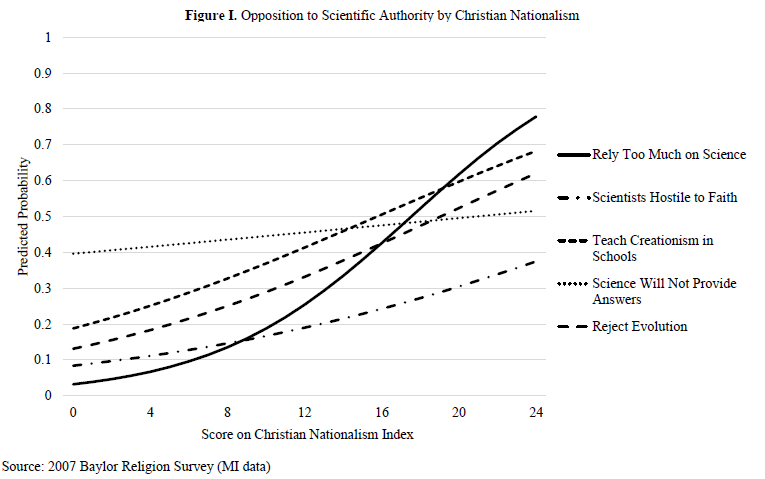
The vertical axis in Fig. V.1 is based on similar numerical scoring for agreement level responses to five statements about science: “We rely too much on science and not enough on faith;” “Most scientists are hostile to religion;” “Creationism should be taught in public schools;” “Science will eventually provide solutions to most of our problems;” “Humans evolved from other primates over millions of years.” The authors use a model to correct for confounding variables other than the Christian Nationalism Index, such as age, gender, race, income, education level, region of the U.S., and rural-to-urban residential setting, all of which were queried in the survey. The predicted probability on the vertical axis of Fig. V.1 then represents the model output for answers from no (0) to yes (1) for the five statements in the legend of the figure (which are opposite to the survey questions in two cases), as would be expected from demographically comparable samples of people at different levels of the Christian Nationalism Index.
The solid curve in Fig. V.1 essentially represents a general level of distrust in science and it shows the strongest variation with devotion to Christian Nationalist principles, stronger even than rejection of evolution. Christian Nationalists distrust science because it undermines the literal interpretation of the Bible on issues of the age and evolution of the universe and of Earth, Earth’s role in the universe, and the evolution of living species on Earth. But their distrust extends far beyond biblical questions to also color their views of climate change, medicine and vaccines, sex and gender, and many other issues at the interface of science and public policy. Evidence of their distrust can be found throughout the Project 2025 plan for Republican governance we describe below.
The answer in Fig. V.1 that depends least on the Christian Nationalism Index is whether science will eventually solve “most of our problems.” This is not surprising, because many of our problems are beyond the reach of science, with “solutions” involving moral judgments, changes in human behaviors, discernment of right from wrong and of fact from fiction, relations among countries and political philosophies, and reconciling the vast range of human beliefs.
Project 2025:
In the summer of 2024, the spotlight was placed on a document called Project 2025. This report outlined a series of proposals that it recommended be adopted during a second Donald Trump administration. In this section, we will briefly summarize the contents of Project 2025. We will then focus on proposals that are rooted in science denial and contain the imprint of Christian Nationalist beliefs. In some cases, the document misrepresents scientific facts; in other aspects, the report urges the repeal or replacement of government policies that have been adopted during the Obama and Biden administrations. In addition, Project 2025 calls for entire government agencies (e.g., the Department of Education) to be abolished; in other cases, the report advocates for axing sections of government agencies (e.g., the National Oceanic and Atmospheric Administration would be shut down; it would be limited to collection of weather data, which would then be used and outsourced by private companies).
Jacqueline Simon is the policy director of the American Federation of Government Employees, a union that represents workers at the National Institutes of Health (NIH), the Environmental Protection Agency (EPA), the Centers for Disease Control and Prevention (CDC) and other agencies. If Project 2025 becomes reality, she says, “the very idea of scientific integrity will be flushed down the toilet.” In this section we will show that Ms. Simon’s assertion is accurate and not hyperbole.
Summary of Project 2025:
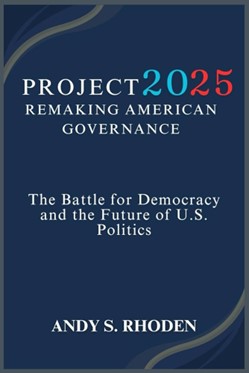
Project 2025 is a 922-page report commissioned by the right-wing Heritage Foundation. Figure V.2 shows the cover of this report. Ever since 1981, the Heritage Foundation has been publishing reports as part of their Mandate for Leadership series. These reports generally provide a series of recommendations on a number of policy issues for the upcoming Presidential election, and for the new administration to consider if Republicans are elected. However, Project 2025 differs from previous Heritage Foundation reports in some notable ways. First, Project 2025 reflects the complete takeover of the Republican Party by Trumpism. The report refers to Trump numerous times by name, and it echoes Trump’s own obsessions and his highly unusual views on political and cultural issues. Second, Project 2025 combines conservative political and economic rhetoric with white Christian Nationalism. Critics have characterized Project 2025 as an authoritarian, Christian nationalist plan to steer the U.S. towards autocracy.
The many contributors to Project 2025 include at least 140 people who were members of the first Trump administration. This reflects the fact that the Heritage Foundation has a particularly close relationship with the Trump government. A number of members of the Foundation had high-ranking positions in his administration, and the Foundation helped to vet many of Trump’s appointees. In April 2022, Donald Trump visited the Heritage Foundation. He praised the organization, describing their work in planning the next Trump administration. “They’re going to lay the groundwork and detail plans for exactly what our movement will do,” Trump said.
In April 2022, Donald Trump visited the Heritage Foundation. He praised the organization, describing their work in planning the next Trump administration. “They’re going to lay the groundwork and detail plans for exactly what our movement will do,” Trump said.
Several points in the document refer to Trump’s claim that while president, he was thwarted in his efforts to effect radical change by members of his administration and by civil servants who were not sufficiently loyal to him. For example, Vice President Mike Pence refused Trump’s order that he should refuse to certify the 2020 election results on Jan. 6, 2021. In addition, Defense Department head Mike Esper refused some of Trump’s requests to use military personnel in dealing with protests. Also, we know that Chair of the Joint Chiefs of Staff Gen. Mark Milley took steps near the end of the Trump Administration to ensure that the armed forces did not participate in or facilitate a coup by Trump to remain in office. As a result, Project 2025 discusses how Trump could replace massive numbers of government employees with true Trump loyalists.
Some of the more radical aspects of Project 2025 include a proposal that Trump invoke Schedule F, an action that would strip tens of thousands of civil servants from their job security. The project suggests that people insufficiently loyal to Trump would be fired. Up to a million federal employees might lose their jobs. Many of these employees would not be replaced, but the replacements of others would be encouraged to express their allegiance with Trump. Offices such as the Department of Justice, FBI, and CIA would lose their independence and be staffed with Trump true believers. The Heritage Foundation would aid in the vetting of the vast number of staff members who would be needed in the wake of such a purge. A number of offices such as the Department of Education, the Department of Homeland Security, the Federal Emergency Management Agency (FEMA) and the National Oceanic and Atmospheric Administration (NOAA) would be closed down; other than data collection, all NOAA activities would be privatized. The EPA and the CDC would receive severe cuts. Also, a proposal was outlined that would round up, detain and deport over ten million undocumented Americans. Such a project would involve massive operations that would include local and state police, supplemented by federal troops. Those picked up would be detained in massive camps that bring to mind the regrettable incarceration of Japanese-American citizens during World War II.
Project 2025 remained largely “under the table” until a June 2024 New Yorker article by Jonathan Blitzer, Inside the Trump Plan for 2025. This detailed article laid out the radical proposals contained in the Heritage Foundation report. Once that article was published, it started in motion a remarkable turn of events. First, Democrats focused on the report, tied it to the Trump campaign, and alleged that the GOP was planning a radical agenda that would install an autocratic government. Then, Donald Trump attempted to distance himself from Project 2025. Despite the fact that the report was co-authored by at least 140 members of his earlier administration, in his Sept. 10, 2024 debate with Kamala Harris, Trump claimed that “I have nothing to do with Project 2025.” In his Truth Social page he repeated his claim that he knew nothing about the report, adding, “I disagree with some of the things they’re saying and some of the things they’re saying are absolutely ridiculous and abysmal.” It’s quite a feat for Trump to express disagreement with a report that he knew nothing about. Note further that in 2022, Trump claimed to know just what the authors of Project 2025 were doing, and he expressed his whole-hearted support for those suggestions.
A crucial element in Trump’s disavowal of Project 2025 is the report’s recommendations for actions with respect to abortion and contraception. We will deal with these in the next section. To summarize, the Project 2025 report suggests a number of radical steps to make abortion illegal nationally and to make medications used in chemical abortions illegal to possess and to mail. Ever since the Supreme Court’s 2022 decision on Dobbs v. Jackson Women’s Health Organization that removed federal protections for abortions during the first two trimesters of pregnancy, Republicans have suffered greatly at the polls on this issue. To date, every state referendum providing protection for abortion has passed, even in rather “red” states. Trump has flailed about in efforts to distance himself from the many draconian state laws on abortion passed or revived in the wake of the Dobbs decision. Although he continues to change his public statements on abortion, he has instructed Republican candidates for office to deny that they support a national abortion ban, and on Oct. 1, 2024 he pledged that he would veto a national abortion ban if passed by Congress. This pledge came just days after he had refused to commit to vetoing such a ban.
Republicans are so eager to dissociate themselves from the proposals in Project 2025 –proposals produced by right-wing Republicans that were initially greeted enthusiastically by Trumpists — that today one can hardly find a Republican candidate for Congress who professes strong support for the Project 2025 proposals. This radical turnabout shows the degree to which Project 2025 has become toxic, once its recommendations became widely known.
In the following section, we will discuss sections of Project 2025 that deal with scientific issues. There are several ways that science denial surfaces in Project 2025. Some cases involve denial of the scientific consensus that global climate change exists and is primarily caused by human activity. Other parts deal with lies regarding the effectiveness and safety of vaccines. In areas involving reproduction and abortion, a number of false statements are made regarding human biology. In other sections, it is proposed to reject scientific findings that motivate environmental regulations.
Science in Project 2025:
Here, we will discuss recommendations made in Project 2025 that refer either to scientific facts (e.g., that global climate change exists and is due to human activity), or that recommend terminating government regulations that are based on scientific consensus.
Climate Change Denial:
Project 2025 envisions a number of drastic changes to federal agencies that deal with global climate change, and that have issued regulations dealing with climate change issues. For example, it recommends cutting altogether or eliminating the federal government’s climate science apparatus, referring to such programs as “climate alarmism.” Bethany Kozma, a USAID official under Trump’s presidency, said that in a future Trump administration government employees “will have to eradicate climate change references from absolutely everywhere.”
Project 2025 recommends eliminating U.S. Department of Energy support for research on renewable energy, battery storage, and other efforts to increase climate resilience. Instead, U.S. agencies would focus on removing regulations on fossil fuels and greenhouse gases. It would open up currently protected federal lands for drilling and excavation, or in Donald Trump’s words, “Drill, baby, drill.” It would shut down attempts to change or update federal infrastructure to adapt to climate-induced threats such as flooding, more frequent and extreme heat waves, and more extreme wildfires. And since it recommends shutting down FEMA, states would be on their own to deal with the increasingly extensive damages caused by hurricanes strengthened over warming seas.
Project 2025 recommends installing a “science adviser” at the EPA who would report directly to the President. A particular target in Project 2025 is the 2009 EPA “endangerment” ruling stating that greenhouse gases are a threat to public health. The report proposes eliminating that ruling. It is hard to imagine steps that would have a greater negative impact on the world’s climate. It would make it impossible for the U.S. to meet any of its targets under the Paris climate accords and subsequent international agreements.
Project 2025 justifies the recommendation to close down NOAA by calling that agency “one of the main drivers of the climate change alarm industry.” Under a new Trump administration, the U.S. would withdraw from all climate accords. This would not only signal a U.S. retreat from international climate talks, but it would almost certainly mean that other countries would scale back or eliminate their own climate targets. The implications for worldwide climate action would be lethal. Global mean temperatures would shoot past limits proposed by climate experts, with exceptionally dire results, which we’re sure Trumpists would blame on the Democratic Party and other countries.
The non-partisan group Energy Innovation has carried out models that contrast the effects of continuing the initiatives in climate plans suggested by the Harris-Walz campaign with those suggested by Project 2025. The results are shown in Fig. V.3. In six years, the Harris-Walz plan would add 2.2 million renewable energy jobs, increase the Gross Domestic Product (GDP) by $450 billion, decrease energy costs by $7.7 billion, and decrease climate-change-related pollution by 24%. Under the predictions from Project 2025, the number of jobs would decrease by 1.7 million, GDP would decrease by $320 billion, energy costs would increase by $32 billion and climate pollution would increase by 19%. Although these represent partisan political suggestions and optimistic estimates from each side, they do qualitatively reflect the climate proposals from both parties. Project 2025 proposes increased spending on fossil fuels, particularly for coal, gas and oil, while also proposing savage cuts in spending on renewable energies. And Project 2025 also recommends gutting environmental regulations.
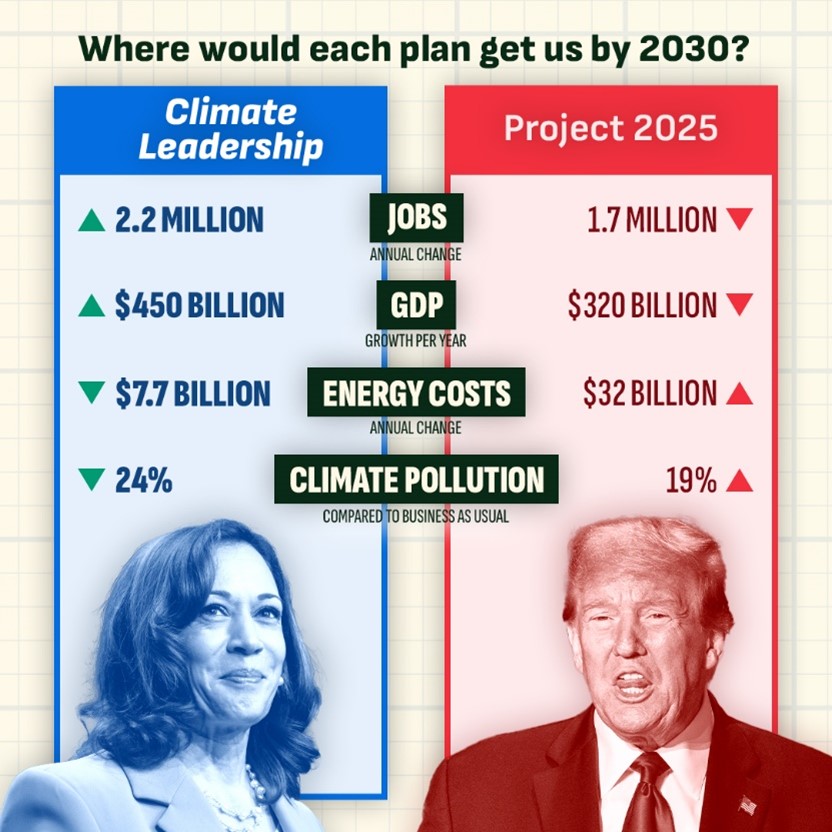
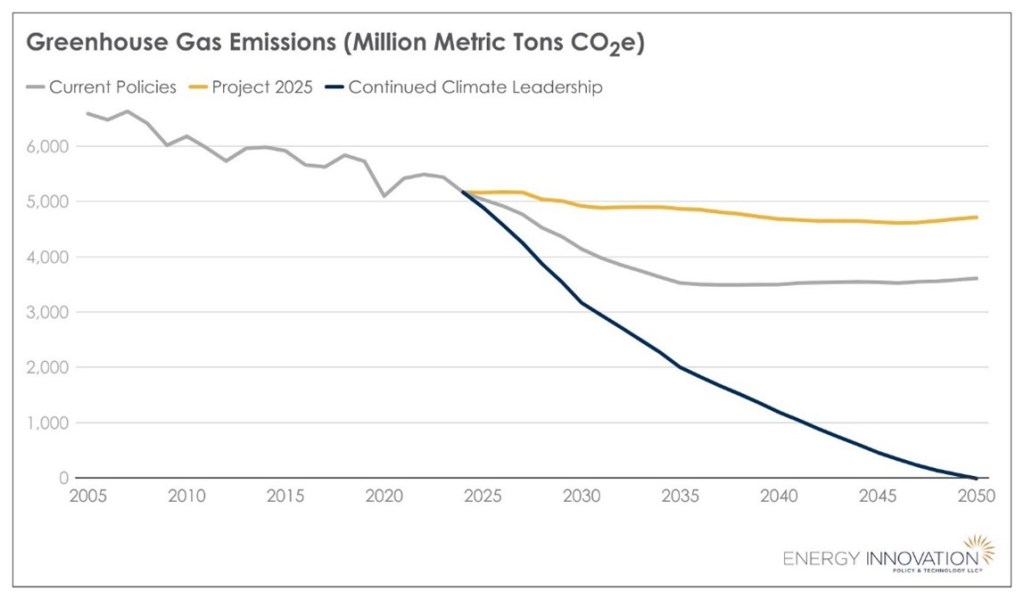
Figure V.4 shows the Energy Innovation projections of greenhouse gas emissions (GGE) up to the year 2050. The grey curve shows projections for GGE, in millions of metric tons of CO2, under the 2022 Inflation Reduction Act. The dark blue curve shows projections if climate plans proposed by Harris-Walz are implemented. The amber curve shows the change in GGE as recommended under Project 2025. It is clear that the Project 2025 recommendations would result in five times the GGE emissions in 2040; and by 2050 the Harris-Walz climate plan envisions a path leading to zero GGE. We remind readers that carbon dioxide remains in the atmosphere for many decades and failure to curb GGE by mid-century will cause global temperatures to rise to dangerous levels.
Project 2025 clearly demonstrates the philosophy of the Trumpists when it comes to science. Scientific study has demonstrated the environmental harm caused by certain chemicals. The response set out in Project 2025 is not to carry out better research in order to counter the claims of environmentalists. It proposes to shut down the research by de-funding those government offices that subsidize it. Thus, the report identifies agencies like the EPA, the CDC and NOAA and announces plans to shut down or viciously slash the budgets of those agencies. Next, archives of these agencies would be closed down. And finally, efforts may be undertaken to prevent government employees from even mentioning the data. In other words, the report advocates combating threatening natural processes with blanket denialism. Nature will not be impressed.
In other words, the report advocates combating threatening natural processes with blanket denialism. Nature will not be impressed.
The Environment:
Creation of the Environmental Protection Agency in 1970 began a process whereby various pollutants were studied to gauge their effect on the environment and on humans. Project 2025 proposes to change the way that environmental damage is assessed. The environmental harm caused by pollutants would be “balanced” against the potential harm to industry profits. The report also calls for defunding the Integrated Risk Information System, a database of chemical health hazards that is widely used to set regulations for these substances. The report also calls for ceasing to consider “co-benefits” in regulating emissions. For example, a method to limit emissions of one chemical could also limit the emission of other harmful substances. Previously, scientists would include the emission of other substances in determining the benefits of that regulation. Project 2025 proposes “revisiting the designation” of chemicals that are currently considered hazardous to health. They particularly mention removing the designation of perfluoroalkyl and polyfluoroalkyl substances (PFAS) as hazardous chemicals. By the way, PFAS have been shown to cause cancers, immune dysfunction and hypertension.
Another proposal from Project 2025 is to eliminate climate change mitigation from the agenda of the National Security Council. Currently, offices such as the Joint Chiefs of Staff have made global climate change a significant factor in their determination of future needs of our armed forces, on the grounds that climate change is an important element in evaluating threats to our national security.
Abortion and Health:
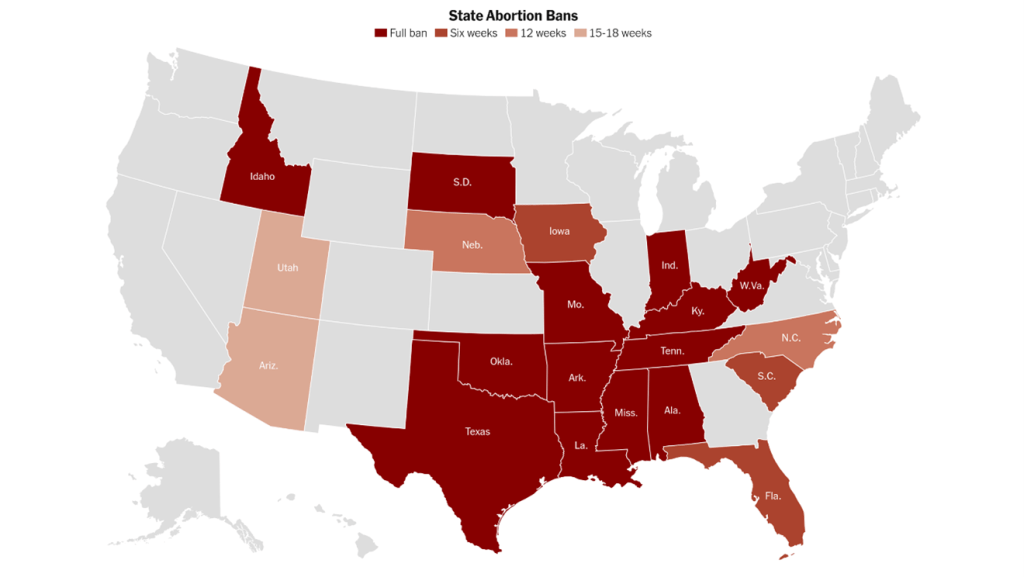
Since the Supreme Court’s 2022 decision that revoked the protection for abortion established in the Roe v. Wade case, a number of states have adopted or reinstated abortion bans. Figure V.5 shows the states that have these bans. The darkest shade of maroon denotes those states that ban abortion from the date of conception (despite the fact we have pointed out in a previous post that conception as an event cannot be detected in vivo); the next lighter shade denotes states that have an abortion ban beginning at six weeks of pregnancy (Iowa, South Carolina and Florida); the next lighter shade denotes states that have a ban beginning at 12 weeks (Nebraska and North Carolina); and the lightest shows Utah and Arizona, where the abortion ban begins at 15 – 18 weeks.
Project 2025 argues that abortion is not health care. It claims, falsely, that medication abortion drugs have complications four times higher than surgical abortions. The report also calls for the FDA to “stop promoting or approving mail-order abortions;” it cites the 1873 Comstock Law that prohibited disseminating birth control materials through the mail or across state lines, which Project 2025 suggests should still be enforced. The report also calls for the Department of Health and Human Services to be re-named the “Department of Life.” Each state would be required to report every abortion carried out in that state; in addition, the CDC would be required to report any complications arising in abortions.
Project 2025 also recommends that federal healthcare providers should refuse to provide gender-affirming care for transgender people, and to prevent the NIH from funding stem-cell research, or from developing vaccines using mRNA techniques, such as the COVID-19 vaccines. Roger Severino, the lead author on the Project 2025 chapter on health and human services, argues that stem-cell research, in vitro fertilization techniques, and mRNA vaccines all use stem cell lines in their development; since the stem cell lines may have been created using leftover embryos, Severino asserts that these products were developed using cells from “murdered humans.” Furthermore, Severino’s recommendations would prevent the CDC from issuing public health advice.
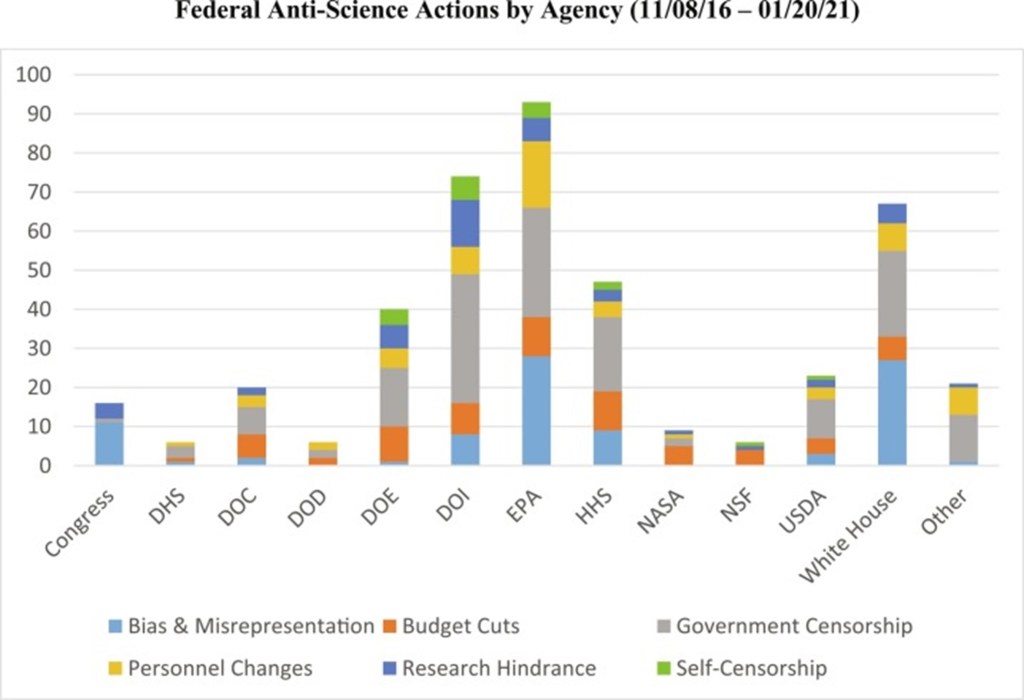
The anti-science proposals from Project 2025 mirror and amplify actions taken during the first Trump administration to undermine science. These actions are documented in the Silencing Science Tracker, an online database that records anti-science actions taken by the federal, state, and local governments. The Silencing Science Tracker is a joint effort by the Sabin Center for Climate Science Law at Columbia University, and the Climate Science Legal Defense Fund. “It tracks government attempts to restrict or prohibit scientific research, education or discussion, or the publication or use of scientific information, since the November 2016 election.” The tracker reported that between the date of Trump’s election in November 2016 to President Biden’s inauguration in January 2021, 346 anti-science actions were taken by the federal government. The anti-science actions during the Trump administration are shown in Fig. V.6. Those actions that occurred between Nov. 8, 2016 and Jan. 20, 2021 are broken down by government agency, and also by the type of action taken. Bias and misrepresentation are shown in light blue; personnel changes are shown in yellow; budget cuts are colored orange; research hindrance in blue; government censorship in grey; and self-censorship in green. If Trump is elected in 2024, we can expect many more such actions if the proposals in Project 2025 are enacted, and if scientists are replaced by Trump loyalists in all of these agencies.
Government agencies would even be prohibited from mentioning “climate change;” in this, they would be following the state of Florida where Governor Ron DeSantis signed a bill in May 2024 that largely excised references to climate change in the laws of that state; the bill also forbids state agencies from considering climate change when writing energy policy.
So, the anti-science actions proposed in Project 2025 basically represent a continuation of actions taken during the first Trump Administration. However, they are amplified by Christian Nationalists’ wholesale rejection of science because Project 2025 envisions replacing scientists and non-partisan administrators in government agencies with Trump loyalists. In this way, they hope to ensure that the most radical proposals of the first Trump administration, which were stymied by the efforts of government officials, would sail through during a second Trump term in office. As we point out in this section and in other posts on this site, the results would be a disaster for the environment, for women, for human health, and for global biodiversity. In particular, world-wide efforts to mitigate the effects of global climate change would likely grind to a halt. In an article in the Bulletin of Atomic Scientists, climate scientist Michael Mann stated that “In all likelihood, [implementing the proposals outlined in Project 2025] would mean the end of meaningful global climate action at this critical juncture. The fate of our planet quite literally hangs in the balance.”
VI. partisan divides among political elites
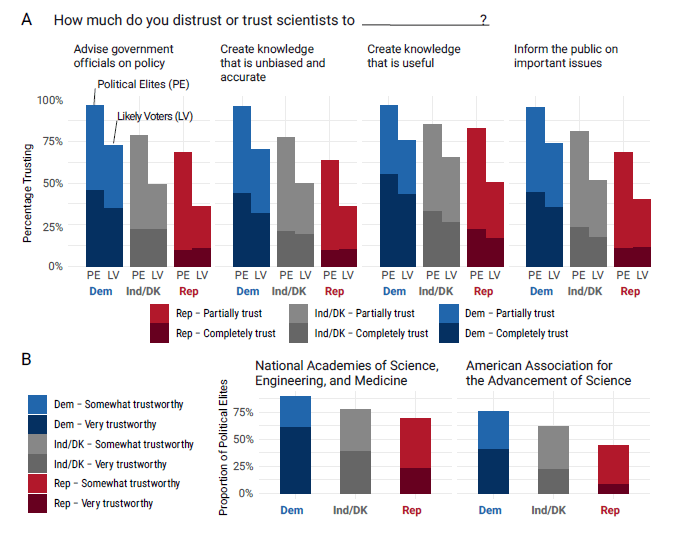
The surveys referenced in the earlier sections all probed general public attitudes among Americans. It is interesting to probe the extent to which the partisan divide among voters in the level of trust in science and scientists is reflected among recent political leaders. Furnas, LaPira, and Wang have done that in a recent article entitled Partisan Disparities in the Use of Science in Policy. As part of their research these authors conducted a survey “of roughly 3,500 US political elites and public servants (e.g., congressional staffers, bureaucrats, political journalists, lobbyists, non-profit advocates and association leadership, corporate C-suite executives, judges and clerks, and state and local government officials) [and]…a contemporaneous survey of roughly 1,000 likely voters.” They asked all respondents to assess their level of trust in scientists to: advise government officials on policy; create knowledge that is unbiased and accurate; create knowledge that is useful; inform the public on important issues. They also asked the political elites to assess whether two specific scientific advisory organizations — the National Academies of Science, Engineering, and Medicine (NAS) and the American Association for the Advancement of Science (AAAS) – were trustworthy as sources of information relevant to public policy.
Some of the results of this survey are shown in Fig. VI.1. One clear inference from frame A of that figure is that, independent of political leaning, political elites trust scientists somewhat more than co-partisan likely voters. However, on all four questions of trust in scientists, the level of trust decreases steadily from Democratic to Independent to Republican respondents. For example, “96.0% of Democratic elites either completely or partially trust scientists to ‘create knowledge that is unbiased and accurate’ compared to only 63.7% of Republican elites…Of Democratic elites, 44.1% completely trust scientists to create unbiased and accurate knowledge, compared to only 9.9% of Republican elites.” From frame B in Fig. VI.1 we learn that “Nearly three times as many Democratic elites (61.2%) rate NAS as ‘very trustworthy’ as Republican elites (22.8%)…The difference is even more pronounced for the AAAS, which Democratic elites trust five times more than Republican elites (40.7% vs. 8.2%).”
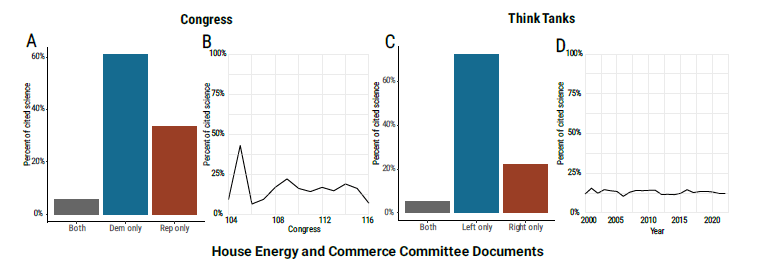
In order to probe how these partisan differences in trust for scientists are reflected in recent policy, Furnas, et al. rely on a dataset from Overton that “tracks 641,894 policy documents published by both the federal government and think tanks in the United States from 1995 to 2021, as well as the scientific papers and other policy documents referenced therein.” For example, analysis of this database reveals that “policy documents from Democratic-controlled [Congressional] committees are nearly 1.8 times more likely to cite science than those from Republican-controlled committees.” The difference is illustrated in Fig. VI.2 for documents from both the U.S. House Energy and Commerce Committee and U.S. policy think tanks. Among all the science papers cited in policy documents, 60% are cited when the U.S. House was under Democratic control and about 75% are cited by left-leaning think tanks. Perhaps the most striking result in Fig. VI.2 is how little overlap there is between the science papers cited under Democratic vs. Republican leadership. The grey bars in that figure reveal that, for both the House Committee and think tanks, “only 5-6% of scientific citations are shared by Republicans and Democrats, suggesting an overall low degree of overlap in the science cited by the two factions.” Even if one restricts consideration to papers that were cited at least twice during the examined years, the authors “observe 30% bipartisan citation in Congress and 20% bipartisan citation from think tanks.”
The Furnas, et al. analysis indicates that Democratic-led committees and left-leaning think tanks are more likely than their Republican-led counterparts to cite “hit” science papers that have among the top 5% of research citations in their field and year. But it also reveals systematic differences in the scientific topics cited in Democratic vs. Republican policy documents. This difference is illustrated in Fig. VI.3 by a clustering algorithm that distinguishes scientific topics related to weather and climate that are cited in left-leaning vs. right-leaning think tank documents. “Left-of-center think tanks tend to rely on science around the topics of the economic costs of climate change, climate resilience and adaption, mental health and [climate-related] disaster, and air pollution and temperature…whereas right-of-center think tanks are much more likely to cite science about the effects of elevated CO2 on plants, ocean acidification, prior ice ages, and Holocene climate patterns.”
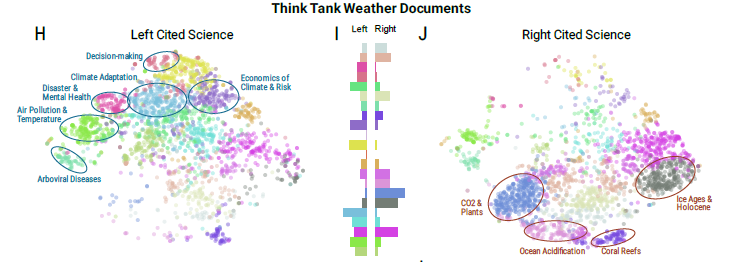
The minimal overlap and detailed analysis of science papers cited by Democratic- vs. Republican-led Congressional committee and think tank documents suggest to us that forefront scientific research and reviews inform Democratic policy formulation whereas Republican policy preferences inform their selections of relevant science. This is the politicization of science in Congress and the nation’s think tanks that results from the growing partisan divide in trust for science and scientists.
forefront scientific research and reviews inform Democratic policy formulation whereas Republican policy preferences inform their selections of relevant science.
And the situation may well now be getting significantly worse. As we saw in Section V, Project 2025 embodies the wholesale rejection of science that the Christian Nationalist movement hopes would be translated into public policy if Trump wins the 2024 election. Meanwhile, Trump’s takeover of the Republican Party has attracted to Congress a number of members who seem proud to display publicly their complete ignorance of science and who are much more likely to cite conspiracy theories spread on social media than any science papers. As we write this post, Florida and the U.S. southeast have seen extensive damage in short order from two powerful hurricanes strengthened by the warming waters in the Gulf of Mexico. Republican Congresswoman Marjorie Taylor Greene of Georgia has claimed publicly that the government, under the control of Democratic President Joe Biden, is controlling these storms and directing them toward regions with more Republican voters just before a Presidential election. Other Republican Congress members appear to be buying in to this absurd, anti-scientific, narrative. And one day after Hurricane Milton roared through Florida just two weeks after Hurricane Helene, Governor Ron DeSantis denied that climate change was making hurricanes more powerful. “This is something that [Florida] has dealt with its whole history, and it’s something that we will continue to deal with,” said DeSantis. If Project 2025 is realized, they will be dealing with it more and more frequently in the coming years, without federal government aid.
VII. outlook
We have documented the growing distrust of science and scientists among Republican voters and political elites in the U.S. This trend has been turbo-charged by Donald Trump, Christian Nationalists, and public attitudes during the COVID-19 pandemic, all added to the aggressive distaste for science-based government regulations within much of the business community. The Heritage Foundation’s Project 2025 embodies all forms of Republican science rejection. The partisan divide on these issues jeopardizes the country’s ability to deal with real problems, such as climate change and health crises, going forward. Our blog is based on our advocacy for evidence-based policy-making. The most successful leaders are ones who anticipate approaching problems and take actions to mitigate their effects before they become unmanageable, but that is difficult to accomplish if one relies not on modern science, but rather on unfalsifiable ancient texts, conspiracy theories, head-in-the-sand denialism, and the whims of a serial fabulist.
references:
T.B. Edsall, MAGA vs. Science is No Contest, New York Times, Sept. 11, 2024, https://www.nytimes.com/2024/09/11/opinion/republicans-science-denial.html
N. Oreskes and E.M. Conway, From Anti-Government to Anti-Science: Why Conservatives Have Turned Against Science, Daedalus 121, 98 (2022), https://direct.mit.edu/daed/article/151/4/98/113706/From-Anti-Government-to-Anti-Science-Why
DebunkingDenial, Conservative Alternative Science Confronts and is Routed by Reality, https://debunkingdenial.com/conservative-alternative-science-confronts-and-is-routed-by-reality/
N. Oreskes and E.M. Conway, Merchants of Doubt: How a Handful of Scientists Obscured the Truth on Issues from Tobacco Smoke to Climate Change (Bloomsbury Publishing, 2011), https://www.amazon.com/Merchants-Doubt-Handful-Scientists-Obscured/dp/1608193942
DebunkingDenial, Scientific Tipping Points: The Ozone Layer, https://debunkingdenial.com/scientific-tipping-points-the-ozone-layer/
DebunkingDenial, Ten False Narratives of Climate Change Deniers, https://debunkingdenial.com/portfolio/ten-false-narratives-of-climate-change-deniers/
DebunkingDenial, Evolution, https://debunkingdenial.com/portfolio/evolution/
DebunkingDenial, Young Earth Creationism, https://debunkingdenial.com/portfolio/young-earth-creationism/
National Opinion Research Center, The General Social Survey, https://www.norc.org/research/projects/gss.html
G. Gauchat, Politicization of Science in the Public Sphere: A Study of Public Trust in the United States, 1974 to 2010, American Sociological Review 77, 167 (2012), https://journals.sagepub.com/doi/10.1177/0003122412438225
DebunkingDenial, QAnon: An Ominous Conspiracy Theory, https://debunkingdenial.com/qanon-an-ominous-conspiracy-theory/
DebunkingDenial, Vaccinations, https://debunkingdenial.com/portfolio/vaccinations/
DebunkingDenial, The Disinformation Dozen: Source of Lies About COVID Vaccines, https://debunkingdenial.com/the-disinformation-dozen-source-of-lies-about-covid-vaccines/
DebunkingDenial, Robert F. Kennedy, Jr., Conspiracy Theorist, https://debunkingdenial.com/robert-f-kennedy-jr-conspiracy-theorist/
K. Koretski, et al., RFK Jr. Endorses Trump After Weeks of Back-Channel Courtship, NBC News, Aug. 23, 2024, https://www.nbcnews.com/politics/2024-election/rfk-jr-says-court-filing-endorsing-trump-ending-presidential-hopes-rcna165936
DebunkingDenial, The Desperation of Book Bans, https://debunkingdenial.com/portfolio/the-desperation-of-book-bans/
Project 2025: Building for Conservative Victory Through Policy, Personnel, and Training, https://www.project2025.org/
I. Saric, Scientific American Makes Second-Ever Endorsement, Backs Kamala Harris, Axios, Sept. 16, 2024, https://www.axios.com/2024/09/16/scientific-american-kamala-harris-2024
A. Kirzinger, A. Kearney, L. Hamel, and M. Brodie, KFF COVID Vaccine Monitor: The Increasing Importance of Partisanship in Predicting COVID-19 Vaccination Status, KFF, Nov. 16, 2021, https://www.kff.org/coronavirus-covid-19/poll-finding/importance-of-partisanship-predicting-vaccination-status/
Wikipedia, Spanish Flu, https://en.wikipedia.org/wiki/Spanish_flu
Our World in Data, Cumulative Confirmed COVID-19 Cases and Deaths, https://ourworldindata.org/grapher/cumulative-deaths-and-cases-covid-19
Center for Countering Digital Hate, The Disinformation Dozen: Why Platforms Must Act on Twelve Leading Online Anti-Vaxxers, https://counterhate.com/research/the-disinformation-dozen/
B. Jones, The Changing Political Geography of COVID-19 Over the Last Two Years, Pew Research Center, March 3, 2022, https://www.pewresearch.org/politics/2022/03/03/the-changing-political-geography-of-covid-19-over-the-last-two-years/
DebunkingDenial, Natural Herd Immunity, A Really Bad Idea, https://debunkingdenial.com/natural-herd-immunity-a-really-bad-idea/
A. Tyson, C. Funk, and B. Kennedy, What the Data Says About Americans’ Views of Climate Change, Pew Research Center, Aug. 9, 2023, https://www.pewresearch.org/short-reads/2023/08/09/what-the-data-says-about-americans-views-of-climate-change/
C.-J. Lim, As Florida Reels from Hurricane Milton, DeSantis Again Dismisses the Role of Climate Change, MSNBC, Oct. 11, 2024, https://www.msnbc.com/top-stories/latest/ron-desantis-climate-change-hurricane-milton-florida-rcna175047
DebunkingDenial, What’s New with Renewables?, https://debunkingdenial.com/whats-new-with-renewables/
DebunkingDenial, The Future of Nuclear Power, Part IV: Progress Toward Fusion Power, https://debunkingdenial.com/the-future-of-nuclear-power-part-iv-progress-toward-fusion-power/
A. Tyson and B. Kennedy, How Americans View National, Local and Personal Energy Choices, Pew Research Center, June 27, 2024, https://www.pewresearch.org/science/2024/06/27/how-americans-view-national-local-and-personal-energy-choices/
Intergovernmental Panel on Climate Change, Climate Change 2023 Synthesis Report, Summary for Policymakers, https://www.ipcc.ch/report/ar6/syr/downloads/report/IPCC_AR6_SYR_SPM.pdf
DebunkingDenial, Climate Tipping Points: Coming Soon to a Planet Near You?, https://debunkingdenial.com/climate-tipping-points-coming-soon-to-a-planet-near-you/
DebunkingDenial, Sex, Gender, Genome, and Hormones, https://debunkingdenial.com/sex-gender-genome-and-hormones-part-i/
K. Parker, J.M. Horowitz, and A. Brown, Americans’ Complex Views on Gender Identity and Transgender Issues, Pew Research Center, June 28, 2022, https://www.pewresearch.org/social-trends/2022/06/28/americans-complex-views-on-gender-identity-and-transgender-issues/
D. Soh, The End of Gender: Debunking the Myths About Sex and Identity in Our Society (Simon & Schuster, 2021), https://www.simonandschuster.com/books/The-End-of-Gender/Debra-Soh/9781982132521
World Values Surveys, https://www.worldvaluessurvey.org/wvs.jsp
J.O. Baker, S.L. Perry, and A.L. Whitehead, Crusading for Moral Authority: Christian Nationalism and Opposition to Science, Sociological Forum 35, 587 (2020), https://onlinelibrary.wiley.com/doi/abs/10.1111/socf.12619
Baylor Religion Survey, The Values and Beliefs of the American Public – A National Study, https://www.thearda.com/ARDA/pdf/originalCodebooks/Baylor%202007%20Booklet.pdf
B. Guarino, A. Thompson, T. Lewis, and L.J. Young, What to Know About Project 2025’s Dangers to Science, Scientific American, July 19, 2024, https://www.scientificamerican.com/article/project-2025-plan-for-trump-presidency-has-far-reaching-threats-to-science/
S. Contorno, Trump Claims Not to Know Who is Behind Project 2025. A CNN Review Found at Least 140 People Who Worked for Him are Involved, CNN, July 11, 2024, https://www.cnn.com/2024/07/11/politics/trump-allies-project-2025/index.html
G. Eckstein, “Our Movement”: In Resurfaced Speech, Trump Endorses Heritage Foundation’s Project 2025, Salon, July 11, 2024, https://www.salon.com/2024/07/11/our-movement-in-resurfaced-speech-endorses-heritage-foundations-project-2025/
Project 2025 Seeks to Dismantle Agencies, Terminate Up to 1 Million Federal Workers, AFGE, July 15, 2024, https://www.afge.org/article/project-2025-seeks-to-dismantle-agencies-terminate-up-to-1-million-federal-workers/
National Archives, Japanese-American Incarceration During World War II, https://www.archives.gov/education/lessons/japanese-relocation
J. Blitzer, Inside the Trump Plan for 2025, The New Yorker, July 15, 2024, https://www.newyorker.com/magazine/2024/07/22/inside-the-trump-plan-for-2025
M. Yang, Donald Trump Claims to ‘Know Nothing’ About Project 2025, The Guardian, July 5, 2024, https://www.theguardian.com/us-news/article/2024/jul/05/donald-trump-project-2025
Supreme Court of the United States, Dobbs v. Jackson Women’s Health Organization, decided June 24, 2022, https://www.supremecourt.gov/opinions/21pdf/19-1392_6j37.pdf
L. Kashinsky and M. Messerly, Trump Vows to Veto Any Federal Abortion Ban – After Previously Refusing to Commit, Politico, Oct. 1, 2024, https://www.politico.com/news/2024/10/01/trump-abortion-veto-national-ban-00182091
Environmental Defense Fund, Overview of EPA Endangerment Finding, https://www.edf.org/overview-epa-endangerment-finding
M.E. Mann, Project 2025: The Right-Wing Conspiracy to Torpedo Global Climate Action, Bulletin of the Atomic Scientists, Aug. 16, 2024, https://thebulletin.org/2024/08/project-2025-the-right-wing-conspiracy-to-torpedo-global-climate-action/
Energy Innovation, https://energyinnovation.org/
Environmental Protection Agency, Integrated Risk Information System, https://www.epa.gov/iris
DebunkingDenial, The Birth Control Disinformation Campaign, https://debunkingdenial.com/the-birth-control-disinformation-campaign/
M. Felix, L. Sobel, and A. Salganicoff, The Comstock Act: Implications for Abortion Care Nationwide, KFF Women’s Health Policy, April 15, 2024, https://www.kff.org/womens-health-policy/issue-brief/the-comstock-act-implications-for-abortion-care-nationwide/
Wikipedia, Roger Severino, https://en.wikipedia.org/wiki/Roger_Severino
The Man Behind Trump’s Religious Freedom Agenda for Health Care, Project2025Admin, https://project2025admin.com/personnel/roger-severino/
Columbia University Sabin Center for Climate Change Law, Silencing Science Tracker, https://climate.law.columbia.edu/Silencing-Science-Tracker
Columbia University Sabin Center for Climate Change Law, https://climate.law.columbia.edu/
Climate Science Legal Defense Fund, https://www.csldf.org/
R.M. Webb and L. Kurtz, Politics v. Science: How President Trump’s War on Science Impacted Public Health and Environmental Regulation, Progress in Molecular Biology and Translational Science 188, 65 (2022), https://www.ncbi.nlm.nih.gov/pmc/articles/PMC8793038/
A. Furnas, T. LaPira, and D. Wang, Partisan Disparities in the Use of Science in Policy, SocArXiv papers, Oct. 18, 2024, https://osf.io/preprints/socarxiv/aep9v?view_only=
Overton, Is Your Work Influencing Policy, https://www.overton.io/
K. Hawkinson, MTG Doubles Down on Weather Modification Conspiracy Theory Despite Experts Rubbishing ‘Hurricane Control’, The Independent, Oct. 9, 2024, https://www.independent.co.uk/news/world/americas/us-politics/marjorie-taylor-greene-weather-control-hurricane-b2626699.html
 Debunking Denial