
October 16, 2024
I. Republicans are rapidly becoming the anti-science party
In posts on this site we have sought to expose pseudoscience promulgated by both left- and right-leaning political groups. But the Republican Party in the U.S. has for a half-century been the home to organized science denial. As we have explained in detail in our earlier post on the resurgence of COVID-19 in the U.S., the industry of science denial was largely driven by two distinct groups. The first group comprises business leaders and Libertarian absolutists who oppose all government regulation as threats to corporate bottom lines, and who therefore established an industry of science denial and a network of astroturf think tanks to systematically undermine the science that underpinned regulations protecting the environment and public health. Theirs was the story told in Naomi Oreskes’ and Erik Conway’s 2010 book Merchants of Doubt. We have covered many of their efforts in our previous posts on stratospheric ozone depletion and ongoing climate change.
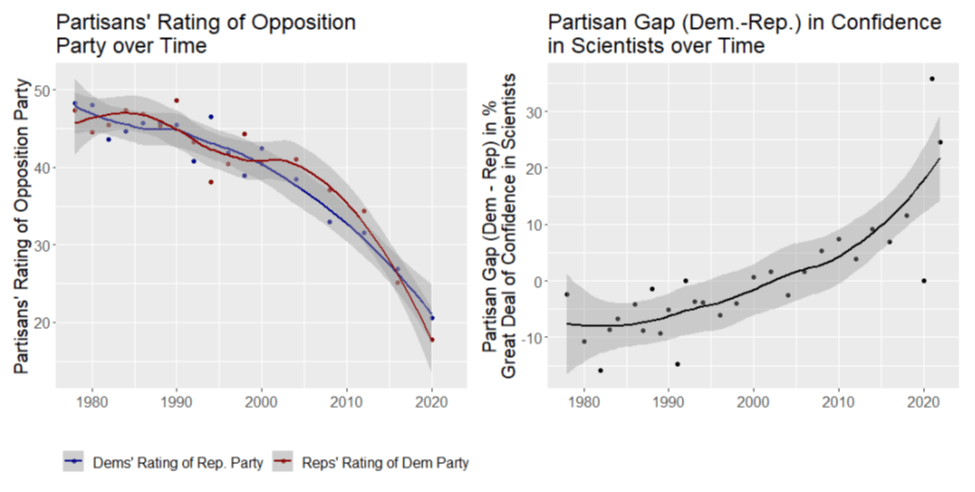
The second group contributing to historical science denial comprises fundamentalist Christians who viewed the science of evolution and Big Bang cosmology as undermining the authority of the Judaeo-Christian Bible. Together, these two groups led a gradual decline in Republicans’ trust in science, documented over the years by periodic General Social Surveys (GSS) carried out by the National Opinion Research Center associated with the University of Chicago, and highlighted in a 2012 research paper by Gordon Gauchat. But during the era of Donald Trump’s domination of the Republican Party that downward slope has evolved into an avalanche, reflected in the GSS results for recent years shown in Fig. I.1. In the two most recent surveys only 20-30% of self-identified Republican voters express “a great deal of confidence in the scientific community,” as opposed to 55-65% of Democratic voters. The same results are included in Fig. I.2, now showing responses for all three confidence-level options in the survey and including smoothed curves averaging over year-to-year fluctuations to emphasize the historical trends.
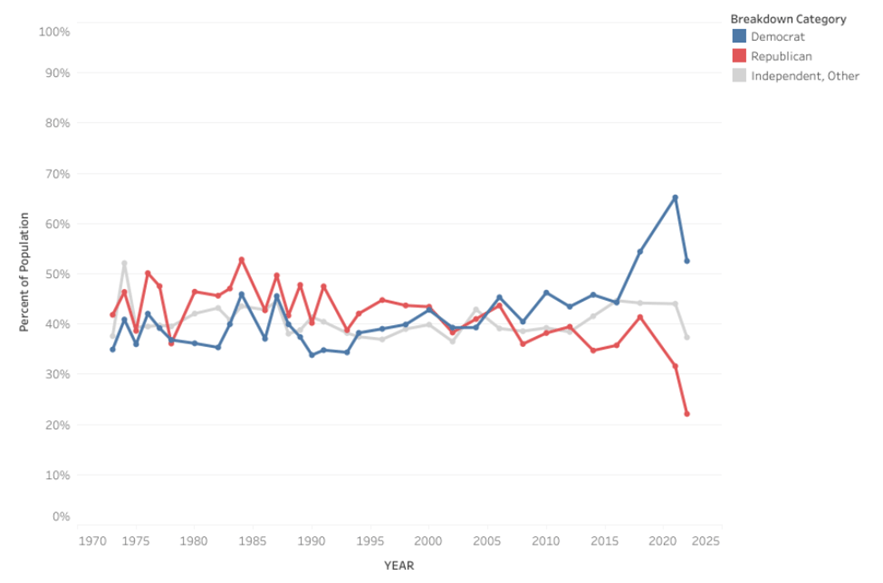

The rapid decline in Republicans’ trust in science has triggered a number of recent opinion columns and essays. In a recent New York Times issue, Thomas Edsall has made the point that “MAGA vs. Science is No Contest.” Naomi Oreskes and Erik Conway authored a 2022 article entitled “From Anti-Government to Anti-Science: Why Conservatives Have Turned Against Science.” Oreskes and Conway attribute the recent declines to the legacy of the merchants of doubt, the first group discussed above. But we think this is an oversimplification of the recent changes Donald Trump’s leadership and the COVID-19 pandemic have wrought, exacerbating the distrust of science that the earlier merchants of doubt had sought to implant.
We see four distinct, but related, reasons underlying the rapid ongoing decline in Republicans’ trust in science:
- Like any cult leader, Donald Trump’s fundamental message to his supporters has been that they should feel free to dwell in an alternate reality, as long as it includes recognizing Trump himself as a “stable genius” (as opposed to the view of many Democratic voters that Trump is an ignorant, dangerous, self-absorbed sociopath). Trump has been happy to offer lies, big and small, to populate the alternate reality. But his “encouragement” has led to an increased susceptibility of his supporters to misinformation of all kinds spread on social media and to a variety of loony conspiracy theories, including QAnon. Trump’s many lies emboldened both domestic and foreign spreaders of disinformation.
- Republican voters increasingly saw government attempts to mitigate the community spread of COVID-19 – especially mask mandates and lockdowns — as infringements on their individual liberty. They therefore began to doubt the scientific accounts of the severity of the virus and its high transmissibility. Many Republicans viewed the scientific spokespeople, such as Anthony Fauci, who were trying to explain the developing science to the public, as perpetrators, together with science funders such as Bill Gates, imposing a scientific fraud to enhance control over the public.
- Before the pandemic people who distrusted vaccinations were distributed in both political parties and were perhaps more prominent among Democratic voters. This changed with the introduction of the COVID-19 vaccines at the beginning of 2021. Ironically, it was Donald Trump who pushed U.S. government funding for the rapid development of the vaccines (although the first approved vaccine from Pfizer did not benefit from that funding). But many Republican voters came to view them as unnecessary instruments intended to dominate or endanger them. Conspiracy theories that the vaccines were dangerous, or embedded microchips in patients, or that mRNA vaccines changed a recipient’s own DNA, abounded. The anti-vaxx movement expanded and migrated nearly completely into the Republican Party, a transition symbolized by Democratic family scion and anti-vaxxer extraordinaire Robert F. Kennedy, Jr.’s recent endorsement of Donald Trump for the 2024 Presidential election.
- The fundamentalist Christians who tried and failed multiple times to get Intelligent Design taught in science classrooms as an alternative to evolution faded from visible political prominence for a while. But they spawned a broader, more political, Christian Nationalist movement, working behind the scenes to populate U.S. courts with judges and justices and legislatures with partisans sympathetic to their desire to transform the U.S. from a constitutional democracy, founded on the separation of church and state and the rule of secular law, toward a Christian state in which ultimate laws would be determined by (their interpretation of) the Bible. With many such judges now in place, various states have renewed hope to find less judicial resistance to new attempts to mandate the teaching of Intelligent Design in public school science classes. Now that Donald Trump has completed his hostile takeover of the Republican Party, the Christian Nationalist movement sees their opportunity to take control of the Party’s future. The prominent parts of their platform recently have been the “anti-woke” movement, book bans, and the draconian governing principles laid out in Project 2025 (see Part II of this post), concentrating power in the Presidency, eliminating many of womens’ rights, and highlighting distrust of science. Christian Nationalists are anti-science because they see scientific research findings as antithetical to biblical authority.
Indeed, distrust for science is becoming a central theme tying disparate parts of the Republican Party base together, folks who reject government regulation and mandates combining with others who want government to intervene to restrict health care options for women and individuals with gender dysphoria. Because of this it was not entirely surprising when the magazine Scientific American made its first and second ever Presidential endorsements for Democrats Joe Biden and Kamala Harris in the 2020 and 2024 U.S. elections. Figure I.3 shows that the growing partisan divide in trust for science has been accompanied by the rapidly increasing political polarization in the U.S. Adherents of the two parties now have largely orthogonal views of reality.
Scientists work to increase understanding of nature. Nature, of course, doesn’t care what individuals believe about science and scientists. When distrust for scientists manifests as disbelief for scientifically documented natural trends there can be disastrous consequences varying in scale from individual to global. In the ensuing sections we will explore some of those consequences along with what surveys reveal of the partisan divide in attitudes toward COVID and vaccines, climate change and energy sources, sex and gender. We will also cover in somewhat more detail in Part II Christian Nationalists’ science distrust and consequences of the science trust divide in the formulation of public policy.
Indeed, distrust for science is becoming a central theme tying disparate parts of the Republican Party base together, folks who reject government regulation and mandates combining with others who want government to intervene to restrict health care options for women and individuals with gender dysphoria.
II. partisan attitudes toward covid and covid vaccines
The COVID-19 pandemic of 2020-21 was the worst worldwide disease episode since the 1918-20 Spanish Flu epidemic. The cumulative human deaths attributed to COVID-19 are 7.1 million globally and 1.2 million in the U.S. alone. The mortality rates began to drop after the introduction of the first COVID-19 vaccines in early 2021. Despite the devastation, the survey results in Fig. II.1 reveal that U.S. Republican voters generally took the pandemic much less seriously than Democratic voters. Even among Republican voters who chose to get vaccinated, a majority still felt that the seriousness of the disease had been exaggerated; that majority was overwhelming among the Republicans who chose not to be vaccinated. Large majorities of Republicans maintained that it was strictly a personal choice whether or not to get vaccinated, rather than a civic responsibility in order to mitigate the spread of a highly transmissible and deadly disease.

As we have reported previously, a dozen social media influencers led the efforts to stoke COVID vaccine mistrust via “a tidal wave of disinformation.” Despite the large-scale clinical trials that were required in order for the vaccines to gain approval from the U.S. Food and Drug Administration even as an experimental treatment, these and other conspiracy theorists promoted lies that the vaccines contained poisons, magnetic substances, microchips to gain control over users, or molecules that would alter the recipient’s DNA. They claimed that the vaccines would cause herpes, infertility, neurological damage, death, or even a future epidemic of “local brain injury … myocarditis and cardiac injury … liver injury … lung injury … and kidney injury.” Of course, none of these dire “predictions” have come true. But the misinformation found willing consumers among inhabitants who started with a strong level of distrust of science and scientists. Thus, many Republican voters decided that the downsides of the vaccines outweighed the upside.
The strong partisan divide in perceptions of the seriousness of the disease and the efficacy vs. danger of the vaccines led to the strong correlation seen in Fig. II.2 between political leaning and COVID vaccination rate. In U.S. counties that voted overwhelmingly for Donald Trump in the 2020 Presidential election often only 50% or fewer of adults chose to get the recommended two COVID vaccine doses, while typically more than 75% received two vaccination doses in the counties that supported Joe Biden most strongly. For a disease that spreads efficiently from person to person, that difference in vaccination rates can be deadly. As we have shown previously, given the transmission rate of the SARS-CoV-2 virus, 75% vaccination rate is well above, while 50% is well below, the threshold to gain herd immunity to suppress the community spread of the virus.

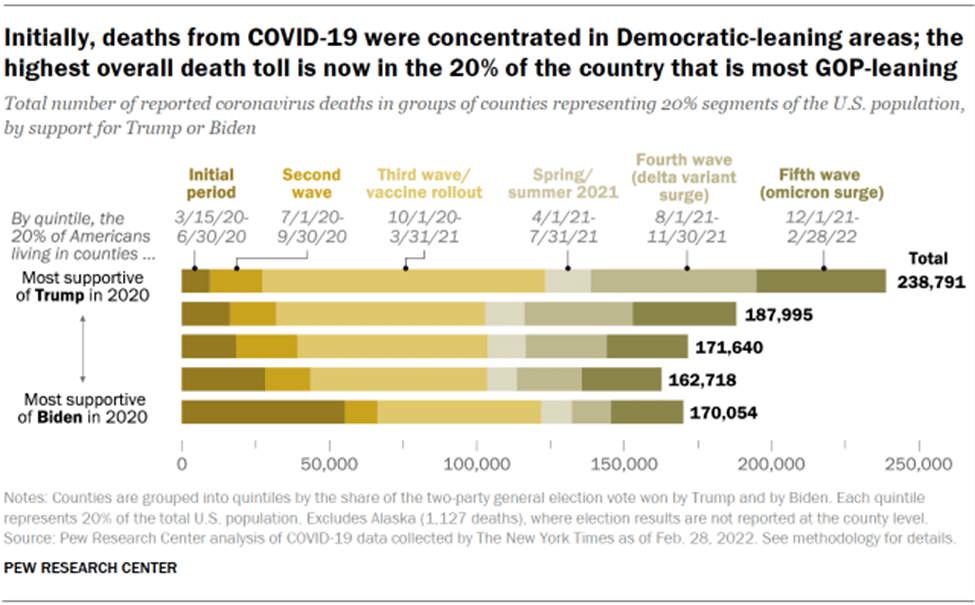
The Pew Research Center analysis in Figs. II.3 and II.4 sorted all U.S. counties into five equally populated groups based on their level of support for Trump or Biden in the 2020 election. The total population and the number of individual counties in each group are listed in the table at the bottom of Fig. II.3, along with the average margin with which voters in those counties supported either candidate over the other. Since Republican support was centered in mostly rural counties while Democratic support was dominated by densely populated urban areas, the average population per county was about 16 times higher in the most Biden-supportive (“blue”) counties than in the most Trump-supportive (“red”) counties. One might expect a highly transmissible disease to cause the most devastation in densely populated areas and this was indeed the case in the blue counties at the start of the pandemic. But the red counties soon overtook the blue counties in COVID deaths despite the sparser red-county population. Science denial can have disastrous consequences.
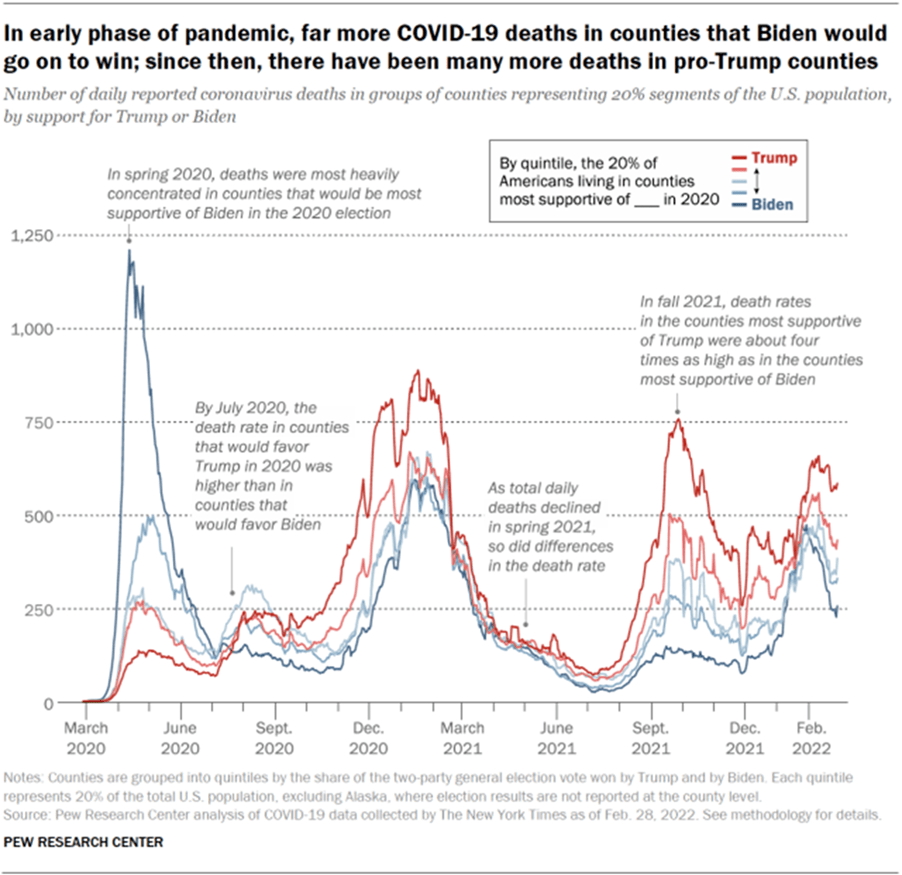
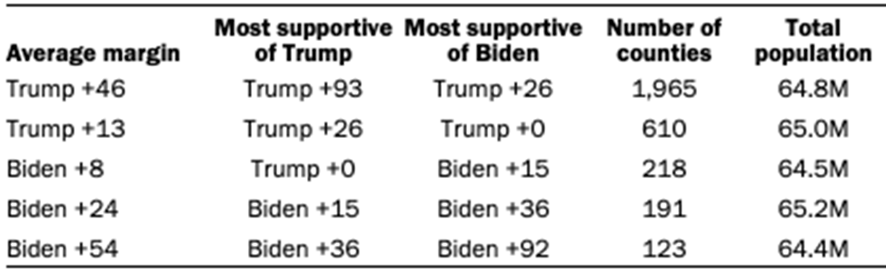
Figure II.3. The COVID-19 deaths as a function of time in five groups of U.S. counties, each containing about 20% of the total U.S. population, organized from most pro-Biden in blue to most pro-Trump in red. Characteristics of the five county groupings are shown in the table below. Note that starting in summer 2021, after COVID vaccines had been available to the public for six months, the most pro-Trump counties had about four times as many deaths as the most pro-Biden counties, despite having about 16 times fewer inhabitants per county, on average.
The graph in Fig. II.3 traces the number of COVID-19 deaths recorded daily within the five county groups from the start of the pandemic through early 2022. During the COVID surge in the Fall of 2021, well after COVID vaccines had been made available at no cost to all U.S. citizens, the trend in deaths reflects the vaccination correlation in Fig. II.2. Summed over that Fall, the reddest counties recorded about four times as many deaths as the bluest counties; the low vaccination rate in the reddest counties more than compensated for their sparse population density in fostering community spread of the virus.
The cumulative impact of vaccine opposition among Republican voters is illustrated in Fig. II.4, which plots the total number of COVID-deaths within the five county groups through five waves of COVID severity up until the end of February 2022. During the initial phase of COVID, deaths were highest from community spread in the densely populated urban blue counties that would eventually support Biden most strongly in the 2020 election. But vaccine opposition caused the mostly rural reddest counties to overtake the bluest counties in cumulative deaths, again despite their much lower population density.
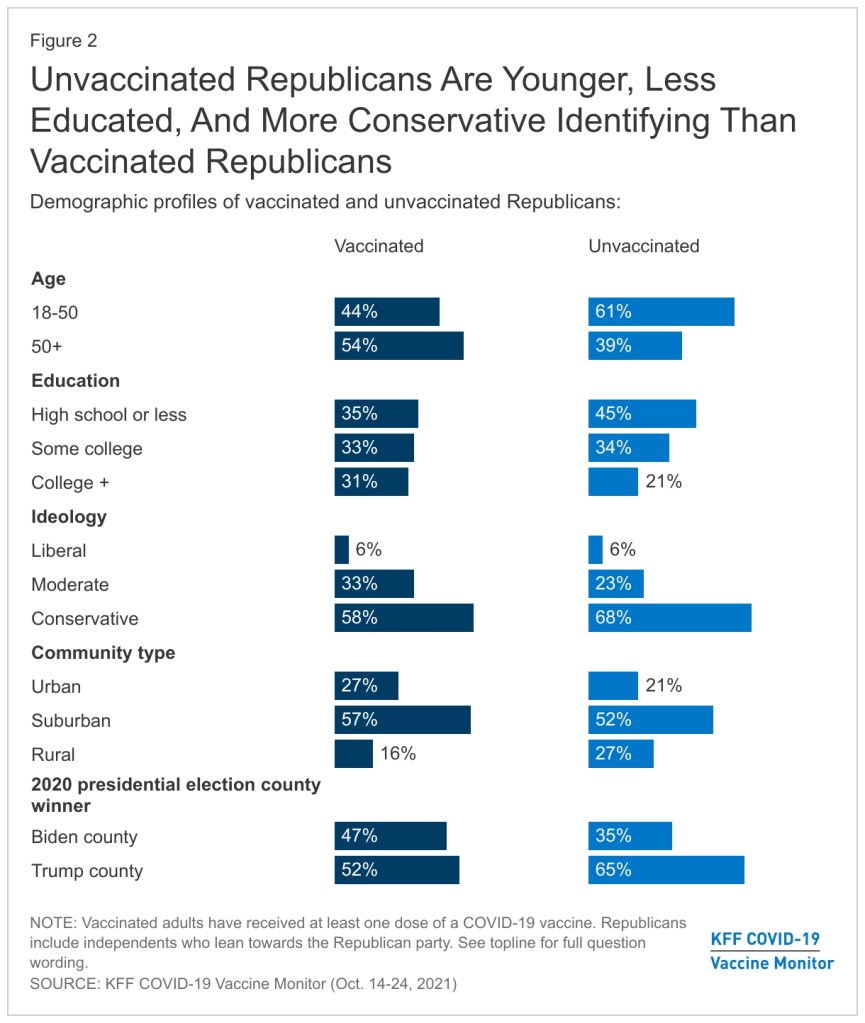
A 2021 KFF survey did a deeper dive into the demographic profiles of vaccine denial among Republican voters. As shown in Fig. II.5, a majority of the Republicans who chose to go unvaccinated were under age 50, did not complete college, and judged themselves to be conservative. The age distribution clearly reflects judgments of personal risk given the belief that vaccination was purely a personal choice. But both the incomplete education and the ideological bent appear to facilitate the partisan distrust of scientists, while older Republicans may have gained through personal experience some appreciation of the medical profession who overwhelmingly vouched for the vaccines.
III. partisan attitudes toward climate change and renewable energy
Beginning in the late 20th century the “merchants of doubt” profiled in Oreskes’ and Conway’s book of that name pioneered denial of the human role in global warming and consequent climate change, with strong financial backing from the fossil fuel industry. Since then, climate change denial has become an article of faith among most Republican voters. That denial has gone through several phases: first denying that the globe was warming at all, then denying that human activities had any significant role in the warming, then arguing that the science was still unsettled and that adapting to climate change would be far less expensive than trying to mitigate it.
The evolution during the current century in the partisan divide over the severity of climate change is illustrated by Pew surveys of U.S. public attitudes in Fig. III.1. Since about 2013, as the scientific evidence of climate change has become more definitive and some of its impacts have been widely felt via severe weather-related events, the fraction of Democratic voters who view climate change as a major threat has grown from about 60% to about 80%. Over that same period, only about a quarter of Republican voters see climate change as a major threat, with no obvious impact on their opinions from the growing frequency of severe storms, floods, droughts, and forest fires they have had to suffer through. Indeed, just after two unusually severe hurricanes, Helene and Milton, have ravaged his state in recent days, Republican Governor Ron DeSantis of Florida has denied that climate change has anything to do with their severity. Earlier this year he signed legislation that removes references to climate change from most Florida state laws.

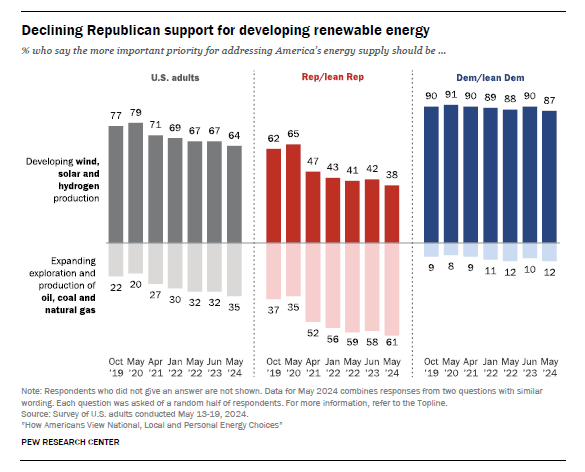
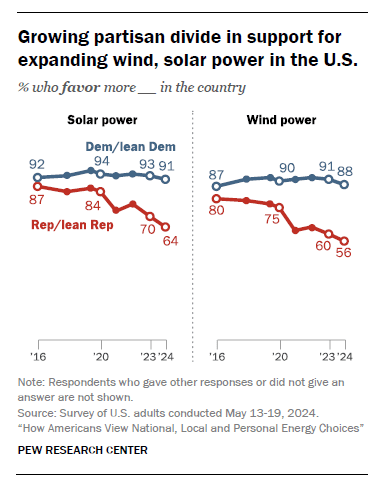
The rise in global temperatures since the pre-industrial era is very strongly correlated with the growing atmospheric concentrations of carbon dioxide and methane and, in turn, with the emission of greenhouse gases by humans’ burning of fossil fuels. While many individual behavioral changes can help, the most important means of mitigating climate change over the next few decades is the replacement of fossil fuel energy sources by renewable energy sources, especially by solar and wind power. In a previous post, we have described the numerous ongoing technological advances that promise to increase the efficiency and reduce the cost of solar and wind power. We have also described the realistic hopes that nuclear fusion power may contribute substantially to a non-fossil-fuel economy during the second half of the 21st century. But attaining that economy is threatened politically by the declining support among Republican voters for developing renewable energy, as charted in Fig. III.2 and specifically for solar and wind power in Fig. III.3. During the years that Donald Trump has dominated the Republican Party, discrediting science and characterizing climate change as a ‘hoax,’ Republican support for renewable energy has plummeted while Democratic support held steady at about 90%.
The Pew survey results in Fig. III.4 reveal a strong age-dependence in Republican, but not in Democratic, support for renewable energy. Fortunately, younger Republican voters, who see their own futures compromised by likely climate change (although not by COVID, as indicated in Fig. II.5), are far more supportive of renewable energy than are middle-aged and senior Republican voters. The youth vote may therefore make Republican politicians more receptive to climate change mitigation in the near future.

Major changes are also needed in the transportation sector to reduce greenhouse gas emissions. Electric vehicles hold great promise in effecting this change, so long as electricity sources also move away from fossil fuel power. But, as shown in Fig. III.5, Republican voters strongly oppose government actions – whether rules or subsidies or rebates – to encourage rapid growth in the share of the vehicle sector devoted to electric vehicles.
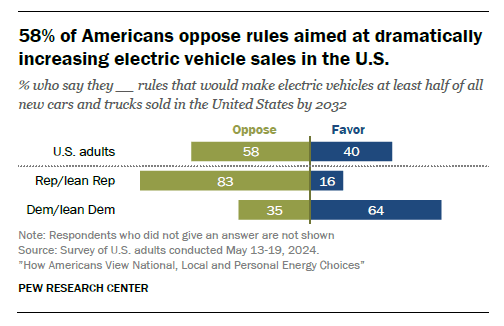
In the case of COVID skepticism and vaccine distrust, the Republican attitudes have had mainly local impacts, endangering their own communities through spread of a still deadly virus. In the case of climate change denial their impacts can be global. The U.S. is the world’s largest per capita emitter of greenhouse gases. If Republican opposition to renewable energy sources and electric vehicles impedes government actions to reduce the country’s emissions, the entire world will suffer the consequences, which grow more severe as global mean temperatures continue to increase. In our post on Climate Tipping Points, we have emphasized the nonlinearity of Earth’s climate, with potentially devastating irreversible changes on the horizon. Such changes render conservative estimates of costs to adapt to unmitigated climate change irrelevant. Relying on after-the-fact adaptation alone is extremely short-sighted and dangerous.
IV. partisan attitudes toward sex and gender issues
The scientific understanding of the biological origins of sex and gender identity has advanced rapidly over the past few decades, as we have described in a previous post. However, misconceptions about sex and gender have been promoted by groups on both the political left and right. The majority of Democratic voters, however, are much more likely to accept new scientific evidence and to be tolerant of non-traditional views than are the majority of Republican voters. The Christian Nationalist movement, in particular, has promoted vehement opposition over the past decade to government acceptance or rights for people who deviate from their traditionalist views of two and only two distinct, heterosexual genders with biblically defined biological roles in society. The political “anti-woke” movement that has emerged from that opposition has strongly colored the views of Republican voters.
The survey results in Fig. IV.1 reveal that 86% of Republican and Republican-leaning voters, essentially independent of age, ethnicity, or educational level, believe that gender is determined by sex assigned at birth. In contrast, 61% of Democratic and Democratic-leaning voters believe that gender can differ from sex assigned at birth. What does the science say? Biological sex is determined by reproductive organs, which begin to form in a fetus during the first trimester of pregnancy. Sex assigned at birth occasionally gets an individual’s true biological sex wrong because there are intersex conditions in which genitals at birth may be ambiguous indicators of the reproductive organs. Gender identity resides in the brain, for which differentiation between the sexes sets in during the second trimester of pregnancy and is heavily influenced by fetal exposure to testosterone. The hormone exposure can be affected by factors outside the influence of chromosomes and, consequently, gender identity can sometimes deviate from the sex determined by reproductive organs.
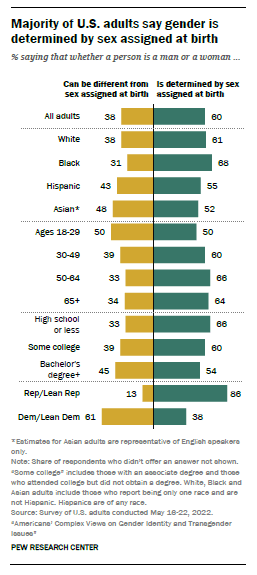
Some social scientists go too far in insisting that gender identity is a purely social construct and encouraging young people to make personal choices about their gender across a very wide spectrum of possibilities. Republican voters tend to view such non-traditional choices as endangering the fabric of society. In fact, gender identity is primarily determined by biological characteristics. Gender dysphoria and the need for transgender transformations are real biological conditions, even if their rapid recent growth, especially among adolescent girls, likely reflects some degree of social contagion.
Most Republican voters are confused and even angered by this emerging understanding of the biological origins of gender identity. As seen in Fig. IV.2, 70% of them consider societal views of gender identity to be changing too quickly, while 77% of Democratic voters think the changes are occurring at about the right speed or not quickly enough. It is not that the majority of Democratic voters are irreligious; they are just more receptive than Republican voters to progress in the scientific understanding of biological origins of sex and gender.

Tolerance for transgender individuals is generally quite low among Republican voters. The survey results in Fig. IV.3 indicate that two-thirds of Republican voters consider societal acceptance for transgender people has gone too far, while 83% of Democratic voters view the acceptance as either about right or not strong enough. Independent of political preferences, transgender acceptance is, not surprisingly, highest among young adults.

— Continued in Part II —
 Debunking Denial