
May 8, 2024
Origin of COVID-19?
The COVID-19 pandemic has been one of the world’s most deadly pandemics. Since its discovery at the end of 2019, as of April 21, 2024 (when the Worldometer Coronavirus Tracker ceased collecting data on the virus because many countries had ceased tracking it), nearly 705 million people worldwide had contracted the disease, and over 7 million had died from it. Figure 1 shows the cumulative cases of COVID and cumulative confirmed deaths from COVID, as a function of time. The semi-logarithmic curve shows that there have been over 700 million cases of COVID-19 worldwide, and nearly 7 million deaths from the pandemic.

Figure 1: Number of confirmed cases of COVID-19, and number of cumulative deaths from COVID, as a function of time, from Jan. 22, 2020 to Apr. 21, 2024. Overall, there are over 700 million confirmed cases of COVID-19 and nearly 7 million deaths from the pandemic.
Figure 2 shows the cumulative COVID-19 excess deaths per 100,000 people for every country. Excess deaths from COVID-19 are the difference between the observed numbers of deaths in a given time period, and the expected numbers of deaths in the same period based on statistics from earlier years. The data shows that the rate of excess deaths in the U.S. was greater than that of many other developed countries. In particular, the normalized excess deaths in the U.S. were greater than island nations such as Australia, South Korea and Taiwan. But the U.S. also fared worse than non-island nations such as Canada and Norway. [Note: Fig. 2 shows excess deaths for all causes; we strongly suspect that the very large figures for Russia and Ukraine reflect many deaths from their war.]
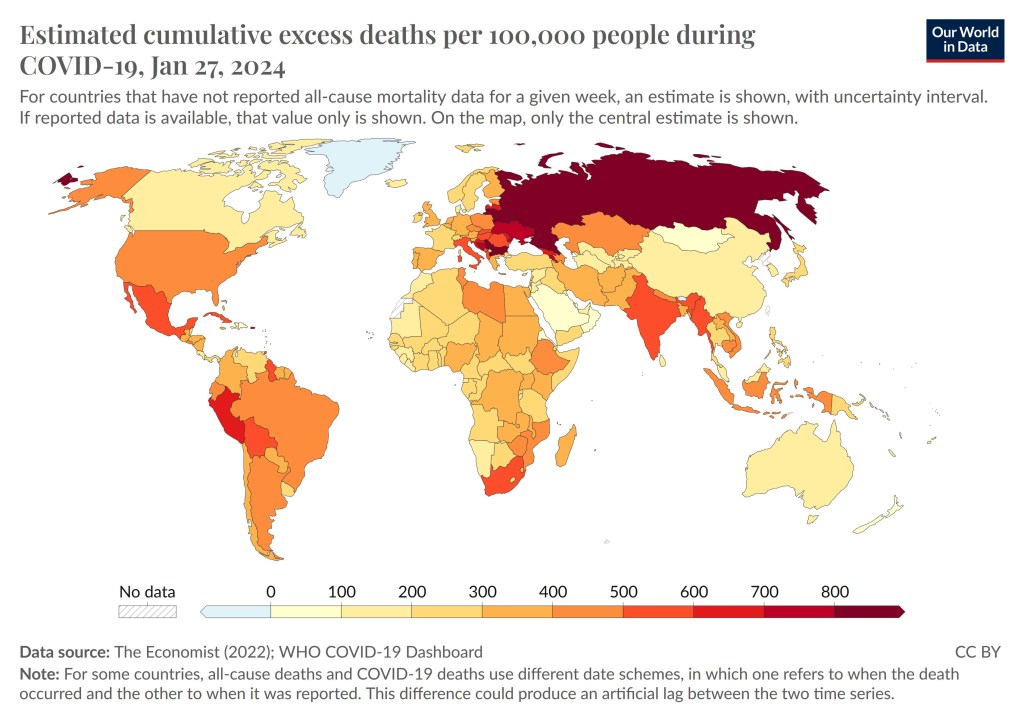
Figure 2: Cumulative excess deaths from COVID-19 per 100,000 people, as of Jan. 27, 2024. Cumulative deaths are defined as the difference between the total number of deaths, and the expected number of deaths, during a given time period, based on statistics from earlier years.
Figure 3 shows the weekly COVID-19 death rate in the U.S., sorted by vaccination status. The brown curve shows the death rate for unvaccinated people, while the purple curve shows the death rate for people who were vaccinated without the bivalent booster. The barely visible blue curve beginning in Fall 2022 shows the negligible death rate for those who were vaccinated with the bivalent booster. The curves clearly show that once the COVID-19 vaccines were widely available in the United States, deaths from COVID were largely from the unvaccinated population.

Figure 3: COVID-19 weekly death rate in the U.S. by vaccination status. The brown curve gives the death rate for unvaccinated Americans, while the purple curve shows the death rate for those vaccinated without the bivalent booster. The barely visible blue curve beginning in Fall 2022 shows the negligible death rate for those who were vaccinated with the bivalent booster.
There have been many efforts to determine where the virus first originated. The first large outbreak of the disease was in Wuhan, China, which hosts both a food market featuring many live animals for sale and one of the world’s leading laboratories studying highly infectious viruses. If the virus originated when it jumped from one animal species to humans, we would gain a great amount of information if we could identify the species and track the mutations in the transition from animal to human. On the other hand, if the coronavirus was accidentally leaked from a virology laboratory to the public, we would want to understand the chain of circumstances that led to the release. In that way we could tighten the safety regulations for research laboratories that deal with viruses. A number of U.S. politicians have pushed one view or the other of COVID’s origins to score political points, and political investigations into the origin remain current and contentious.
However, a recent study by the Associated Press has concluded that we will never be able to determine the origin of the SARS-CoV-2 virus. They argue that politics has superseded science in the search for the virus origins, and that by now it is no longer possible to identify with certainty where the pandemic originated. In this post, we will construct a timeline of events and (to the best of our ability) we will discuss how facts regarding the origin of COVID-19 became obscured, in large part because of actions taken by Chinese government and medical officials. We will use information provided in the Associated Press study to construct this timeline.
Timeline of Events, COVID-19 Origins:
Dec. 25, 2019: For quite a while, it was believed that the first search for the coronavirus took place on Dec. 31, 2019. On this date, Chinese officials visited the Huanan Seafood Wholesale Market in Wuhan, China. However, the Associated Press (AP) learned that officials at the World Health Organization (WHO) heard of an inspection of the Huanan Market in Wuhan, China on Dec. 25, 2019. The WHO meeting in late January 2020 where this information was discussed was confidential, and neither the WHO nor Chinese officials have publicly admitted knowledge of such a search. At the Jan. 2020 WHO meeting, the top expert in animal viruses at WHO was Dr. Peter Ben Embarek. Ben Embarek told his WHO colleagues that Chinese officials were “Looking at what was on sale in the market, whether all the vendors have licenses, [and] if there was any illegal [wildlife] trade happening in the market.” Asked if this search was unusual, Ben Embarek replied that the Chinese “Must have had some reason” to investigate the market, and he said “We’ll try to figure out what happened and why they did that.” The AP asked Ben Embarek, who is no longer at WHO, to confirm this but he did not respond. However, a WHO colleague of Dr. Ben Embarek confirmed his comments at that meeting.
It would be of tremendous interest if it was known what the Chinese inspectors were looking for at the Huanan market, what if anything they found, and whether they tested for the coronavirus in live animals that were for sale at the Huanan Seafood Wholesale Market. Fig. 4 shares photos of wild animals in cages that were for sale at the Huanan market before the COVID outbreak. Dr. Robert Garry, a virologist at Tulane University, said that information regarding the Dec. 25 investigation could be “hugely significant” in determining the origin of the virus. “Being able to swab it directly from the animal itself would be pretty convincing and nobody would be arguing” about the origins of COVID-19. The WHO responded that it was “not aware” of any Dec. 25 investigation in Wuhan, and that date does not appear in the WHO COVID-19 timeline. The Associated Press also found that a doctor in Wuhan took a sample from an ill market vendor on Dec. 24; that sample turned out to contain COVID-19. The AP obtained this information from Chinese doctors who insisted on remaining anonymous.
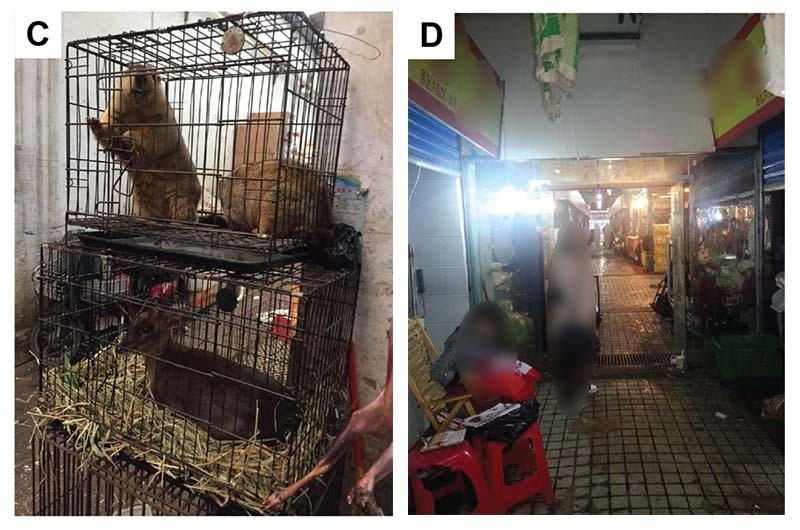
Figure 4: Photos of live animals in cages at the Huanan Seafood Wholesale Market prior to the COVID-19 pandemic. The animals were removed from the market by January 1, 2020.
Dec. 31, 2019: This is the first date on which the Chinese government acknowledges a search for the coronavirus. On this date, scientists from the Chinese Center for Disease Control (CCDC) visited the Huanan market in Wuhan. The visit was prompted by the fact that many of the earliest cases of COVID-19 originated in or around the market. The CCDC scientists took samples and inspected the market.
Jan. 1, 2020: CCDC officials from Beijing visited the Huanan market for an inspection and to collect samples. However, on that date they found that the market had been ordered closed, and that no animals could be found there. In addition, the market was in the process of being disinfected, making it impossible for the Beijing scientists to find evidence for the coronavirus. Dr. Ian Lipkin, an epidemiologist from Columbia University, said that Dr. Gao Fu, head of the CCDC, conveyed this information to Lipkin, who recounted “His [Fu’s] complaint when I met him was that all the animals were gone.” So, already by Jan. 1, 2020 Chinese officials had taken steps that prevented a definitive determination of whether or not the SARS-CoV-2 virus had originated in the Huanan market. It is surmised that either local or higher Chinese government officials were worried about losing their jobs. In 2003, a SARS outbreak was traced back to a Chinese origin. At that point, several officials were fired; however, the firings acknowledged that the disease had originated in China.
Jan. 11, 2020: Chinese scientist Zhang Yongzhen (see Fig. 5) decoded the structure of the SARS-CoV-2 virus on Jan. 5, 2020. Zhang immediately sent a message to Chinese authorities warning that this virus had a high potential for spreading. At that time, he did not publish his results. The following day, Chinese authorities ordered his laboratory closed temporarily. Since this time, Zhang has been under pressure from Chinese authorities. Scientists outside China heard that Zhang had discovered the structure of the coronavirus, and they urged the Chinese to make the sequence public. On Jan. 11, Zhang uploaded the sequence for the new virus, despite the fact that he had not yet received permission to make this public. In March 2020, researchers published more than 200 genetic sequences from COVID-19 samples that were taken from patients at Renmin Hospital in Wuhan on Jan. 30, 2020. However, scientists looking for those sequences could not locate them. It was originally believed that the researchers may have taken down the sequences after pressure from Chinese officials. However, in July 2021 staff at the journal Small, that had originally published the sequences, claimed that they had mistakenly deleted a paragraph that gave a link to those sequences. At that time a link to the sequences was restored. In an update, on April 30, 2024, Zhang Yongzhen was locked out of his laboratory by Chinese officials. At the time of this blog (May 1, 2024) Zhang was sleeping outside his lab in protest of this action. It would appear that Chinese scientists who had released information about the COVID pandemic were continuing to be persecuted by the government.

Figure 5: Dr. Zhang Yongzhen. Dr. Zhang was the first person to decode the structure of the SARS-CoV-2 virus. He notified authorities of this. On Jan. 11, 2020, Zhang uploaded the structure of the coronavirus to the Web, despite the fact that he had not yet received permission from Chinese authorities to release this information.
Feb. 2020: A further visit from WHO to study the pandemic was stage-managed by the Chinese. First, they refused a visa for Dr. Ben Embarek who was the most knowledgeable WHO scientist on animal viruses. Next, the agenda for the visit removed nearly all items relating to a search for the origin of the virus. Dr. Gao Fu, then head of the China CDC and an expert on the origin of viruses, was also left off the schedule for the visit. Instead, epidemiologist Dr. Liang Wannian was named head of the international delegation. Liang had strong connections with top Chinese government officials. Only a few of the members of the international visiting team were allowed to visit Wuhan, as it was then under a lockdown due to the pandemic. Those who visited Wuhan did not visit either the Wuhan Institute of Virology (shown in Fig. 6), nor did they visit the Huanan Seafood Wholesale Market. And Liang urged the WHO scientists on this delegation to express strong praise for China’s response to the pandemic. His efforts were a success, as the final report of the visiting committee stated “It is remarkable how much knowledge about a new virus has been gained in such a short time.”

Figure 6: The Wuhan Institute of Virology. This Institute conducted research on viruses, and it was located not far from the Huanan Seafood Wholesale Market, where many people believe that the COVID-19 pandemic originated.
March 17, 2020: Five prominent virologists – Kristian Andersen from the Scripps Research Institute; Andrew Rambaut from the University of Edinburgh; Ian Lipkin from the Mailman School of Public Health, Columbia University; Edward Holmes from the University of Sydney, Australia; and Robert Garry from Tulane University – co-authored a paper The Proximal Origin of SARS-CoV-2, that was published in Nature Medicine (see Fig. 7). It has turned out to be one of the most widely cited papers in recent scientific history. For this reason, we summarize aspects of the article and of research and communications that preceded it in some detail below. Our summary of this article is closely based on an article, Evolution of a Theory, published by Jimmy Tobias in The Intercept in Jan. 2023. The Nature Medicine paper “has been accessed online more than 5.7 million times and has been cited by more than 2,000 media outlets.”

Figure 7: The paper The Proximal Origin of SARS-CoV-2, by Andersen, Rambaut, Lipkin, Holmes and Garry. It appeared in the Mar. 17, 2020 edition of the journal Nature Medicine, and the paper has been accessed online more than 5.7 million times.
The five virologists concentrated their attention on the structure of the SARS-CoV-2 virus molecule. This molecule, with its characteristic ‘spike’ proteins, is shown schematically in Fig. 8. The virologists were looking for properties of this molecule that were not found in similar coronaviruses, or for properties that would strongly suggest they were ‘engineered’ in a laboratory. A major feature of the Nature Medicine paper was the conclusion by the authors that the virus almost certainly arose through transmission from animals to humans. The authors stated that “our analyses clearly show that SARS-CoV-2 is not a laboratory construct or a purposefully manipulated construct” adding at the end of the paper “We do not believe that any type of laboratory-based scenario is plausible.”
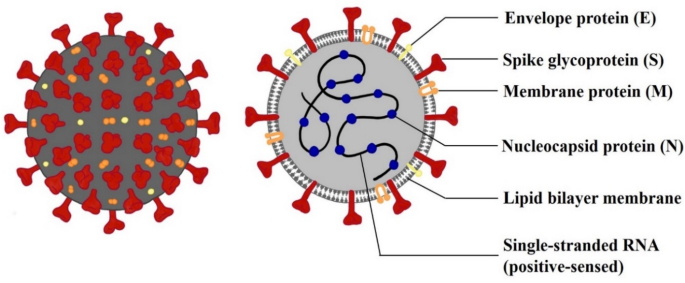
Figure 8: Schematic picture of a molecule of SARS-CoV-2, the virus that causes COVID-19. The molecule shows the characteristic ‘spike’ proteins on the surface of the molecule.
There were essentially three different hypotheses put forth in the paper regarding the coronavirus origin. The first, and a rather striking conspiracy theory, was that the coronavirus was deliberately manufactured in a laboratory and then intentionally released. Such a claim was made in Sept. 2020 by Chinese virologist Li-Meng Yan and three pseudonymous collaborators, in a paper (Fig. 9) titled Unusual Features of the SARS-CoV-2 Genome Suggesting Sophisticated Laboratory Modification Rather Than Natural Evolution and Delineation of Its Probable Synthetic Route. The research was not peer-reviewed and published in a scientific journal; rather it was uploaded on the non-reviewed site Website Zenodo, and was credited to the non-scientific organization Rule of Law Society, a group founded by former Trump advisor Steve Bannon. This group specifically concentrates on material that places the Republic of China in an unfavorable light.

Figure 9: The title page of the paper by Li-Meng Yan on the origin of COVID-19. This paper, which claimed that the coronavirus molecule had been deliberately engineered in a laboratory, was never submitted for peer review.
This theory of Dr. Yan has been widely shared by conspiracy theorists. It was heavily publicized on Fox News during the 2020 presidential campaign, and it was championed by Tucker Carlson at Fox and by Steve Bannon on his own podcast. The allegations by Yan have been viewed millions of times, and the paper continues to circulate on the Web. Because the Yan paper was never peer-reviewed, and because of the serious allegations made in that paper, it has been subsequently reviewed by several virus specialists. A group at the Center for Health Security at Johns Hopkins published a point-by-point refutation of the claims made in the Yan paper. We leave it to our readers to scrutinize the 39 specific comments made by the Johns Hopkins group. They conclude that the Yan paper completely fails to prove its claims, and that many of the assertions in that paper either provide no references to back them up, or they refer to work by people with no expertise in virology.
The MIT Press Online published reviews of the Yan paper by three renowned virologists, Robert Gallo, Takahiko Koyama and Adam Lauring. Each of them independently rated the study as misleading, and wrote that “the manuscript does not demonstrate sufficient scientific evidence to support its claims.” The conclusion reached by all reviewers was that “collectively, reviewers have debunked the authors’ claims that: (1) bat coronaviruses ZC45 or ZXC21 were used as a background strain to engineer SARS-CoV-2, (2) the presence of restriction sites flanking the RBD suggest prior screening for a virus targeting the human ACE2 receptor, and (3) the furin-like cleavage site is unnatural and provides evidence of engineering. In all three cases, the reviewers provide counter-arguments based on peer-reviewed literature and long-established foundational knowledge that directly refute the claims put forth by Yan et al. There was a general consensus that the study’s claims were better explained by potential political motivations rather than scientific integrity.” So the proposal of intentional engineering of COVID-19 in a laboratory has been thoroughly debunked.
A second theory was that the coronavirus may have been the result of laboratory tests involving viruses which gain in function after they are passed repeatedly through lab animals or cell cultures. The virus would then have been released accidentally from a research laboratory. These suppositions were based on speculation that certain features of the SARS-CoV-2 virus seemed unlikely to have arisen through mutations in animals. This hypothesis was examined by S. Yee and collaborators. They concluded that “all these specific features observed in SARS-COV-2 helps scientists to rule out the idea that this pandemic caused by the novel coronavirus is the result of a man-made action that could be either engineered in the laboratory or further created as a bioweapon out of conspiracy.” However, these authors also speculated that the coronavirus may have originated in another country before being transmitted to China. In fact, a WeChat account in China re-posted a theory that the coronavirus had originated in U.S. Army research at the Fort Detrick research laboratory in Maryland. That theory further speculated that the virus had been transmitted to China by American athletes who participated in a 2019 competition in Wuhan.
The third hypothesis, the one favored by Andersen, et al., was that the virus might have arisen through zoonosis, or animal-to-human transmission. This could arise either through direct transmission from a single animal, e.g., a bat, to humans; or it could involve transmission from one animal to another and thence to humans. The conclusion of the Nature Medicine paper seemed to put to rest speculation that the SARS-CoV-2 virus might have originated elsewhere. However, a number of scientists and non-scientists felt that the accidental lab-leak theory had not been ruled out. Their suspicions were heightened after e-mails between Anthony Fauci, Francis Collins and the co-authors of the “Proximal Nature” paper were obtained through Freedom of Information requests. The e-mails showed that the five authors of the Nature Medicine paper initially were suspicious that the coronavirus might have been released from a biological research facility, either deliberately or by accident. In particular, Kristian Andersen of the Scripps Research Institute had expressed a concern that the virus structure contained features that looked as though they had been “engineered.” In an e-mail to Fauci shortly after the researchers began to examine the virus structure closely, Andersen stated that four of the five researchers “find the genome inconsistent with expectations from evolutionary theory.”
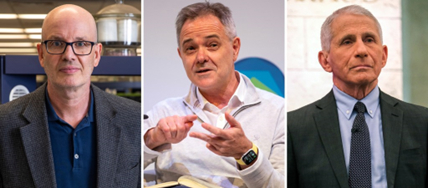
Figure 10: Three virologists who corresponded during the research behind the paper published in Nature Medicine. Left: Dr. Edward Holmes of the University of Sydney, one of the Nature Medicine co-authors; center: Dr. Jeremy Farrar, head of the British Wellcome Trust; right: Dr. Anthony Fauci, at the time the head of the U.S. National Institute for Allergy and Infectious Diseases.
The researchers scrutinized a specific genomic structure called a “furin cleavage site,” a structure that had not been observed in other coronaviruses that were related to SARS. Some outside scientists argued that a furin cleavage site would not represent a “smoking gun” that the SARS-CoV-2 virus had been engineered in a lab. After deliberating for a few days, the scientists studying the structure of the coronavirus concluded that “deliberate engineering” of the virus could be ruled out “with a high degree of confidence.” They relayed their conclusion to three scientists who had urged them to study the virus – Jeremy Farrar, the Director of the Wellcome Trust, Anthony Fauci, at the time the head of the National Institute of Allergy and Infectious Diseases, and Francis Collins, then Director of the National Institutes of Health (NIH). This left two other potential scenarios for the emergence of the virus: either zoonosis or through accidental release from a lab, possibly after “serial passage” of a virus. In serial passage, a virus is repeatedly passed through lab animals and/or cell cultures. Some of these lab animals may have genes altered in order to express some human proteins. Such “gain of function” techniques allow researchers to rapidly select more pathogenic variants of a virus. This technique can produce more dangerous viruses in the laboratory. Researchers can then develop vaccines against this virus. At the same time, serious precautions must be taken to prevent such pathogens from accidentally being released from a lab.
As they were carrying out their research, the researchers on the Nature Medicine paper were told that coronaviruses had been discovered in pangolins in China. Pangolins are endangered animals that are frequently sold in live-animal markets, particularly in Asia; Fig. 11 shows an adult pangolin. Although those viruses lacked the furin cleavage sites, they did possess a number of features very similar to SARS-CoV-2. This news apparently played a major role in convincing the virologists that the zoonosis hypothesis was the most likely one. On March 17, the five scientists published their paper in Nature Medicine. The final summary from the group was now quite strong: “Although the evidence shows that SARS-CoV-2 is not a purposefully manipulated virus, it is currently impossible to prove or disprove the other two theories of its origin described here [i.e., zoonosis or accidental release from a lab]. However, since we observed all notable SARS-CoV-2 features … in related coronaviruses in nature, we do not believe that any type of laboratory-based scenario is plausible.”

Figure 11: A pangolin, an endangered animal that is frequently sold in live-animal markets.
This statement that all types of lab-release scenarios were “not plausible” was taken up by the media, and it was also repeated by many scientists. Even though the Nature Medicine paper specifically stated that it was “impossible to prove or disprove” the animal-to-human origin or the lab-leak hypothesis, the paper was used to downplay any possibility of an accidental lab-leak origin. Those who subscribed to the zoonosis theory praised the group for its thorough study of the situation, while critics accused the authors of having been brow-beaten by Anthony Fauci to arrive at this conclusion. The five authors strongly deny being unduly influenced by Fauci. From reading e-mails exchanged by the authors, Fauci and Farrar, we do not find strong evidence that the authors were swayed by outside influences. In fact, at the beginning of this process Fauci raised the prospect that the scientists might conclude the virus had been deliberately engineered, “if everyone agrees with this concern, they should report it to the appropriate authorities. I would imagine that in the USA this would be the FBI and in the UK it would be MI5.” We accept the claims by these authors that, like good scientists, they considered all the possibilities and eventually settled on their conclusion.
However, in February, 2023 both the US Department of Energy (DOE) and the FBI announced that they had concluded an accidental leak from a virus research laboratory was the most likely origin for the coronavirus. This caused a great deal of concern, both from scientists who felt that the Nature Medicine paper had overstated the case for zoonosis, and from politicians who accused the scientists of deliberately (perhaps even maliciously) downplaying the very real possibility of an inadvertent lab-leak origin for the pandemic. We discuss this further in the Feb. 26, 2023 entry on our timeline. However, the release of e-mails by Jimmy Tobias did show that the authors of the Nature Medicine paper had taken into account political implications of support for a lab-leak hypothesis. For instance, the following sentence appeared in an early draft of the paper. “Basic research involving passage of bat SARS-like [viruses] in cell culture and/or animal models have been ongoing in BSL-2 [BioSafety Level 2 labs, which do not have the most stringent safety protocols] for many years across the world, including in Wuhan.” However, the sentence, with its specific citation of the Wuhan lab, was cut from the final version.
Dr. Andrew Rambaut, one of the co-authors of the Nature Medicine paper, commented in an internal e-mail about the sensitivity to Chinese politics. “Given the shit show that would happen if anyone serious accused the Chinese of even accidental release, my feeling is we should say that given there is no evidence of a specifically engineered virus, we cannot possibly distinguish between natural evolution and escape so we are content with ascribing it to natural processes.” This suggests that the authors may have downplayed the possibility that the origin of COVID could have resulted from an inadvertent lab leak, and that political rather than scientific considerations may have led them to the specific wording in their paper.
Feb. 26, 2023: The Wall Street Journal reported that the U.S. Department of Energy had received new intelligence, leading them to conclude that an accidental leak from the Wuhan Institute of Virology was the most likely cause of the coronavirus pandemic. People noted that the intelligence behind this conclusion was relatively weak and that it was made with “low confidence.” The U.S. national intelligence community (IC) defines this category as “An indication that the information used in the analysis is scant, questionable, fragmented, or that solid analytical conclusions cannot be inferred from the information, or that the IC has significant concerns or problems with the information sources.” The FBI also rates an accidental Wuhan laboratory leak as being the most likely origin of the pandemic, with “moderate confidence.”
However, four other U.S. government entities, together with the National Intelligence Council, believe that the most likely scenario is transmission from animals to humans, probably through the Huanan Seafood Wholesale Market in Wuhan. And none of those groups has changed their assessment in light of the lab-leak claims by the DOE and the FBI. In a report issued in Oct. 2021, the intelligence community indicated that all agencies “assess that two hypotheses are plausible: natural exposure to an infected animal and a laboratory-associated incident.” Lori Robertson produced a very useful summary of this issue for FactCheck.org. She agreed that both the accidental lab-leak and the zoonotic-transmission theories are still plausible and that it is unlikely this issue will ever be definitively settled. However, she quoted two expert researchers regarding the likelihood of animal-to-human transmission.
One of these experts was Michael Worobey from the University of Arizona. Worobey was one of 18 scientists who emphasized in May 2021 that neither hypothesis regarding the origin of COVID could be ruled out. However, Worobey published two articles in July 2022 (here and here) that supported the animal-to-human hypothesis. Those papers pointed out that “The earliest known COVID-19 cases from December 2019 were geographically centered on” the Huanan Seafood Wholesale Market in Wuhan. They concluded “Our analyses indicate that the emergence of SARS-CoV-2 occurred through the live wildlife trade in China and that the Huanan market was the epicenter of the COVID-19 pandemic.” They stated that “Analyses within the market show that SARS-CoV-2-positive environmental samples, including cages, carts, and freezers, were associated with activities concentrated in the southwest corner of the market. This is the same section where vendors were selling live mammals, including raccoon dogs, hog badgers, and red foxes … Multiple positive samples were taken from one stall known to have sold live mammals, and the water drain proximal to this wall … tested positive for SARS-CoV-2.”
Angela Rasmussen, a co-author with Worobey on one of the Science papers, also strongly supported the zoonotic transmission hypothesis. Referring to the DOE assessment, she stated that “The available evidence shows overwhelmingly that the pandemic started at Huanan market via zoonosis.” Dr. Rasmussen claimed to have an open mind on the issue. “One piece of evidence that could change my mind would be conclusive proof that WIV [Wuhan Institute of Virology] possessed a progenitor of SARS-CoV-2.” However, Rasmussen stated “Despite 3 years of a global search for this evidence, it has not materialized, while evidence supporting zoonosis associated with Huanan continues to stack up.”
The question of the origin of COVID-19 then became a political football. This was closely related to the animosity between Anthony Fauci and Donald Trump over the treatment of the pandemic. At the beginning of the pandemic, Trump frequently referred to the virus as the “Chinese flu” or “Kung Flu.” In the early months of 2020, Trump falsely claimed that his actions had successfully prevented the virus from arriving on U.S. soil. A further clash with Fauci occurred when Trump assured his followers that hydroxychloroquine and ivermectin were effective against the virus, and Fauci repeatedly corrected false claims made by Trump (see our blog posts here, here and here on the early history of the coronavirus). As a result of the feud between Trump and Fauci, Republican politicians began a sustained attack on Fauci and his statements about the pandemic.
We generally take Dr. Fauci’s side in these debates. However, Fauci did stress the likelihood that COVID-19 arose from animal-to-human transmission, before the reports were issued by the DOE and the FBI. Many in the scientific community spoke of the lab-leak hypothesis as though it had been determined to be false, rather than a hypothesis that could not be definitively falsified. The U.S. House of Representatives Subcommittee on the Coronavirus Pandemic has been holding hearings about COVID’s origins for a year-and-a-half now. At an April 2024 meeting designed to explore “any potential inappropriate influence exerted by the federal government related to COVID-19 over research publications,” subcommittee chair Brad Wenstrub, Rep. Rich McCormick, and Rep. Marianette Miller-Meeks (all Republicans) lambasted government officials like Fauci and the authors of the Nature Medicine paper, while praising scientists and lawmakers “who had the courage to challenge the government’s preferred narrative about the origin of COVID-19.” The Congressional officials did present evidence that both research scientists and the staff at Nature had exerted influence to make the lab-leak hypothesis seem less plausible, and that the authors of the Nature Medicine article had been in close contact with government scientists, particularly Anthony Fauci. However, from the transcript of the House Subcommittee meeting, it would have been easy to assume that the “brave scientists” who challenged the scientific consensus on the origin of the pandemic had been correct, rather than that the lab-leak hypothesis cannot be ruled out.
March 2023: An international team of virus specialists announced that they had found genetic data from the Huanan Seafood Wholesale Market in Wuhan that connected the coronavirus with raccoon dogs that were for sale in that market. The raccoon dog, shown in Fig. 12, is another creature often sold at live-animal markets. This finding increased the likelihood that the COVID-19 pandemic had originated through transmission from infected animals to humans. The data consisted of swabs that were taken of walls, floors, metal cages and carts at the Huanan market in Jan. 2020. By the time the swabs were taken, all animals had been cleared out of the market, but researchers tested areas where animals had been kept, and material such as cages and carts that had been used to confine and transport live animals.
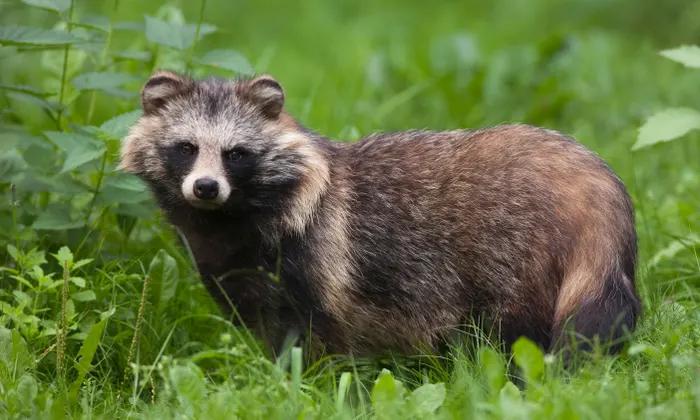
Figure 12: A raccoon dog. This creature is often sold at live-animal markets, particularly in Asia.
An international research team tested samples that had tested positive for COVID-19. They found large amounts of genetic material from raccoon dogs mixed with the virus. This established that material from raccoon dogs “deposited genetic signatures in the same place where genetic material from the virus was left.” The genetic data from the Huanan market “offers some of the most tangible evidence yet of how the virus could have spilled into people from wild animals outside a lab.” This new information certainly tipped the scales further towards the zoonosis hypothesis; and furthermore, it points to raccoon dogs as a likely animal that could have transmitted COVID from animal to human.
However, scientists emphasized that these new results did not prove how the coronavirus originated. First, the fact that genetic material from both the virus and the raccoon dogs was mixed together does not prove that the animal was infected. Next, it is not clear that the raccoon dog passed the virus to humans. Another infected animal or human could have transmitted the virus to the raccoon dog. University of Utah virologist Stephen Goldstein stressed that “We don’t have an infected animal, and we can’t prove definitively there was an infected animal at that stall.” However, evidence linking the origin of the pandemic to the Huanan Seafood Wholesale Market continues to accumulate.
Summary:
There remain several possible explanations for the origin of the COVID-19 pandemic, and also for the location where the pandemic originated. One hypothesis is that the SARS-CoV-2 virus was engineered in a research laboratory and then deliberately released. A paper by Dr. Li-Meng Yan made this claim; similar claims can also be found on Web sites that specialize in conspiracy theories. However, various groups of virologists examined the paper by Dr. Yan, and all groups of medical specialists (particularly one from Johns Hopkins and another from MIT Press Online) rated that paper as seriously misleading. So the Yan paper has been seriously debunked; and we know of no group of serious virus experts who believe that the SARS-CoV-2 virus was deliberately engineered and released.
A second hypothesis is that of zoonosis, or transmission of the virus from animals to humans. Based on the available studies of COVID transmission, that remains the most likely explanation for the origin of the pandemic. However, we do not know what animal transferred the virus to humans. Various animals have been suggested, among them bats, pangolins and raccoon dogs. We have some secondary information (e.g., presence of animal DNA and COVID in samples from raccoon dogs at the Huanan Seafood Wholesale Market in Wuhan). But that does not prove that this was the source of the pandemic.
A third hypothesis is that the virus was developed in research being carried out by a lab that specializes in virus research, and was accidentally released from that facility. A leading candidate is the Wuhan Institute of Virology, which is not far from the Huanan market. In February 2023, the US Department of Energy (DOE) announced that it believed, with “low confidence,” that the origin of the pandemic was due to a virus escaping from a virus research laboratory. The FBI also believes that the pandemic was caused by an inadvertent lab leak, with “moderate confidence.” Unfortunately, neither the DOE nor the FBI released the information on which their judgment was based. We can speculate that they may have information regarding sick workers from a virus research lab. The most probable such institution is the Wuhan Institute of Virology; however, some Chinese have suggested that the coronavirus escaped from the Fort Detrick medical research lab in Maryland. Without this information we cannot assess the probability that these groups are correct. We can only point out that the assessments by both DOE and FBI did not cause any of four other government groups in the U.S., as well as the National Intelligence Council, to change their conclusion that the pandemic most likely arose through zoonosis.
The Associated Press group that studied the history of the COVID-19 virus concluded that we will never know with any certainty the origin of this pandemic. They stated that politics had trumped science here, and that it was now impossible to obtain information that would definitively prove the origin. We agree with this assessment. In particular, government officials in China have prevented scientists from pursuing leads to track down the origin of the pandemic. The first step was to remove all live animals from the Huanan Seafood Wholesale Market, close the market, and disinfect the property. While some of these actions represented an understandable attempt to limit the spread of the disease by quarantine, other actions made it impossible for scientists to acquire information crucial to identifying the source.
For example, in February 2020 the Chinese hosted a delegation from WHO to discuss the disease. However, the Chinese authorities refused to issue a visa to Dr. Peter Ben Embarek, who was at the time the most knowledgeable expert at WHO on animal-borne diseases. The Chinese delegation also did not include Dr. Gao Fu, who was the head of the Chinese CDC and an expert in viruses. The agenda for this meeting included almost no discussion of the origin of the pandemic. As the city of Wuhan was then in lockdown because of the pandemic, almost none of the participants in this conference were able to visit Wuhan. And those who did visit Wuhan were unable to see either the Wuhan Institute of Virology or the Huanan Market. If Chinese authorities have carried out a major search for the origin of the pandemic, they have not shared it with the rest of the world. In fact, Dr. Liang Wannian, the head of the Feb. 2020 conference with WHO, has claimed that COVID was released from Fort Detrick, Maryland, and carried to China by athletes participating in a 2019 competition in Wuhan.
In the U.S., the origin of the pandemic has split along political partisan lines. In March, 2020, five leading virologists published a paper in Nature Medicine that strongly endorsed the idea that the pandemic arose through zoonosis. Their conclusion stated that “We do not believe that any type of laboratory-based scenario is plausible.” This seemed to imply that inadvertent release of the virus from a research lab had been ruled out. Earlier in that paper the authors had admitted that “It is currently impossible to prove or disprove the other two theories of its origin described here [i.e., zoonosis or accidental release from a lab].” Although the authors admitted that they could not rule out the possibility of accidental release, the media (and other scientists) used the paper’s concluding statement to claim that release of the virus from a lab had been ruled out.
The right-wing media have had a field day with the later statements from the DOE and FBI that their information leads them to believe that the most likely cause of the pandemic is accidental release from a research lab. Unfortunately, we do not know what information has caused these agencies to draw this conclusion. We only know that their conclusion differs from the assessment of four other U.S. scientific and intelligence bodies. This leads us to the conclusion drawn by the Associated Press group, namely that we will never be able to pin down the origin of the COVID virus. The only thing we could imagine is that the Chinese government may have information that would definitively answer this question. At present, they certainly are not sharing this with the rest of the world.
This is a shame, as it would be extremely valuable if the pandemic was due to animal-to-human transmission, and we could definitely identify the animal involved and the evolution of the virus as it passed to humans. Alternatively, if we knew for certain that the virus was accidentally released from a scientific establishment, we could review the research that had been undertaken in that lab, and also determine how the virus escaped from the lab. This could cause us to re-evaluate “gain of function” experiments in such laboratories, and to tighten safety requirements in these labs. On the other hand, we should point out that the distance between the two possible origins is not as great as it might appear. Gain-of-function research is in some sense an attempt in the laboratory to accelerate virus evolution by passing naturally occurring viruses through a series of animals. An evolved virus chosen by medical researchers for the purposes of vaccine development might then plausibly occur naturally, as well. The main conclusion of this entire saga ought to be a focus on improving safety protocols both at virology labs and at live-animal markets.
Because politics has trumped science here, we have lost a unique opportunity to study the origin of this pandemic, that has taken over 7 million lives worldwide, and is still evolving and causing infections today.
Source Material:
Worldometer Coronavirus Tracker, https://www.worldometers.info/coronavirus/
Wikipedia, Wuhan Institute of Virology, https://en.wikipedia.org/wiki/Wuhan_Institute_of_Virology
Toxic: How the Search for COVID’s Origins Turned Politically Poisonous, Associated Press, Apr 22, 2024 https://www.medpagetoday.com/infectiousdisease/covid19/109771?xid=nl_mpt_DHE_2024-04-22&eun=g1961082d0r&utm_source=Sailthru&utm_medium=email&utm_campaign=Daily%20Headlines%20Evening%202024-04-22&utm_term=NL_Daily_DHE_dual-gmail-definition
Matt Field, Republicans and Democrats Investigating the Origins of COVID-19 Find a Common Target: Peter Daszak, Bulletin of the Atomic Scientists, May 2, 2024, https://thebulletin.org/2024/05/republicans-and-democrats-investigating-the-origins-of-covid-19-find-a-common-target-peter-daszak/
Jimmy Tobias, Evolution of a Theory, The Intercept, Jan. 19, 2023 https://theintercept.com/2023/01/19/covid-origin-nih-emails/
K.G. Andersen, A. Rambaut, W.I. Lipkin, E.C. Holmes and R.F. Garry, The Proximal Origin of SARS-CoV-2, Nature Medicine Mar. 17, 2020 https://pubmed.ncbi.nlm.nih.gov/32284615/
S. Yee et al., SARS-CoV-2 as an Artificial Creation: Scientific Arguments and Counterarguments, Journal of Medicine and Life 14, 118 (2021) https://www.ncbi.nlm.nih.gov/pmc/articles/PMC7982270/
Research Shows COVID-19 was not Manufactured in a Lab, Associated Press, Sept. 16, 2020 https://apnews.com/article/archive-fact-checking-9391149002
Julian Barnes, Lab Leak Most Likely Caused Pandemic, Energy Dept. Says, New York Times Feb. 26, 2023 https://www.nytimes.com/2023/02/26/us/politics/china-lab-leak-coronavirus-pandemic.html
Lori Robertson, Still No Determination on COVID-19 Origin, FactCheck.org, Mar. 2, 2023 https://www.factcheck.org/2023/03/scicheck-still-no-determination-on-covid-19-origin/
Jesse D. Bloom et al., Investigate the Origins of COVID-19, Science 372, 694 (2021) https://www.ncbi.nlm.nih.gov/pmc/articles/PMC9520851/
Jonathan Pekar et al., The Molecular Epidemiology of Multiple Zoonotic Origins of SARS-CoV-2, Science 377.6609 (2022) https://www.ncbi.nlm.nih.gov/pmc/articles/PMC9348752/pdf/science.abp8337.pdf
Michael Worobey et al., The Huanan Seafood Wholesale Market in Wuhan Was the Early Epicenter of the COVID-19 Pandemic, Science 377.6609 (2022) https://pubmed.ncbi.nlm.nih.gov/35881010/
Benjamin Mueller, New Data Links Pandemic’s Origins to Raccoon Dogs at Wuhan Market, New York Times Mar. 16, 2023 https://www.nytimes.com/2023/03/16/science/covid-wuhan-market-raccoon-dogs-lab-leak.html
Carl Zimmer, Those Virus Sequences That Were Suddenly Deleted? They’re Back, New York Times, July 21, 2021 https://www.nytimes.com/2021/07/30/science/coronavirus-sequences-lab-leak.html
Chinese Scientist Who First Published COVID Sequence Stages Protest After Being Locked Out of Lab, Associated Press Apr. 30, 2024 https://apnews.com/article/covid19-scientist-virus-sequence-protest-laboratory-eviction-b54e2a88610e813c9383833f2c9a2379
Timeline of WHO’s COVID-19 Response https://www.who.int/emergencies/diseases/novel-coronavirus-2019/interactive-timeline#!
Gerry Shih, China Turbocharges Bid to Discredit Western Vaccines, Spread Virus Conspiracy Theories, Washington Post Jan. 20, 2021 https://www.washingtonpost.com/world/asia_pacific/vaccines-coronavirus-china-conspiracy-theories/2021/01/20/89bd3d2a-5a2d-11eb-a849-6f9423a75ffd_story.html
Sheryl Gay Stolberg and Benjamin Mueller, Scientists, Under Fire From Republicans, Defend Fauci and Covid Origins Study, New York Times July 11, 2023 https://www.nytimes.com/2023/07/11/us/politics/covid-lab-leak-fauci.html
Craig Timberg, Scientists Said Claims About China Creating the Coronavirus Were Misleading. They Went Viral Anyway. Washington Post, Feb. 12, 2021 https://www.washingtonpost.com/technology/2021/02/12/china-covid-misinformation-li-meng-yan/
Johns Hopkins Center for Health Security, Response to Yan et al. Pre-Print: Examinations of the Origin of SARS-CoV-2, Sept 21, 2020 https://www.centerforhealthsecurity.org/sites/default/files/2023-02/200921-in-response-yan.pdf
Li-Meng Yan, Shu Kang, Jie Guan, and Shanchang Hu, Unusual Features of the SARS-CoV-2 Genome Suggesting Sophisticated Laboratory Modification Rather Than Natural Evolution and Delineation of Its Probable Synthetic Route. New York: Rule of Law Society and Rule of Law Foundation, 2020 https://zenodo.org/records/4028830
Takahiko Koyama, Adam Lauring, Robert Gallo and Marvin Reitz, Reviews of “Unusual Features of the SARS-CoV-2 Genome Suggesting Sophisticated Laboratory Modification Rather Than Natural Evolution and Delineation of Its Probable Synthetic Route,” MIT Press Online, https://rrid.mitpress.mit.edu/pub/78we86rp/release/2 Wiley Online Library, Small https://onlinelibrary.wiley.com/journal/16136829
 Debunking Denial