
05/11/2026
IV. PROFESSIONAL ORGANIZATION STATEMENTS ABOUT CONVERSION THERAPY
Since 1973, the medical community has rejected the notion that homosexuality is a medical disorder. Physicians have amassed a great deal of data showing that attempts at conversion therapy have produced serious and long-lasting psychological harm to gays. Essentially every medical association now realizes that conversion therapy, either represented by physical methods such as castration, lobotomy, or electro-convulsive therapy, or psychological techniques, are ineffective and they produce permanent physical and emotional trauma. Religious/psychological interventions on minors also produce lasting harm. Here, we reproduce a few of the statements from medical groups that reject all forms of “conversion therapy.” Many of these groups have been successful in convincing state legislatures in the U.S. to ban such practices. We will review the legal situation in Section V.
- American Psychiatric and Medical Association Resolutions
Until 1973, the American Psychiatric Association (APA) listed homosexuality as a “mental disorder.” However, the work of various researchers, particularly Alfred Kinsey among them, argued that homosexuality was normal and not a manifestation of pathological behavior. Beginning in the 1960s, the claim that homosexuality was pathological was also challenged by the growing gay rights movement. In 1973, the board of the APA voted to remove homosexuality as a mental disorder. In 1974 the membership of the APA approved this change. The first edition of the Diagnostic and Statistical Manual of Mental Disorders (DSM) that did not list homosexuality as a mental disorder was in 1974, with the publication of the seventh edition of DSM-II. This edition introduced “sexual orientation disturbance,” a category that referred to people who were upset with their sexual orientation.
Over the intervening years, the term “sexual orientation disturbance” was changed to various other terms, all referring to people who were upset with their sexual orientation. This eventually changed in 2013, when the DSM-5 stopped referring to homosexuality as being the cause of mental disturbances. Over time, a very large number of professional medical organizations have issued statements regarding homosexuality. The APA not only pointed out the harm caused by attempts at conversion therapy, in 2021 they issued a resolution that firmly rejected all forms of sexual orientation change efforts or SOCE aimed at changing homosexual behavior. This 14-page resolution lists the types of SOCE that are currently being offered to minors, and it shows that such efforts are not based on legitimate scientific principles. It points out that sexual orientation diversity is normal and healthy, and it shows the harm perpetuated by such practices. The resolution also lists the ethical and professional concerns that SOCE treatments produce, and it points out that negative SOCE practices violate the principle that psychologists should strive to do no harm to their patients.
In fact, there is abundant evidence, much of it considered in the previous Section, that efforts to change the sexual orientation of LGBTQ+ youth produce harmful outcomes. Researchers at the Family Acceptance Project at San Francisco State University conducted a survey where they examined outcomes for LGBTQ+ youth who were “highly rejected” by their family or caregivers. Comparing them with a similar cohort of LGBTQ+ youth who were not highly rejected, the researchers found outcomes summarized in Figure IV.1. The highly rejected youth were more than 8 times as likely to have attempted suicide; nearly 6 times as likely to report high levels of depression; more than 3 times as likely to use illegal drugs; and more than 3 times as likely to be at high risk for HIV and STDs.
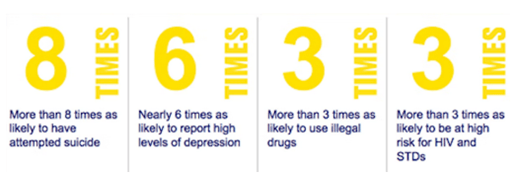
The results of the San Francisco State University study show the psychological trauma inflicted upon LGBTQ+ youth when they are “highly rejected” by their families. And one sign that such young people interpret as high rejection would be receiving pressure from family or clergy to undergo “conversion therapy.” This is one of the reasons that the medical profession is so united in opposing conversion therapy practitioners in their attempts to “get the gay out.”
Organizational Positions on Reparative Therapy
The following are some of many statements by American professional organizations regarding the dangers and impropriety of SOCE efforts to “convert” homosexuals to heterosexual behavior. Many conservative religious groups maintain that homosexuality is not innate but is simply a “lifestyle” adopted by these sexual minorities. Furthermore, they maintain that homosexuality is sinful. Since they claim that this is just a sinful lifestyle adopted by sexual minorities, they justify using sometimes coercive methods such as aversive therapy to alter this behavior.
Declaration on the Impropriety and Dangers of Sexual Orientation and Gender Identity Change Efforts (adopted by a coalition of mental health professionals, educators and advocates):
“We, as national organizations representing millions of licensed medical and mental health care professionals, educators, and advocates, come together to express our professional and scientific consensus on the impropriety, inefficacy, and detriments of practices that seek to change a person’s sexual orientation or gender identity, commonly referred to as “conversion therapy.” We stand firmly together in support of legislative and policy efforts to curtail the unscientific and dangerous practice of sexual orientation and gender identity change efforts.”
American Medical Association
“Our AMA… opposes the use of ‘reparative’ or ‘conversion’ therapy that is based upon the assumption that homosexuality per se is a mental disorder or based upon the a priori assumption that the patient should change his/her homosexual orientation.”
American Psychiatric Association
“… In 1997 APA produced a fact sheet on homosexual and bisexual issues, which states that ‘there is no published scientific evidence supporting the efficacy of ‘reparative therapy’ as a treatment to change one’s sexual orientation.’ The potential risks of ‘reparative therapy’ are great and include depression, anxiety, and self-destructive behavior, since therapist alignment with societal prejudices against homosexuality may reinforce self-hatred already experienced by the patient. Many patients who have undergone ‘reparative therapy’ relate that they were inaccurately told that homosexuals are lonely, unhappy individuals who never achieve acceptance or satisfaction. The possibility that the person might achieve happiness and satisfying interpersonal relationships as a gay man or lesbian are not presented, nor are alternative approaches to dealing with the effects of societal stigmatization discussed…
Therefore, APA opposes any psychiatric treatment, such as ‘reparative’ or ‘conversion’ therapy, that is based on the assumption that homosexuality per se is a mental disorder or is based on the a priori assumption that the patient should change his or her homosexual orientation.”
American Psychological Association
“THEREFORE, BE IT RESOLVED, That the American Psychological Association affirms that same-sex sexual and romantic attractions, feelings, and behaviors are normal and positive variations of human sexuality regardless of sexual orientation identity;
BE IT FURTHER RESOLVED, That the American Psychological Association reaffirms its position that homosexuality per se is not a mental disorder and opposes portrayals of sexual minority youths and adults as mentally ill due to their sexual orientation;
BE IT FURTHER RESOLVED, That the American Psychological Association concludes that there is insufficient evidence to support the use of psychological interventions to change sexual orientation;
BE IT FURTHER RESOLVED, That the American Psychological Association encourages mental health professionals to avoid misrepresenting the efficacy of sexual orientation change efforts by promoting or promising change in sexual orientation when providing assistance to individuals distressed by their own or others’ sexual orientation…”
Just the Facts Coalition (American Academy of Pediatrics, American Association of School Administrators, American Counseling Association, American Federation of Teachers, American Psychological Association, American School Counselor Association, American School Health Association, Interfaith Alliance Foundation, National Association of School Psychologists, National Association of Secondary School Principals, National Association of Social Workers, National Education Association, School Social Work Association of America)
“The most important fact about ‘reparative therapy,’ also sometimes known as ‘conversion’ therapy, is that it is based on an understanding of homosexuality that has been rejected by all the major health and mental health professions. The American Academy of Pediatrics, the American Counseling Association, the American Psychiatric Association, the American Psychological Association, the National Association of School Psychologists, and the National Association of Social Workers, together representing more than 477,000 health and mental health professionals, have all taken the position that homosexuality is not a mental disorder and thus there is no need for a ‘cure.‘”
American College of Physicians “The College opposes the use of “conversion,” “reorientation,” or “reparative” therapy for the treatment of LGBTQ persons.”
American Association for Marriage and Family Therapy
“[T]he association does not consider homosexuality a disorder that requires treatment, and as such, we see no basis for [reparative therapy]. AAMFT expects its members to practice based on the best research and clinical evidence available.”
American Academy of Pediatrics
“Confusion about sexual orientation is not unusual during adolescence. Counseling may be helpful for young people who are uncertain about their sexual orientation or for those who are uncertain about how to express their sexuality and might profit from an attempt at clarification through a counseling or psychotherapeutic initiative. Therapy directed specifically at changing sexual orientation is contraindicated, since it can provoke guilt and anxiety while having little or no potential for achieving changes in orientation.”
B. Statements from physician groups in other countries
World Psychiatric Association
“There is no sound scientific evidence that innate sexual orientation can be changed. Furthermore, so-called treatments of homosexuality can create a setting in which prejudice and discrimination flourish, and they can be potentially harmful (Rao and Jacob 2012). The provision of any intervention purporting to “treat” something that is not a disorder is wholly unethical…The WPA considers same-sex attraction, orientation, and behavior as normal variants of human sexuality. It recognizes the multi-factorial causation of human sexuality, orientation, behavior, and lifestyle. It acknowledges the lack of scientific efficacy of treatments that attempt to change sexual orientation and highlights the harm and adverse effects of such ‘therapies’.”
C. Human Rights Concerns
Around the world, there is an increasing understanding that conversion therapy violates the human rights of young people coerced into this treatment. In 2020 Victor Borloz, the UN Independent Expert on sexual orientation and gender identity, stated that in his opinion, conversion therapy practices are “inherently discriminatory, that they are cruel, inhuman and degrading treatment, and that depending on the severity or physical or mental pain and suffering inflicted to the victim, they may amount to torture.” That same year the International Rehabilitation Council for Torture Victims stated that conversion therapy is torture.
In recent years there have been repeated calls for the European Union to ban conversion therapy for all of its member states, based on arguments that conversion therapy violated the EU prohibition against degrading treatment. In May 2024 a European Citizens Initiative began collecting signatures calling for the EU to ban this practice. At present, several individual member states of the EU have banned conversion therapy (see Section V), and other states have issued guidelines that discourage this practice but don’t ban it altogether. At the present time (April 2026), momentum is developing for the European Union to ban conversion therapy, at least for youth, for all member states.
V. LEGAL STATUS
In light of the overwhelming consensus among medical, psychological, and human rights organizations around the world that sexual orientation and gender identity change efforts are based on false premises, ineffective, and often quite harmful, many countries, U.S. states, and cities have adopted bans on these change effort practices. Countries with comprehensive bans including criminal penalties on conversion therapy practiced by any person, not only medical professionals, include Belgium, Canada, Cyprus, Ecuador, France, Germany, Greece, Iceland, Malta, Mexico, New Zealand, Norway, Portugal, and Spain. Additional countries that have health-sector regulations prohibiting healthcare providers from performing conversion therapy include Albania, Brazil, Chile, India, Israel, Taiwan, and Vietnam.
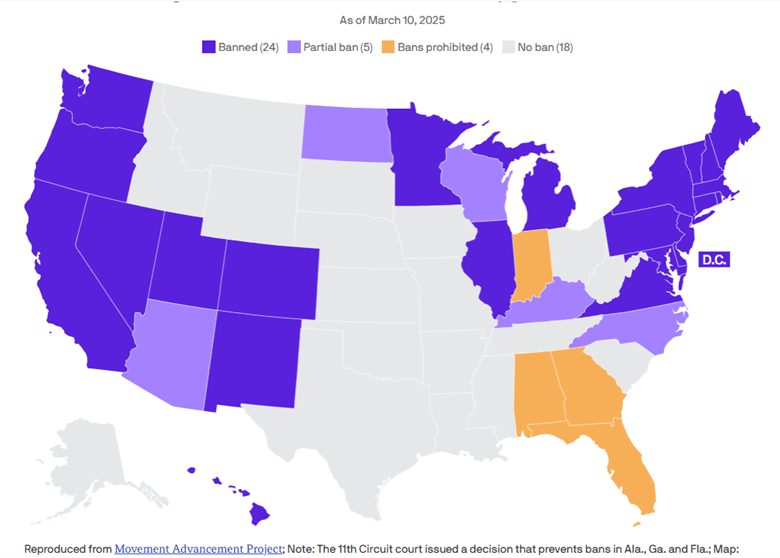
In Australia and the U.S. it is left for states and territories to consider bans on the practice. The status of bans specifically for minor patients in the U.S., as of March 2025, is summarized in Fig. V.1. In the U.S. to date 23 states plus the District of Columbia and Puerto Rico have enacted laws or regulations protecting youth from conversion therapy modalities provided by licensed professionals. The Human Rights Campaign notes that “Eight of these state laws or regulations were enacted under Republican governors. A growing number of municipalities have also enacted similar protections, including at least 70 cities and counties in Arizona, Colorado, Florida, Georgia, Iowa, Kentucky, Michigan, Minnesota, Missouri, New York, Ohio, Pennsylvania, Washington and Wisconsin.”
On at least six occasions lawsuits against state bans have reached the Supreme Court of the United States (SCOTUS). In 2015 and 2019 the Third Circuit Court of Appeals upheld New Jersey’s ban on SOCE practices. In the 2015 ruling the Appeals Court wrote that: “There is no medically valid basis for attempting to prevent homosexuality, which is not an illness.” Also: “The fundamental rights of parents do not include the right to choose a … mental health treatment that the state has reasonably deemed harmful.” In its 2019 ruling the Appeals Court directly addressed the question of First Amendment free speech rights in the context of SOCE: “[T]he verbal communication that occurs during SOCE counseling is speech that enjoys some degree of protection under the First Amendment… Because Plaintiffs are speaking as state-licensed professionals within the confines of a professional relationship, however, this level of protection is diminished.” The Appeals Court decisions were further appealed to SCOTUS in May 2015, February 2016, and April 2019. On each occasion, SCOTUS refused to hear the challenges, thereby upholding the 3rd Circuit rulings.
The Ninth Circuit Court of Appeals has similarly twice upheld California bans on conversion therapy practices, in 2013 and 2016. Again, SCOTUS refused to hear challenges to the 9th Circuit rulings in June 2014 and May 2017. However, the seeds of the SCOTUS adverse ruling in March 2026 in Chiles v. Salazar were planted in a different SCOTUS ruling with respect to a different California law regulating crisis pregnancy centers. In the 2013 conversion therapy ruling the 9th Circuit said the following: “California has authority to prohibit licensed mental health providers from administering therapies that the legislature has deemed harmful, and … the fact that speech may be used to carry out those therapies does not turn the prohibitions of conduct into prohibitions of speech. … We further conclude that the First Amendment does not prevent a state from regulating treatment even when that treatment is performed through speech alone.” In the 2018 case National Institute of Family and Life Advocates v. Becerra SCOTUS picked up on a similar argument distinguishing conduct from speech made by the 9th Circuit. SCOTUS interpreted that argument as establishing a new category of “professional speech” and it ruled that SCOTUS: “had not recognized ‘professional speech’ as a separate category of speech” and therefore attempted bans on professional speech were still subject to the judicial standard of “strict scrutiny.”
Strict scrutiny applies whenever a fundamental Constitutionally guaranteed right is restricted by a government law. The government is then required to demonstrate that the law or regulation is needed to achieve a “compelling state interest” and does so in the “least restrictive means” needed to achieve that goal. In 2020 the Eleventh Circuit Court of Appeals applied strict scrutiny to rule that SOCE prohibitions passed by the city of Boca Raton and Palm Beach County, Florida were unconstitutional restrictions of free speech. The ruling uses the following questionable logic (with our added emphasis): “Whether therapy is prohibited depends only on the content of the words used in that therapy, and the ban on that content is because the government disagrees with it. And whether the government’s disagreement is for good reasons, great reasons, or terrible reasons has nothing at all to do with it. All that matters is that a therapist’s speech to a minor client is legal or illegal under the ordinances based solely on its content.” Preventing well-documented psychological harm to minors that often results in suicide attempts (see Fig. III.3), with consequent drains on public funds, seems to us a “legitimate state interest.” One of the primary responsibilities of governments is to protect the safety of their citizens. The Court’s statement that government’s reasons for such a ban are irrelevant to the discussion of free speech rights is itself a violation of the strict scrutiny standard.
SCOTUS has now taken up the issue of SOCE bans because the various Appeals Courts seem to disagree with one another on the appropriate standards to apply. In Chiles v. Salazar SCOTUS has now remanded the suit against Colorado’s ban on SOCE for minors back to the Tenth Circuit Court of Appeals to reconsider the ban on “talk therapy” subject to the strict scrutiny standard. However, the majority ruling leaves little doubt about where SCOTUS currently stands on this issue: “A prevailing standard of care may reflect what most practitioners believe today, but it cannot mark the outer boundary of what they may say tomorrow… We do not doubt that the question ‘how best to help minors’ struggling with issues of gender identity or sexual orientation is presently a subject of ‘fierce public debate.’.. But the First Amendment stands as a shield against any effort to enforce orthodoxy in thought or speech in this country. It reflects instead a judgment that every American possesses an inalienable right to think and speak freely, and a faith in the free marketplace of ideas as the best means for discovering truth. However well-intentioned, any law that suppresses speech based on viewpoint represents an ‘egregious’ assault on both of those commitments.”
We note that the “free marketplace of ideas,” when it involves every American offering their own opinions freely, cannot be the means to establish scientific truth. It is not yet definitively proven that sexual orientation is an immutable characteristic of humans. But the frequent occurrence of significant psychological harm, including suicidal ideation, among minors subjected to SOCE or GICE, seems to us quite well established by now.
The Chiles ruling notes that: “this Court has recognized a ‘few historic and traditional categories of expression long familiar to the bar’ where content-based restrictions on speech will not automatically trigger strict scrutiny—categories that include fraud, defamation, and ‘fighting words.’” Presumably under the “fighting words” restriction, U.S. courts have upheld state anti-bullying laws, including prohibitions of cyber-bullying, which is certainly a form of speech. In our view, having an adult in a position of authority work to convince a minor, who may well not be in the counseling of their own volition, that they can change their sexual orientation, when there is no convincing evidence that is possible, is a form of professional bullying and is contributing to a current U.S. crisis with elevated youth suicide rates. Unfortunately, mental health therapists do not adopt the Hippocratic Oath’s implication to “first, do no harm.”
If the Tenth Circuit follows the lead SCOTUS has laid down, many existing state laws regarding sexual orientation and gender identity change efforts will likely have to be rewritten. We hope that will be possible without increasing suicide attempts among LGBTQ+ youth.
VI. SUMMARY
The neuroscience of human sexual attraction and gender identity are topics of vigorous ongoing research. The best information available to date from brain imaging on subjects responding to sexual stimuli indicates that the brain sections most activated in determining sexual attraction reside in the limbic system and do not appear to involve cognitive (cerebral cortex) monitoring. Those results suggest that sexual attraction may be inborn, resulting from variations in fetal brain development. Similarly, fetal brain development variations, particularly in the connective tissue within the brain, are implicated in cases of gender dysphoria and transgender identity.
Partially as a result of such neuroscience studies, psychiatric views of homosexuality and gender dysphoria have shifted away over the past half-century from characterizing them as psychological disorders. The vast majority of psychiatrists and psychologists today view same-sex attractions and gender identity issues as occupying a natural portion of the spectrum of human sexual identity, as revealed in many official statements from medical and psychological organizations summarized in Section IV of this post. In contrast, some conservative religious organizations and a very small fraction of psychotherapists still view these conditions as unnatural or sinful feelings and behavior that may have been caused by early childhood trauma or social influences, such as “grooming” by adult homosexuals. These groups have been behind sexual orientation (SOCE) and gender identity (GICE) change efforts. Rather appalling physical and coercive change efforts used throughout the 20th century have largely by now fallen by the wayside. But many efforts to alter sexual orientation or gender identity through forms of counseling, such as “reparative therapy” or “regenerative therapy,” are still practiced relatively widely in the U.S.
While proponents of SOGICE have made many claims in the literature that their methods have resulted in actual change, there is no convincing evidence to back up such claims. The results reported almost always rely on self-reporting of change, often in subject reconstructions after the fact, among patients who are highly motivated to report such improvements. Many of these “experiments” have seen significant dropout rates of subjects throughout the counseling or later evaluations of results, and little attention is paid to the reasons for the dropouts, nor are they included in final statistics reporting successful change. The few studies that were done in the 20th century to test male penile response to sexual stimuli after allegedly successful SOCE “treatments” have refuted claims of orientation change.
On the other hand, many studies of individuals who have gone through SOGICE “treatments” have documented serious psychological risks of the procedures. Depression, anxiety, and suicidal tendencies have resulted among patients who expected to change their sexual attraction but did not, or who felt rejected by their family or their church or their counselors, or who suffered a loss of sexual desire and deterioration in relationships as a result of cognitive-behavioral or aversive “therapies.” The suicide risks are especially high among LGBTQ+ youth who have been subjected, often at the insistence of their families or churches, to SOGICE. Research thus suggests that the risks far outweigh any benefits of these efforts. Consequently, there has been widespread condemnation of “conversion therapy” in recent years. The risk of psychological harm seems to be reduced by “affirmative psychotherapy” aimed at helping individuals to come to terms with their homosexuality or gender identity, to cope with its effects on their standing within family, church, or peer group, and to live satisfying lives.
Many countries and U.S. states have enacted bans on SOGICE approaches, particularly for minor patients. However, the March 2026 U.S. Supreme Court decision in Chiles v. Salazar has called such bans into question when they restrict “talk therapy,” which may be protected speech under the First Amendment. The Supreme Court thus remanded consideration of Colorado’s ban on conversion therapy for minors back to the Tenth Circuit Court of Appeals to weigh the ban on “talk therapy” specifically against the “strict scrutiny” judicial standard. If the Tenth Circuit finds that under this standard the ban is unconstitutional, many states may have to rewrite their laws to avoid what the courts determine to be restrictions on protected speech.
REFERENCES:
J.M. Bailey, et al., Sexual Orientation, Controversy, and Science, Psychological Science in the Public Interest 17, 45 (2016), https://www.researchgate.net/publication/301639075_Sexual_Orientation_Controversy_and_Science
American Psychological Association, Appropriate Therapeutic Responses to Sexual Orientation, August 2009, https://www.apa.org/pi/lgbt/resources/therapeutic-response.pdf
J.M. Glassgold, Research on Sexual Orientation Change Efforts: A Summary, in D.C. Haldeman (Ed.), The Case Against Conversion “Therapy”: Evidence, Ethics, and Alternatives (American Psychological Association, 2022), https://psycnet.apa.org/record/2021-98492-002
A. Przeworski, E. Peterson, and A. Piedra, A Systematic Review of the Efficacy, Harmful Effects, and Ethical Issues Related to Sexual Orientation Change Efforts, Clinical Psychology: Science and Practice 28, 81 (2021), https://psycnet.apa.org/doiLanding?doi=10.1111%2Fcpsp.12377
Wikipedia, Conversion Therapy, https://en.wikipedia.org/wiki/Conversion_therapy
American Psychological Association, The Evidence Against “Conversion Therapy,” https://www.apa.org/topics/lgbtq/evidence-against-conversion-therapy
Psychology Today, Conversion Therapy, https://www.psychologytoday.com/us/basics/conversion-therapy?msockid=1a3d5c52c50361ea28674ac9c4586058
Human Rights Commission, The Lies and Dangers of Efforts to Change Sexual Orientation or Gender Identity, https://www.hrc.org/resources/the-lies-and-dangers-of-reparative-therapy
Supreme Court of the United States, Chiles v. Salazar, March 31, 2026, https://www.supremecourt.gov/opinions/25pdf/24-539_fd9g.pdf
Alliance for Therapeutic Choice and Scientific Integrity, https://www.therapeuticchoice.com/
The Journal of Human Sexuality, https://www.journalofhumansexuality.com/
R.C. Savin-Williams and Z. Vrangalova, Mostly Heterosexual as a Distinct Sexual Orientation Group: A Systematic Review of the Empirical Evidence, Developmental Review 33, 58 (2013), https://www.sciencedirect.com/science/article/abs/pii/S0273229713000026
J. Graves, Born This Way? An Evolutionary View of ‘Gay Genes’, The Conversation, June 2, 2014, https://theconversation.com/born-this-way-an-evolutionary-view-of-gay-genes-26051
A. Camperio-Ciani, F. Corna, and C. Capiluppi, Evidence for Maternally Inherited Factors Favouring Male Homosexuality and Promoting Female Fecundity, Proceedings: Biological Sciences 271, 2217 (2004), https://pubmed.ncbi.nlm.nih.gov/15539346/
J.G. Pfaus, L.A. Scepkowski, L. Marson, and J.R. Georgiadis, Biology of the Sexual Response, in D.L. Tolman, et al. (Eds.), APA Handbook of Sexuality and Psychology, Vol. 1: Person-Based Approaches (2014), https://psycnet.apa.org/record/2013-05866-007
T.M. Poeppl, et al., A Neural Circuit Encoding Sexual Preference in Humans, Neuroscience and Biobehavioral Reviews 68, 530 (2016), https://www.sciencedirect.com/science/article/abs/pii/S0149763416302342
M. Votinov, et al., Brain Structure Changes Associated with Sexual Orientation, Scientific Reports 11, article # 5078 (2021), https://www.nature.com/articles/s41598-021-84496-z
T.M. Poeppl, B. Langguth, A.R. Laird, and S.B. Eikhoff, The Functional Neuroanatomy of Male Psychosexual and Physiosexual Arousal: A Quantitative Meta-Analysis, Human Brain Mapping 35, 1404 (2013), https://pmc.ncbi.nlm.nih.gov/articles/PMC4981637/
D. Soh, The End of Gender (Simon & Schuster, 2021), https://www.simonandschuster.com/books/The-End-of-Gender/Debra-Soh/9781982132521
C.L. Henley, A.A. Nunez, and L.G. Clemens, Hormones of Choice: The Neuroendocrinology of Partner Preference in Animals, Frontiers in Neuroendocrinology 32, 146 (2011), https://www.sciencedirect.com/science/article/abs/pii/S0091302211000288
J.A. Smith, Oscar Wilde is Convicted of Gross Indecency, https://www.ebsco.com/research-starters/social-sciences-and-humanities/oscar-wilde-convicted-gross-indecency
E. Meisfjord, The Tragic Conviction of Alan Turing, https://www.grunge.com/227345/the-tragic-conviction-of-alan-turing/
Wikipedia, Sigmund Freud, https://en.wikipedia.org/wiki/Sigmund_Freud
Wikipedia, History of Conversion Therapy, https://en.wikipedia.org/wiki/History_of_conversion_therapy
Wikipedia, Melanie Klein, https://en.wikipedia.org/wiki/Melanie_Klein
Wikipedia, Anna Freud, https://en.wikipedia.org/wiki/Anna_Freud
Wikipedia, Edmund Bergler, https://en.wikipedia.org/wiki/Edmund_Bergler
Wikipedia, Alfred Kinsey, https://en.wikipedia.org/wiki/Alfred_Kinsey
Wikipedia, Eugen Steinach, https://en.wikipedia.org/wiki/Eugen_Steinach
Cleveland Clinic, Chemical Castration, https://my.clevelandclinic.org/health/procedures/22402-chemical-castration
K. Davidson, et al., An Inclusive History of LGBTQ+ Aversion Therapy: Past Harms and Future Address in a UK Context, Review of General Psychology 29, 33 (2024), https://journals.sagepub.com/doi/10.1177/10892680241289904
The Trevor Project, Facts About Suicide Among LGBTQ+ People, Dec. 15, 2021, https://www.thetrevorproject.org/resources/article/facts-about-lgbtq-youth-suicide/
Wikipedia, Lobotomy, https://en.wikipedia.org/wiki/Lobotomy
Wikipedia, Walter Jackson Freeman II, https://en.wikipedia.org/wiki/Walter_Jackson_Freeman_II
Wikipedia, Orbitoclast, https://en.wikipedia.org/wiki/Orbitoclast
Wikipedia, Norbert Wiener, https://en.wikipedia.org/wiki/Norbert_Wiener
Wikipedia, Electroconvulsive Therapy, https://en.wikipedia.org/wiki/Electroconvulsive_therapy
American Psychological Association, APA Resolution on Sexual Orientation Change Efforts, February 2021, https://www.apa.org/about/policy/resolution-sexual-orientation-change-efforts.pdf
Conversion “Therapy” Laws, https://mapresearch.org/equality-map/conversion-therapy-laws/#
Wikipedia, Garrard Conley, https://en.wikipedia.org/wiki/Garrard_Conley
Wikipedia, Boy Erased: A Memoir, https://en.wikipedia.org/wiki/Boy_Erased:_A_Memoir
The Trevor Project, It’s Still Happening: A Report on Practitioners of So-Called Conversion “Therapy” in the U.S. (2023), https://storage.googleapis.com/trevor-web-public/2023/12/FINAL_Its-Still-Happening-Report.pdf
M. Higbee, E.R. Wright, R.M. Roemerman, Conversion Therapy in the Southern United States: Prevalence and Experiences of the Survivors, Journal of Homosexuality 69, 612 (2022), https://www.tandfonline.com/doi/full/10.1080/00918369.2020.1840213
Harvard Civil Rights-Civil Liberties Law Review, “Reparative Therapy” is Legal for Adults. Here’s Why it Shouldn’t Be, https://journals.law.harvard.edu/crcl/reparative-therapy-is-legal-for-adults-heres-why-it-shouldnt-be/
Joseph Nicolosi, https://www.josephnicolosi.com/
R.L. Spitzer, Can Some Gay Men and Lesbians Change Their Sexual Orientation? 200 Participants Reporting a Change from Homosexual to Heterosexual Orientation, Archives of Sexual Behavior 32, 403 (2003), https://link.springer.com/article/10.1023/A:1025647527010
B. Carey, Psychiatry Giant Sorry for Backing Gay ‘Cure’, New York Times, May 18, 2012, https://www.nytimes.com/2012/05/19/health/dr-robert-l-spitzer-noted-psychiatrist-apologizes-for-study-on-gay-cure.html
J.M. Becker, EXCLUSIVE: Dr. Robert Spitzer Apologizes to Gay Community for Infamous ‘Ex-Gay’ Study, Truth Wins Out, April 25, 2012, https://archive.truthwinsout.org/news/2012/04/24542/
C. Pela and P. Sutton, Sexual Attraction Fluidity and Well-Being in Men: A Therapeutic Outcome Study, Journal of Human Sexuality 12, 61 (2021), https://www.journalofhumansexuality.com/_files/ugd/ec16e9_d0708a0dc82e4da78e0258eb96dc1467.pdf
Reintegrative Therapy Association, https://www.reintegrativetherapy.com/about-us/
B. Fitzpatrick, Opinion: Legal Bans Won’t Stop Conversion Therapy, GCN, April 19, 2019, https://gcn.ie/opinion-legal-bans-conversion-therapy/
Wikipedia, Penile Plethysmography, https://en.wikipedia.org/wiki/Penile_plethysmography
Wikipedia, Kurt Freund, https://en.wikipedia.org/wiki/Kurt_Freund
S.R. Conrad and J.P. Wincze, Orgasmic Reconditioning: A Controlled Study of Its Effects Upon the Sexual Arousal and Behavior of Adult Male Homosexuals, Behavior Therapy 7, 155 (1976), https://www.sciencedirect.com/science/article/abs/pii/S0005789476802717
J. Attard-Johnson, et al., Measurement of Sexual Interests with Pupillary Responses: A Meta-Analysis, Archives of Sexual Behavior 50, 3385 (2021), https://link.springer.com/article/10.1007/s10508-021-02137-y
60 Minutes Australia, Former Gay Conversion Therapist Says Practice Does Not Work, https://www.youtube.com/watch?v=BdzgqRGdzUY
S. Prasad, Boy Erased: Is Love in Action a Real Organization? Does it Still Exist?, The Cinemaholic, Aug. 16, 2023, https://thecinemaholic.com/boy-erased-is-love-in-action-a-real-organization-does-it-still-exist/
Wikipedia, Restoration Path, https://en.wikipedia.org/wiki/Restoration_Path
K. Bradshaw, et al., Sexual Orientation Change Efforts Through Psychotherapy for LGBQ Individuals Affiliated with the Church of Jesus Christ of Latter-Day Saints, Journal of Sex and Marital Therapy 41, 391 (2015), https://psycnet.apa.org/record/2015-17735-006
J.R. Blosnich, et al., Sexual Orientation Change Efforts, Adverse Childhood Experiences, and Suicide Ideation and Attempt Among Sexual Minority Adults, United States, 2016-2018, American Journal of Public Health 110, 1024 (2020), https://ajph.aphapublications.org/doi/10.2105/AJPH.2020.305637
T. Salway, et al., Prevalence of Exposure to Sexual Orientation Change Efforts and Associated Sociodemographic Characteristics and Psychosocial Health Outcomes Among Canadian Sexual Minority Men, Canadian Journal of Psychiatry 65, 502 (2020), https://journals.sagepub.com/doi/10.1177/0706743720902629
A.E. Green, M. Price-Feeney, S.H. Dorison, and C.J. Pick, Self-Reported Conversion Efforts and Suicidality Among US LGBTQ Youths and Young Adults, 2018, American Journal of Public Health 110, 1221 (2020), https://ajph.aphapublications.org/doi/abs/10.2105/AJPH.2020.305701
C. Ryan, D. Huebner, R.M. Diaz, and J. Sanchez, Family Rejection as a Predictor of Negative Health Outcomes in White and Latino Lesbian, Gay, and Bisexual Young Adults, Pediatrics 123, 346 (2009), https://publications.aap.org/pediatrics/article-abstract/123/1/346/71912/Family-Rejection-as-a-Predictor-of-Negative-Health
J.N. Fish and S.T. Russell, Sexual Orientation and Gender Identity Change Efforts are Unethical and Harmful, American Journal of Public Health 110, 1113 (2020), https://pmc.ncbi.nlm.nih.gov/articles/PMC7349462/
J.M. Cantor, How Many Transgender Kids Grow Up to Stay Trans?, PsyPost, Dec. 30, 2017, https://www.psypost.org/many-transgender-kids-grow-stay-trans/
The Trevor Project, 2024 U.S. National Survey on the Mental Health of LGBTQ+ Young People, https://www.thetrevorproject.org/survey-2024/
The Trevor Project, Time Since Exposure to Conversion Therapy and Suicidal Thoughts and Behaviors Among LGBTQ+ Young People, Feb. 18, 2026, https://www.thetrevorproject.org/research-briefs/time-since-exposure-to-conversion-therapy-and-suicidal-thoughts-and-behaviors-among-lgbtq-young-people/
Healio, Conversion Therapy Significantly Associated with Adverse Cardiovascular Effects, May 9, 2025, https://www.healio.com/news/primary-care/20250509/conversion-therapy-significantly-associated-with-adverse-cardiovascular-effects
J.K. Gibb, et al., Conversion Therapy Exposure and Elevated Cardiovascular Disease Risk, JAMA Network Open 8, e258745 (2025), https://jamanetwork.com/journals/jamanetworkopen/fullarticle/2833579
Psychology Today, Affirmative Therapy, https://www.psychologytoday.com/us/therapy-types/affirmative-therapy
J.E. Pachankis, et al., LGB-Affirmative Cognitive-Behavioral Therapy for Young Adult Gay and Bisexual Men: A Randomized Controlled Trial of a Transdiagnostic Minority Stress Approach, Journal of Consulting and Clinical Psychology 83, 875 (2015), https://psycnet.apa.org/doiLanding?doi=10.1037%2Fccp0000037
J. Burger and J.E. Pachankis, State of the Science: LGBTQ-Affirmative Psychotherapy, Behavior Therapy 55, 1318 (2024), https://www.sciencedirect.com/science/article/pii/S0005789424000352#b0470
The Curbsiders, Gender Affirming Care, April 14, 2021, https://thecurbsiders.com/cribsiders-podcast/23-gac
Wikipedia, Homosexuality in the DSM, https://en.wikipedia.org/wiki/Homosexuality_in_the_DSM
Family Acceptance Project, https://familyproject.sfsu.edu/
American Medical Association, Policies on Lesbian, Gay, Bisexual, Transgender & Queer (LGBTQ) Issues, https://www.ama-assn.org/public-health/population-health/policies-lesbian-gay-bisexual-transgender-queer-lgbtq-issues
American Psychiatric Association, Position Statement on Conversion Therapy and LGBTQ+ Patients, July 2024, https://www.psychiatry.org/getattachment/3d23f2f4-1497-4537-b4de-fe32fe8761bf/Position-Conversion-Therapy.pdf
Just The Facts Coalition, Just the Facts About Sexual Orientation and Youth, https://www.apa.org/pi/lgbt/resources/just-the-facts.pdf
American College of Physicians, Lesbian, Gay, Bisexual, and Transgender Health Disparities: Executive Summary of a Policy Position Paper from the American College of Physicians, https://www.acponline.org/sites/default/files/acp-policy-library/policies/lgbt_health_disparities_2015.pdf
American Association for Marriage and Family Therapy, AAMFT Position Statements and Amicus Briefs, https://www.aamft.org/About_AAMFT/Pos_on_couples.aspx
American Academy of Pediatrics, Homosexuality and Adolescence, https://publications.aap.org/pediatrics/article-abstract/72/2/249/74864/Homosexuality-and-Adolescence
World Psychiatric Association, WPA Position Statement on Gender Identity and Same-Sex Orientation, Attraction, and Behaviours, Sept. 2023, https://www.wpanet.org/wp-content/uploads/2025/09/2.GA23.10.2-Gender-identity-Position-Statement-10.8.23.pdf
A. Lotz, Supreme Court Will Hear Challenge to Colorado Conversion Therapy Ban, Axios, March 10, 2025, https://www.axios.com/2025/03/10/supreme-court-conversion-therapy-challenge
J.W. Belle Isle, The 3rd Circuit U.S. Court of Appeals Upheld the Ban on “Gay Conversion Therapy” in New Jersey, Legal Reader, Apr. 17, 2015, https://www.legalreader.com/the-3rd-circuit-u-s-court-of-appeals-upheld-the-ban-on-gay-conversion-therapy-in-new-jersey/
W. Peacock, N.J.’s Conversion Therapy Ban Stands: 3rd Cir., FindLaw, Mar. 21, 2019, https://www.findlaw.com/legalblogs/third-circuit/njs-gay-conversion-therapy-ban-stands-3rd-cir/
D. Cassens Weiss, 9th Circuit Upholds California Ban on ‘Conversion Therapy’ for Gay Youths, ABA Journal, Aug. 30, 2013, https://www.abajournal.com/news/article/9th_circuit_upholds_california_ban_on_conversion_therapy_for_gay_youths
M. Dinzeo, Gay Conversion Therapy Ban Upheld by 9th Circ., Courthouse News Service, Aug. 23, 2016, https://www.courthousenews.com/gay-conversion-therapy-ban-upheld-by-9th-circ/
Wikipedia, Pickup v. Brown and Welch v. Brown, https://en.wikipedia.org/wiki/Pickup_v._Brown_and_Welch_v._Brown
Wikipedia, Strict Scrutiny, https://en.wikipedia.org/wiki/Strict_scrutiny
United States Court of Appeals for the Eleventh Circuit, Robert W. Otto and Julie H. Hamilton v. City of Boca Raton, Florida and County of Palm Beach, Florida, https://media.ca11.uscourts.gov/opinions/pub/files/201910604.pdf
R.R. Schultze and J. Knight, ‘There Is No Constitutional Right to Be a Bully’, NFHS, Oct. 9, 2018, https://www.nfhs.org/stories/there-is-no-constitutional-right-to-be-a-bully?utm_source=copilot.com
Jed Foundation, Youth Suicide: Current Trends and the Path to Prevention, Dec. 6, 2023, https://jedfoundation.org/wp-content/uploads/2024/06/JED-Suicide-Trends-Report_June-2024.pdf

