
June 26, 2026
I. Growing Public Concerns About Generative AI
Generative AI platforms – the ones people use to generate texts, images, video, audio, computer codes, and smart internet searches – are growing rapidly more sophisticated and simultaneously losing public support in the U.S. and other Western countries. There is widespread public concern that the Big Tech companies are engaged in a headlong arms race for market share, competition with China, and the path to human-like artificial general intelligence (AGI), with minimal concern for the cost in dollars and resources, the threats to human jobs, the intellectual property rights of AI’s sources, users’ privacy rights, and the potential for illicit, criminal, and destabilizing uses of their products.
Data centers:
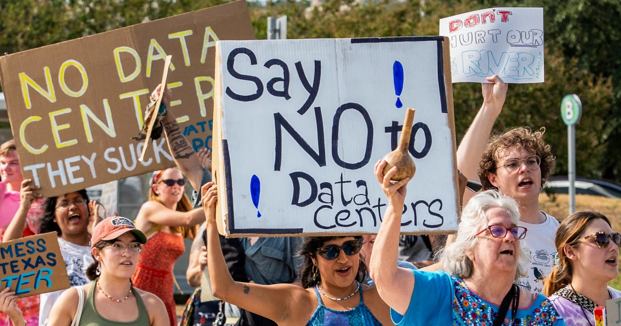
The most publicly visible manifestation of the concern is seen in the growing wave of public protests against AI data centers planned for specific communities (see Fig. I.1). As reported in the New York Times, “the top A.I. companies…have forecast spending $710 billion on data centers across North America in 2026.” On the other hand, “At least $156 billion across 48 projects with publicly disclosed values was blocked or stalled amid coordinated local opposition in 2025.”
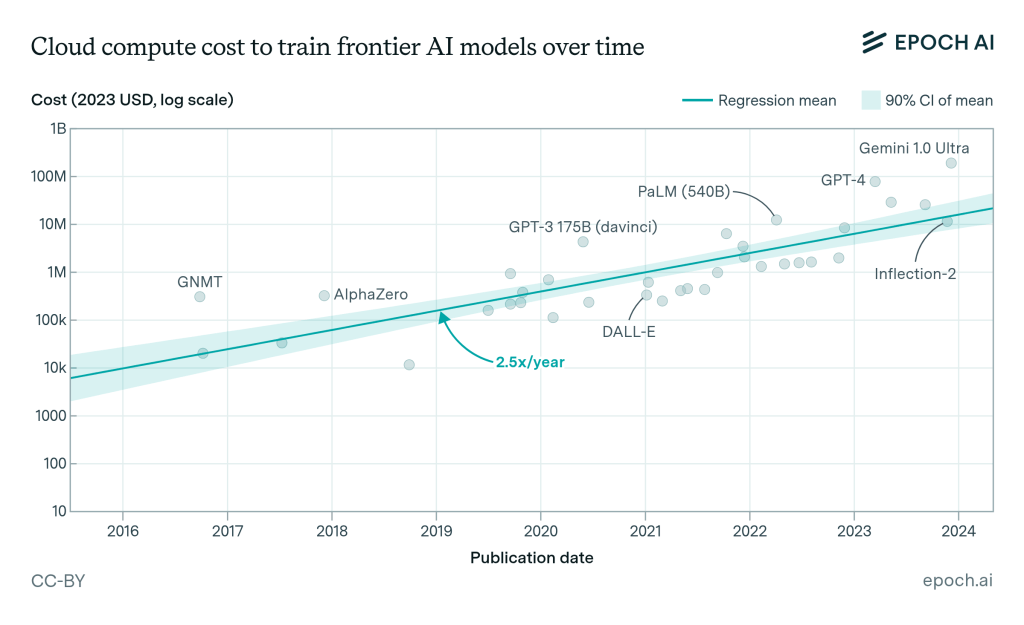
Although Fox News blames the protests on Chinese money and America-haters, the truth is much simpler. As we have described in a previous post on The Cyberhogs, the costs and resource demands of AI data centers are growing exponentially. As revealed in Fig. I.2, the cost for just the training of frontier AI models is growing, on average, by a factor of 2.5 every year. One of the most recent of the large language models (LLMs) behind generative AI, Google’s Gemini 1.0 Ultra, cost about $200 million for staffing, processors, servers, computing time, and electricity usage for final training at the end of 2023, requiring a continuous electrical power input of 35 megawatts (MW) throughout the training period. The hyperscale data centers planned for the current generations of LLMs are enormous in size and appetite. For example, Microsoft’s Fairwater AI data center being constructed in Wisconsin contains three massive buildings covering 1.2 million square feet cumulatively, housing hundreds of thousands of NVIDIA graphical processor units (GPUs) consuming hundreds of MW. And this center is modest by the standards of new projects. The largest planned facilities target power usage of 5 GW, enough to power 5 million homes! For example, a planned Meta data center in Wyoming would require more electricity than the combined usage of every household in the state.
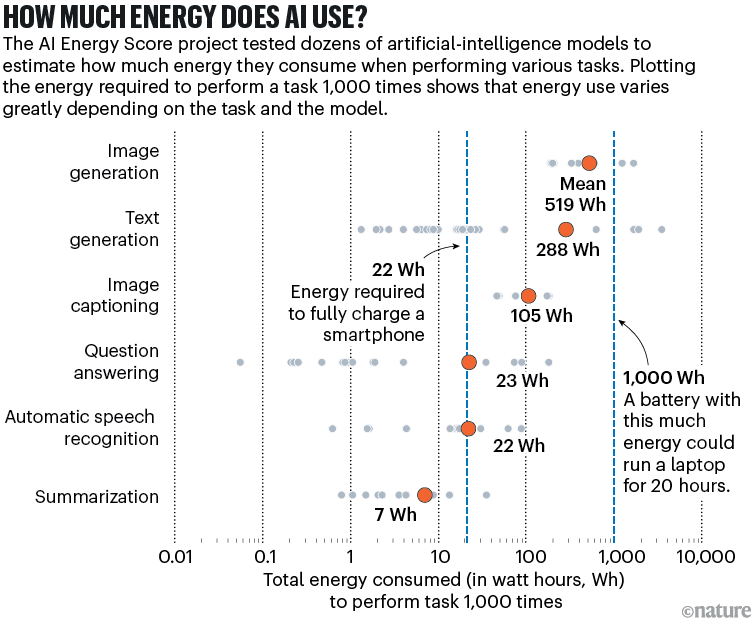
Electrical power, of course, is used not only to train the generative AI models, but to generate user-requested output. Figure I.3 shows estimates of the energy cost incurred by various generative AI tasks. The energy is plotted logarithmically, i.e. each vertical line reflects a factor of 10 increase. It may seem modest to require 519 Wh, on average, to generate 1,000 AI images. But roughly 80 million such images are now generated daily around the world and across all platforms, requiring continuous power of nearly 2 MW. Over 14 million videos are generated by AI each day, and these are much more expensive to produce. And text generation still accounts for the vast majority of generative AI interactions. All told, user interactions with generative AI platforms currently require more than 10 MW of continuous electrical power, or nearly 100 GWh per year, and the cost is climbing rapidly.
The hyperscale data centers also have enormous water demands. As the density with which GPUs are stacked in racks increases dramatically, air cooling has become impractical: “Direct-to-chip cooling circulates chilled fluid through cold plates attached to graphics processing units and CPUs, absorbing heat 3,000 times more efficiently than air.” Additional water cooling is needed for the building infrastructure. A single large hyperscale data center can consume up to 5 million gallons of drinking water per day, equivalent to the needs of tens of thousands of people. For example, a currently planned hyperscale AI data center has been paused by public protest in Bessemer, Alabama because “The facility demanded 2 million gallons of water daily. This volume represents roughly the same amount of water required to sustain two-thirds of the city’s entire population.” It is the cavalier attitude of the Big Tech companies involved in the AI arms race toward dominating small communities’ electricity and water resources that has triggered the data center protests, not Chinese money or hatred for America.
In the U.S., Big Tech companies are usually requesting states to give them massive tax breaks in return for the job creation they claim data centers will bring. They are likely to request breaks or even elimination of property taxes. They may also request special deals on their use of exceptional consumption of energy and water. For example, in 2018 the state of Georgia passed legislation that gave tax breaks to data centers for computer systems and cooling infrastructure, with additional tax breaks for job creation and property taxes. Such tax breaks eliminate support for local schools and shift the burden of support to other community members. A large data center will require large numbers of workers during the construction phase. However, when the plant is running it will employ very few workers. A large data center may employ about 150 workers; however, some data centers operate with only 25 employees. Furthermore, it is unlikely that American data centers will attract large numbers of other businesses, especially when many data centers are located in rural areas.
Another feature of data centers is their costs to the environment. One major emission from data centers is noise pollution. The centers emit a large continuous low-frequency hum that can reach 96 decibels, as the centers run 24 hours a day. Another concern is that many data centers are constructed in rural areas, where they may accelerate the process of converting farmland to other purposes. Data centers often rely on gas-fired energy sources for routine operations, with diesel generators for emergency backup. The diesel generators emit large amounts of fine particulate matter (PM2.5), and they also emit large amounts of nitrogen oxides. The PM2.5 particulate matter is known to cause respiratory and heart disease and asthma. Several data centers are located in areas where the population has significant poverty or low educational levels.
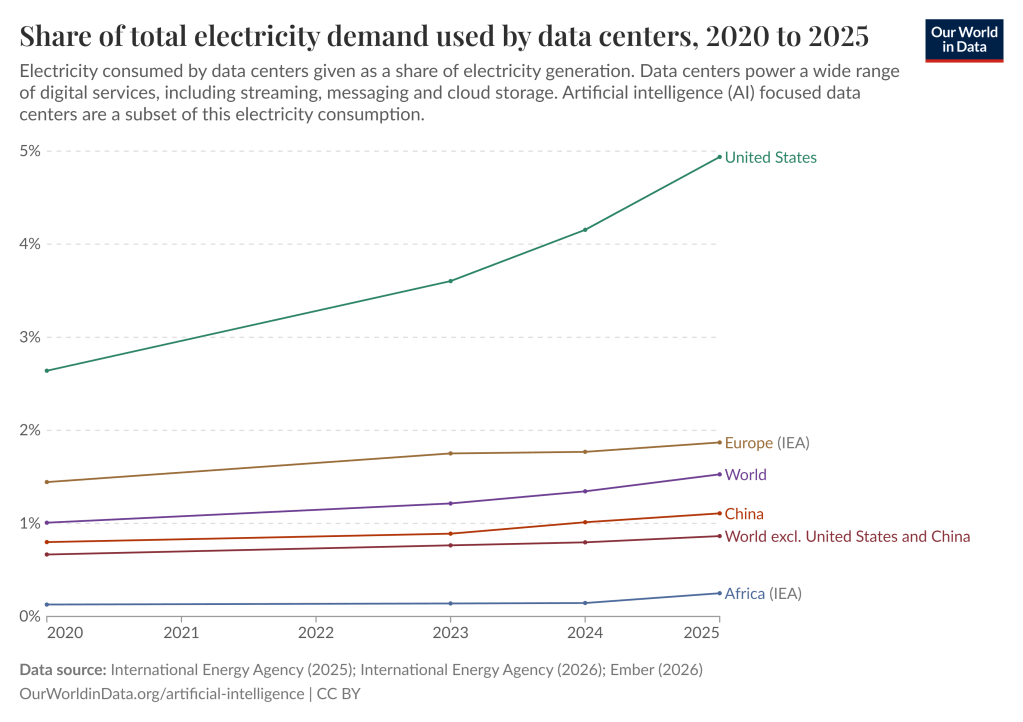
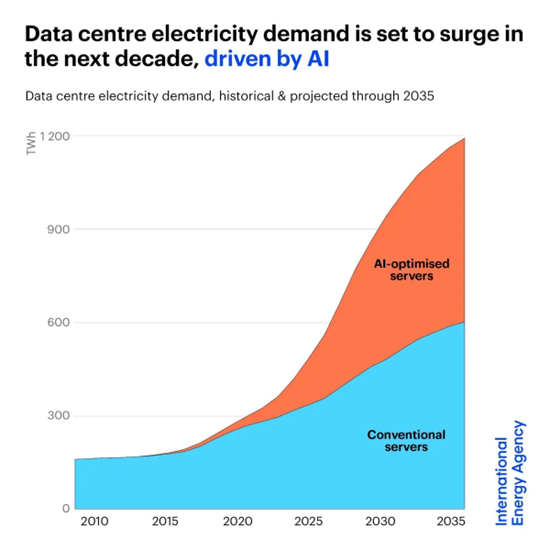
What does the proliferation of AI hyperscale data centers imply for U.S. and global electricity and water demand? Figure I.4 plots the share of total electricity demand in various regions that has been devoted to all data centers since 2020. The rapid growth in the U.S., reaching 5% of national demand in 2025, results from the growth in AI data centers. At the projected rate of building new hyperscale data centers, AI may use 15% of all U.S. electricity by 2030. The relatively low AI electricity demand in China will be addressed below. Globally, as projected by the International Energy Agency (IEA, see Fig. I.5), the electricity usage by AI data centers is expected to more than quadruple by 2035, bringing all data centers’ annual demand to about 1200 terawatt-hours (TWh). For calibration, total global electricity consumption was about 30,000 TWh in 2022.
The massive demands for electricity generated by AI testing and use will create an immediate need for more power plants. New nuclear plants will require at least a decade before they are licensed and running. On June 4, 2026, Donald Trump announced $700 million in federal funding that would be used to create new coal-fired power plants. These would be the first new coal-fired plants in the U.S. in 13 years. In addition, $425 million of these funds would be used to extend and upgrade 12 coal-fired plants that were scheduled for closing in the near future. Although the new coal plants were not explicitly earmarked for support for AI efforts, the increased energy demands related to AI would constitute a significant demand for more energy from coal.
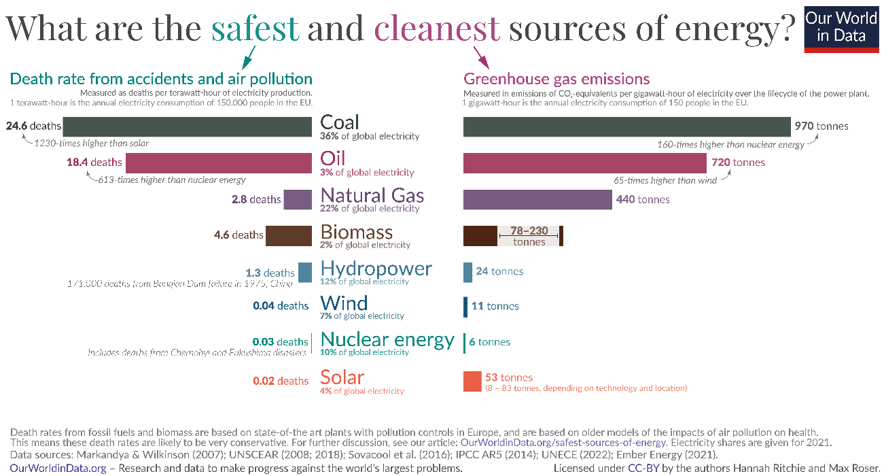
Continuing to use coal-fired power plants, and building new ones, is a terrible idea. In order to allow these old, polluting energy sources to continue operating, the Trump administration announced relaxation of environmental rules limiting emissions from these plants. Coal-fired plants have by far the highest death rate from accidents and pollution. In addition, they have the highest greenhouse emissions of any energy source. Figure I.6 shows the death rate per terawatt-hour of energy produced by all commercial sources of energy – coal, oil, natural gas, biomass, hydropower, wind, nuclear and solar. It also shows the greenhouse gas emissions per gigawatt-hour of electricity during the lifecycle of each source. Not only is coal associated with over 1,200 times the deaths per terawatt-hour of energy than solar, but coal-fired plants will emit 160 times as much greenhouse gas as a nuclear power plant. A responsible energy policy would involve closing down coal-fired plants as fast as possible. Ironically, the funds designated by President Trump for these coal-fired plants come from money that Congress approved for carbon-capture technology.
The IEA estimates that total water usage by data centers globally was about 560 billion liters, or roughly 150 billion gallons, of water during 2025. That usage is expected to more than double by 2030, to an amount (roughly 10,000 gallons per second!) equivalent to annual consumption by more than 4 million U.S. households. When one adds in the cooling systems used in generating the electrical power required by the data centers, the annual AI demand can reach one trillion gallons of water per year by the end of this decade. Roughly one-third of AI data centers currently under construction are being built in global regions anticipated to face water shortages by mid-century.
It seems essential to plan more carefully for the proliferation of AI hyperscale data centers than the U.S. Big Tech companies appear to be doing. In their race to win AI wars they do not seem to have so far devoted sufficient attention to efficiency of resource usage. Although there have been numerous justified skeptical accounts of the very low training costs claimed by the Chinese company DeepSeek for its generative AI versions, nonetheless, DeepSeek appears to have devoted considerable effort to optimizing hardware, software, and data handling to enhance its computational efficiency. Perhaps such development helps to account for the modest growth shown in Fig. I.4 in Chinese vs. U.S. data center electricity usage.
The U.S. Big Tech companies also understand that the exponential growth in hyperscale data centers is not sustainable. They are therefore in the midst of trying to shift much of the burden to user devices. While the training of ever more sophisticated LLMs will continue to require large data centers, much of the computing involved in AI inferences – answering user queries and generating user-requested products – can be shifted from cloud computing at data centers to apps that can be downloaded to your personal smart phone, desktop, laptop, or tablet computer. Each use of these apps will still be costly in energy demand, but the demand would then be distributed among millions (and, for the Big Tech companies, hopefully billions) of customers, rather than concentrated at data centers that currently serve as targets for massive public protest.
Public opinion surveys:
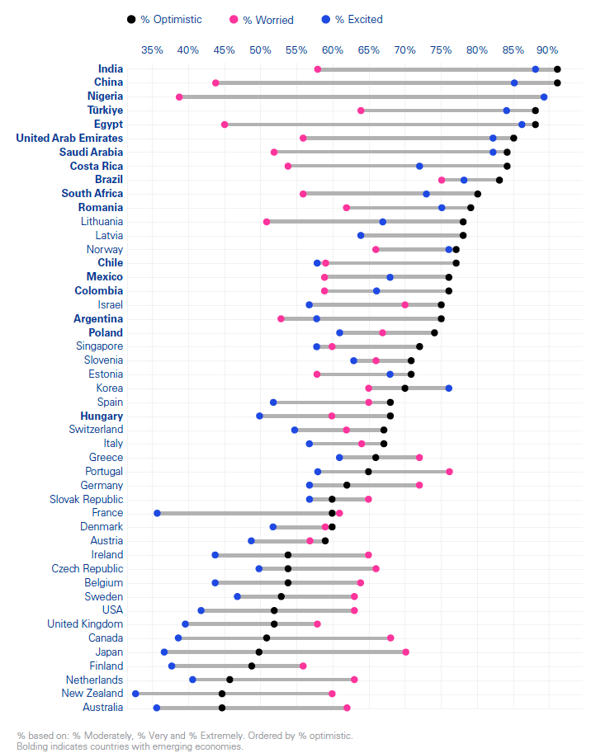
Recent surveys of public attitudes towards AI have revealed a general unease about the technology in the U.S., but not in all countries. Because the technology is advancing so quickly it is best to rely on the most recent surveys. A research team at the University of Melbourne carried out a global online survey from November, 2024 to mid-January 2025, with responses from 48,340 people across 47 countries spanning all global geographical regions. Figure I.7 summarizes the findings with respect to general attitudes towards AI. The most striking feature of the results is that optimism about AI is much higher in emerging economies than in advanced economies. For example, while more than 90% of respondents in India are moderately, very, or extremely optimistic about AI, the percentage who share those feelings in the U.S. is barely more than half. And many more Americans (about 2/3) are moderately, very, or extremely worried about AI than in India. Respondents in emerging economies report much higher levels of training, knowledge, and effectiveness with AI than those in advanced economies. Basically, the view in emerging economies is that AI is a technology that can level the playing field with advanced countries and enhance individuals’ financial condition. In contrast, people in advanced economies tend to be more worried about job losses and a worsening of their financial condition. There is also a marked difference in the level of trust in AI: 76% of Indian respondents but only 41% of American respondents and 25% of Finnish respondents said they were somewhat, mostly, or completely willing to trust AI outputs.
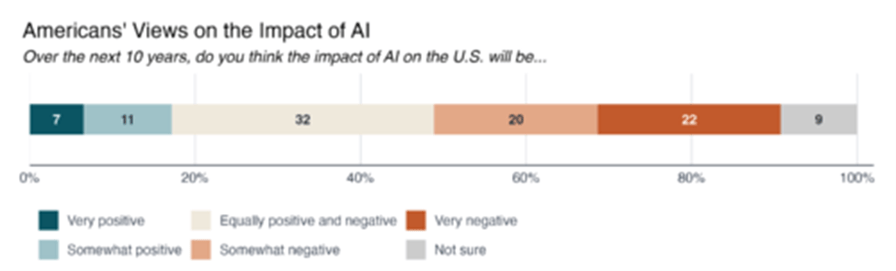
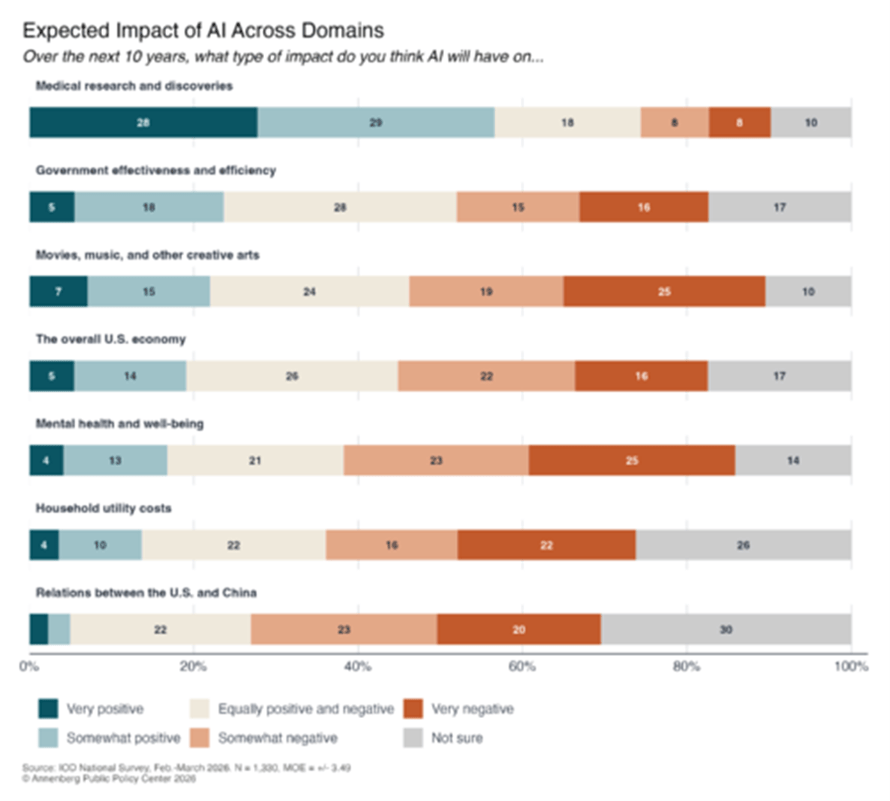
More detail specifically about American attitudes has been revealed in a very recent survey by the Annenberg Public Policy Center, reporting responses from a nationally representative sample of 1,330 adult U.S. citizens between Feb. 17 and Mar. 20, 2026. The results shown in Fig. I.8 reveal a generally pessimistic outlook: “Despite widespread awareness of artificial intelligence – 78% say they have heard at least a moderate amount about it and 67% report using AI at least a few times in the past month – the public outlook on AI’s trajectory is negative. When respondents are asked what they think the impact of AI on the United States will be over the next 10 years, only 7% say ‘very positive’ and 11% say ‘somewhat positive.’ In contrast, 22% say the impact will be ‘very negative’ and 20% say ‘somewhat negative.’… When asked about AI’s expected impact across seven specific domains, Americans see one clear area of promise: medical research and discoveries, where over half (57%) expect a positive impact. But optimism drops sharply elsewhere. Only 24% expect AI to have a positive impact on government effectiveness, 22% on creative arts, and 19% on the economy. The most pessimistic assessments are reserved for mental health and well-being (17% positive), household utility costs (14% positive), and U.S.-China relations (5% positive).”
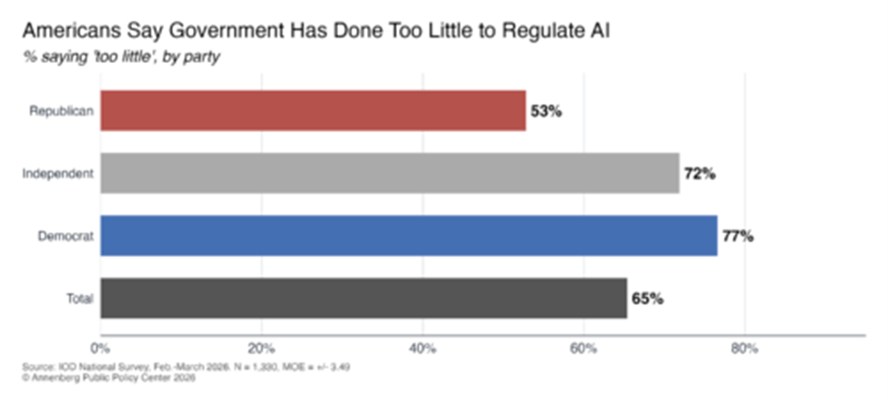
Furthermore, as revealed in Fig. I.9, there is strong bipartisan agreement that the U.S. government has done too little to regulate AI: “The demand for regulation intensifies with pessimism about AI but is not confined to it. Among those who believe AI’s impact will be “very negative,” 83% say the government has done too little. But even among those people who expect AI’s impact to be “very positive,” 43% say the government has done too little – and a majority (57%) of those who think it’ll be equally positive and negative agree with that view.” And the demand for regulation goes well beyond the American rank and file. On May 25, 2026 Pope Leo XIV issued his first encyclical, Magnifica Humanitas, containing a chapter entitled Technology and Dominance: The Grandeur of Humanity in Light of the Promises of AI. In that chapter, Pope Leo calls for robust governmental regulation of AI development, in part because of its environmental impact, but also because “a more moral AI is not enough if that morality is determined by a few.” In the call for AI regulation the Pope was joined by Chris Olah, the billionaire co-founder of Anthropic, one of the world’s largest AI companies.
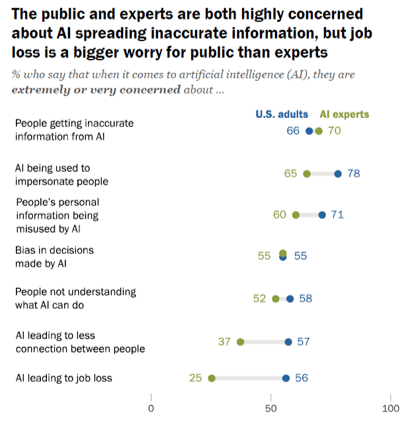
Similar indications of American pessimism about AI were found in a slightly older survey carried out by the Pew Research Center in August 2024. The Pew survey separated responses from a random sample of 5,410 U.S. adults and from 1,013 AI “experts” who live in the U.S. and who were authors or presenters at AI conferences in 2023 and 2024. The major reasons for concern expressed in that survey are summarized in Fig. I.10. Well over half of the adult U.S. respondents said they were very or extremely concerned about each of the following topics: people getting inaccurate information from AI; AI being used to impersonate people; people’s personal information being misused by AI; bias in decisions made by AI; people not understanding what AI can do; AI leading to less connection between people; and AI leading to job losses. A majority of the AI experts shared all but the latter two concerns. We will see in Section II that those concerns mirror only some of the current dangers of AI.
Recent events:
Americans’ concerns about AI have only been exacerbated by a number of recent events. AI-generated “deepfakes” reproducing an individual’s appearance and voice in undesirable, often pornographic, images and videos have proliferated. Deepfakes of fictional events can cause panic; for example, a fake image of the Pentagon exploding caused a momentary stock market panic in 2023, causing a $500 billion selloff over a few minutes before the image was identified as AI-generated. Spurred in part by deepfake pornographic images of pop star Taylor Swift and of Texas high school students, the U.S. Congress passed a 2025 law, the TAKE IT DOWN Act, that prohibits “non-consensual intimate imagery” with criminal penalties. Despite the law, Elon Musk’s AI Grok has been flooding his social media platform X with 1.8 million sexualized photos of women and minors in 2026. Musk has responded to the controversy by posting an image of himself in a bikini with laugh-cry emojis.
The Take It Down Act so far does nothing to address the use of AI voice cloning in telephone scams that have targeted many grandparents with warnings of dire situations facing their grandchild without an immediate delivery of money, often in the form of cryptocurrency. In another instance of cringe-inducing AI behavior, it was revealed in 2025 that Meta’s AI policies allowed their chatbot to engage in romantic conversations with children. And without basing them on specific real individuals, AI has also found a lucrative business in creating digital porn stars.
Numerous individuals have relied on AI chatbots to provide advice on the optimal ways to carry out suicides or homicides. For example, the perpetrator of a mass shooting event at Florida State University in April 2025 asked OpenAI’s ChatGPT for information about the type of gun and ammunition to use and the time and location that would maximize the number of victims of the shooting. The widow of a man killed in the rampage has recently filed a lawsuit against OpenAI. An OpenAI spokesperson denied any wrongdoing by pointing out that “In this case, ChatGPT provided factual responses to questions with information that could be found broadly across public sources on the internet, and it did not encourage or promote illegal or harmful activity.” One would think that there are questions that chatbots should be taught not to answer, even if clever users pose their queries in very indirect ways.
One area in which AI benefits have been rapidly adopted by commercial companies is the writing of software codes, but even here there are unforeseen dangers. The company PocketOS, which produces software for car rental businesses, has been using Anthropic’s Claude Opus software agent Cursor to streamline a number of coding tasks. According to the PocketOS founder, “the AI agent had been performing a routine task when it chose ‘entirely on its own initiative’ to resolve an issue by deleting the [company’s entire] database. And then all the backups, for good measure…It took nine seconds…The agent then, when asked to explain itself, produced a written confession enumerating the specific safety rules it had violated.” Caveat emptor!
A serious long-term worry arising from AI’s excellent coding ability is that it can not only find vulnerabilities in other codes or computers, but then can exploit those vulnerabilities in hacking attacks perpetrated either by human hackers or by AI itself. When Anthropic’s latest model Claude Mythos was announced in April 2026 Anthropic said that the AI had revealed major zero-day vulnerabilities “in every major operating system and every major web browser,” and many of those flaws had existed in codes for decades. Anthropic judged the new system too powerful and dangerous for public release but provided an early version to 40 tech companies so that they could use it to update software to patch those identified vulnerabilities.
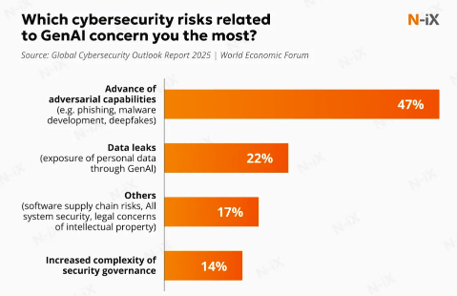
In their 2025 Global Security Outlook the World Economic Forum queried organizations both large and small about their cybersecurity concerns. Figure I.11 summarizes responses specifically about issues related to the use of generative AI. Two recent events bring some of the cybersecurity concerns to the forefront. In May, 2026 Google announced that it had thwarted a cyberattack made by a criminal hacking group apparently with the aid of AI to find a previously unreported bug in Google’s software. Even more recently, Meta announced that more than 20,000 Instagram accounts – including accounts associated with the Obama White House, the U.S. Space Force, and the cosmetics company Sephora – had been breached by hackers who used Meta’s own AI chatbot to link the breached accounts to the hackers’ email addresses and to allow the hackers to reset passwords for the accounts.
Around the same time a group of researchers carrying out a controlled study revealed that AI was quite capable of carrying out a viral cyberattack on its own. The study “tested models including OpenAI’s GPT 5, 5.1, and 5.4, Anthropic’s Claude Opus 4, 4.5, and 4.6 and Alibaba’s Qwen against computers which had deliberately planted security flaws that allowed outsiders to gain access.” The AI models were connected to a software agent that allowed them to issue commands on other computers. They were then instructed to find a serious flaw in the target computer system and “use it to get inside, steal login details, transfer the files it needed to run, and start a working copy of itself on the new machine.” Not only did each AI model complete the assigned task in a significant fraction of the trials (81% for Claude Opus 4.6), but they then proceeded to find vulnerabilities in other computers that had not been specifically prepared by the research team, to take over those computers and to reproduce themselves anew. “The research team stopped the experiment after three stages, but said the final copy was still working and could have attacked further systems.”
If autonomous AI self-replication is no longer hypothetical, what are the chances that AI clones on many different computer systems could, perhaps even inadvertently, wipe out existing databases or launch false stories that trigger public panic, stock market crashes, or even government collapses? What are the chances that a government in control of such powerful AI models could use them to launch disabling cyberattacks on critical infrastructure in enemy (foreign or domestic) societies, or to exploit them to carry out clandestine surveillance of their own citizens, or to design new lethal weapon systems? In short, what are the chances that generative AI will be weaponized by governments and criminal organizations?
These questions are no longer hypothetical. The U.S. Department of Defense (DoD) and Anthropic are currently in court to present their cases in a lawsuit stemming from Anthropic’s insistence that any contract it signed with DoD had to restrict use of Claude to carry out lethal autonomous warfare (e.g., using robotic soldiers or weapons systems and drones that choose their own targets without human control) or mass surveillance of Americans. Because Defense Secretary Hegseth did not like those restrictions, he designated Anthropic as a “supply chain risk,” a move that bars defense contractors, suppliers, and their partners from using any Anthropic models in work on American national security. Anthropic sued DoD to have the designation removed.
Furthermore, Donald Trump very recently signed an Executive Order allowing the federal government to get 30 days of advanced access to new AI systems prior to their public release. The stated goal of the Executive Order is to provide oversight of possible national security risks that the AI systems might pose. But the oversight window would also allow the U.S. government to have first access to use of the new platforms as cyberweapons against adversaries. The White House attempted to quell concerns from the public and Big Tech by announcing that the order “creates a process for frontier labs to voluntarily share cutting-edge cyber models in order to secure critical infrastructure and strengthen the government’s own cyber defenses. We are NOT conducting oversight of all new models, as that level of government overreach would have chilling effects on free speech and innovation.”
All of the issues discussed in this Section raise two critical questions: do AI’s benefits outweigh its risks? What can governments do to regulate AI providers and their users. We address these questions in the following Parts of this post.
— Continued in Part II —

