
May 8, 2025
I. introduction
Among the many ill-fitting monikers Donald Trump has awarded himself is “the fertilization President.” He first dubbed himself this in pledging support for in vitro fertilization (IVF), despite the fact that many Christians in his base view the disposal of unused fertilized eggs in IVF as murder of incipient life. But now his administration, spurred by an American Pronatalist movement, is weighing policies aimed at solving the problem of falling fertility, without necessarily understanding the reasons for the decline or the factors real families consider in deciding how many children to have. The American Pronatalist movement counts among its prominent supporters several extremely wealthy and conservative Silicon Valley pioneers, the Vice President JD Vance, Elon Musk, who seems committed to raising national fertility single-handedly, and a couple – Malcolm and Simone Collins – who are dedicated to producing many of their own “genetically selected” (Aryan?) children and convincing other couples to do the same. Meanwhile, many of the economic and cultural policies the Trump administration is pursuing will tend to depress fertility further.
We have written in detail previously about the evidence and reasons for the nearly universal decline in human fertility that has been going on for the past half-century. Women in all developed countries have been having progressively fewer babies and the decrease is still ongoing, as illustrated in Fig. I.1. In order to replace each generation, without loss or expansion, the average fertility rate needs to be about 2.1 children per woman, allowing for losses to maternal, infant, and child mortality. For the U.S. in 2023 that number was 1.62, down from about 2.0 at the beginning of this century. The country most direly affected by fertility decline is South Korea, whose present value is 0.75. Not all countries are currently below replacement level: many countries in Africa and some in western Asia still have average fertility rates between 3 and 6, though most are beginning to decline.
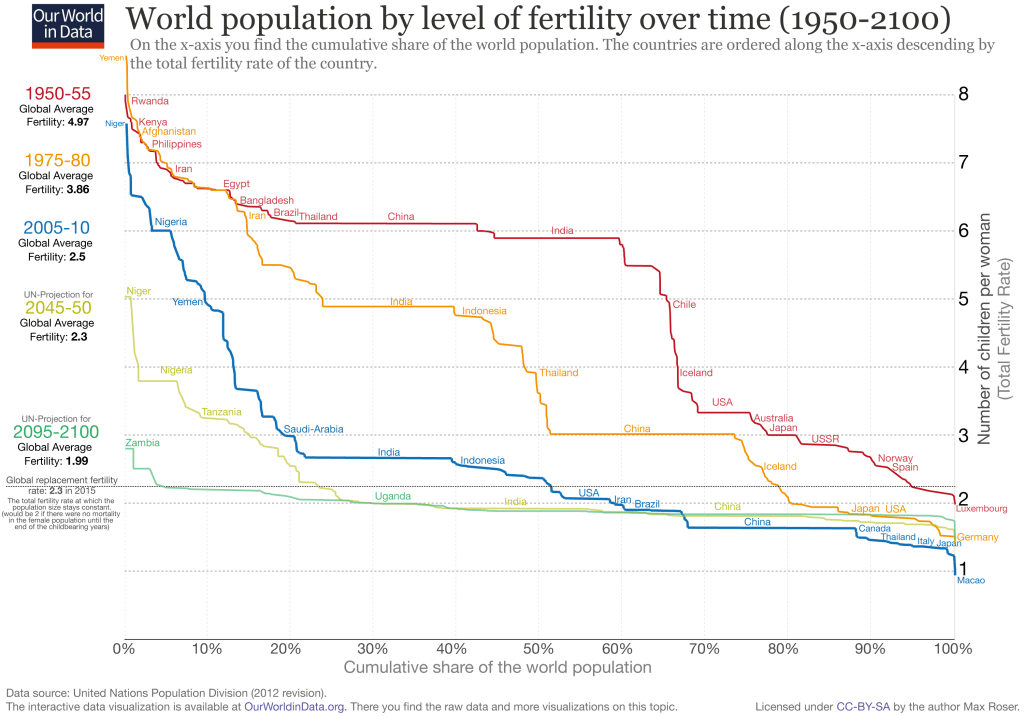
The primary reasons for the global fertility decline are demographic and cultural, and they are not easily ameliorated by government policies. Government policies can make the situation much worse, as China learned when its 1980 One-Child Policy led not only to a generation of “missing women,” but also to a permanent cultural change in which women no longer feel family pressure to have multiple children.
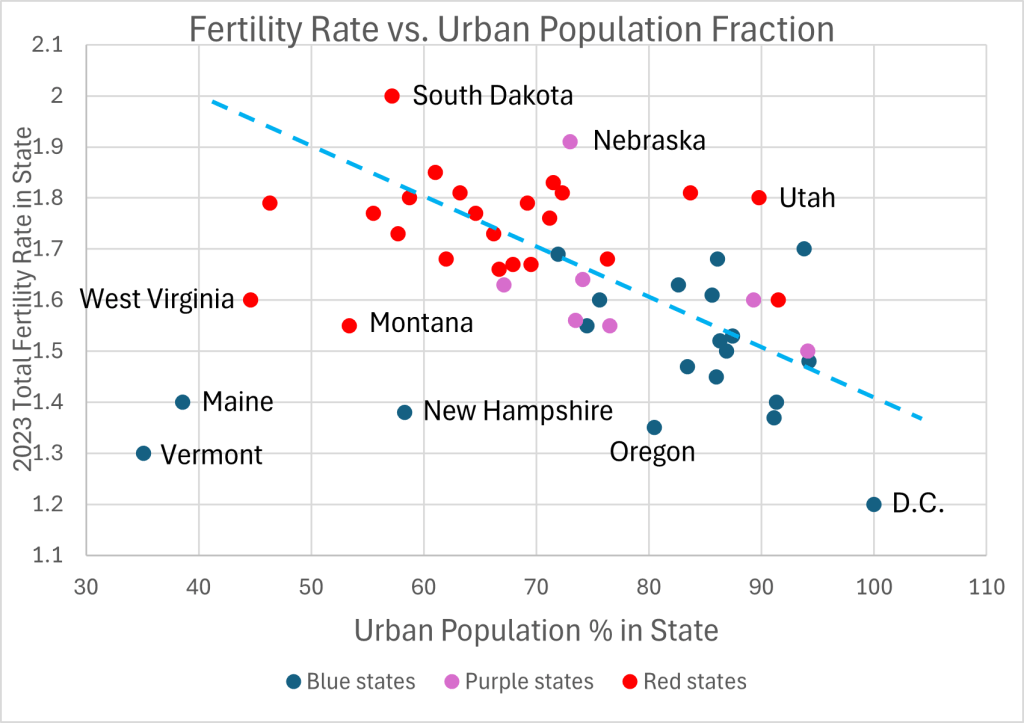
The main worldwide demographic pressure on fertility comes from urbanization. As countries industrialize their population migrates increasingly to urban centers where the majority of job opportunities arise. City dwellers no longer need as many children as rural families who maintain farms, they have less space on average for children, and the costs of raising children are higher in urban settings. Africa is currently the continent with the most rapid ongoing urbanization, providing strong reasons to expect African fertility to decline rapidly through the 21st century. In the U.S. the largest part of the differences in fertility rate among states and the District of Columbia is attributable to their differences in urban fraction of the state population. This is illustrated in Fig. I.2 where most states fall close to a linear correlation in which fertility rate decreases as urban fraction increases. A number of outlier states from that correlation are named in the figure.
The cultural changes that affect fertility rates include the waning influence of religion and family pressures on women’s decisions about family size. But the main cultural pressure comes from the empowerment of women: the advent in the 1960s of the birth control pill and readily available, reliable contraceptive methods giving women more control of their reproductive choices; the increasing education of women around the world; and the rapid growth of women entering the workforce. The percentage of U.S. women of childbearing age who entered the labor force tripled from 1940 to 2000. The combination of these changes has been dubbed the “Quiet Revolution” by Nobel Prize-winning economist Claudia Goldin.
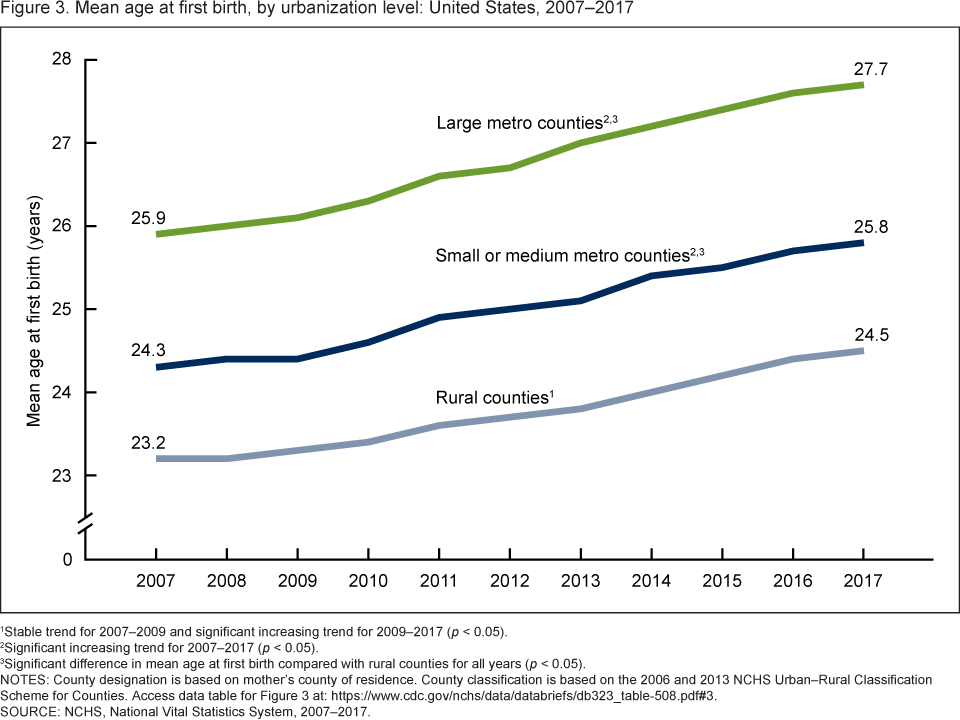
There are two particularly critical impacts of the Quiet Revolution in the U.S. First, the birth rate among teenage women has dropped by a factor of six from the late 1950s to the present as women extend their education and use contraceptives at younger ages. Second, women are on average delaying childbirth as they seek higher education, a stable entry into the workforce, and family economic stability before taking on the increasing costs and time commitments of child rearing. This is true across all ethnic groups and counties although, as shown in Fig. I.3, the delay is especially long in urban counties. The delay in first childbirth is leading to a substantial skewing of the maternal age distribution in the U.S., as illustrated in Fig. I.4, which runs up eventually against the limits imposed by menopause.
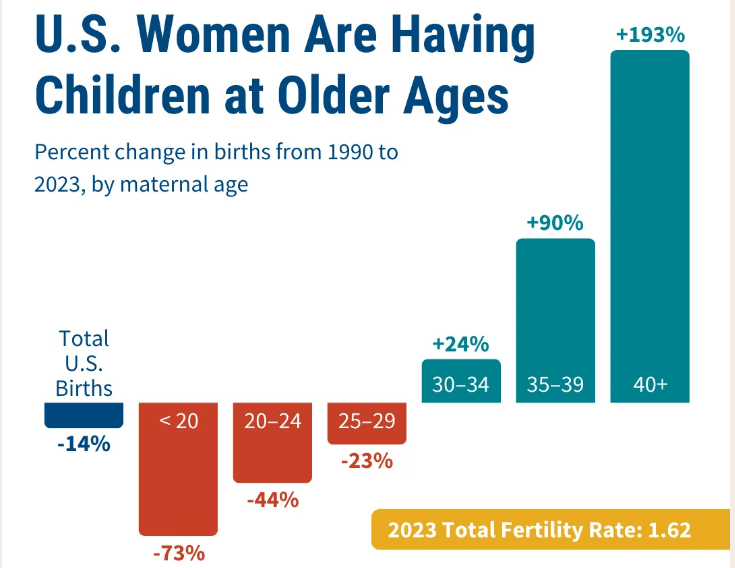
There are serious economic consequences of sustained fertility rates below replacement levels, especially when combined with increasing life expectancy. The combination leads to aging populations in which a dwindling workforce must support an expanding group of senior citizens. The population inversion will place a strong burden on workers to increase productivity, services, and tax revenue. It will make it very challenging to maintain or launch pension or social security systems. It will lead to a reduction in candidates for universities or the military. It will likely produce less creative societies. And, of course, it will eventually lead to dwindling populations and, for the countries with the lowest fertility rates, to loss of economic and geopolitical power. Globally, human population is expected to be well into decline by the end of the 21st century.
The United States has so far been relatively immune to these problems. Despite declining fertility, the U.S. population has continued to grow slowly because the country has welcomed new waves of immigrants who join the workforce and enrich the culture. However, the American Pronatalist movement, with strong overlap with Christian Nationalists and Trump’s MAGA base, is following the lead of Hungarian Prime Minister Viktor OrbanOrbán, who told his country in 2019 that “In our minds, immigration means surrender…We do not need numbers, but Hungarian children.” Hungary is, indeed, one of the world’s least welcoming nations to immigrants; in a 2018 Pew Research Center survey, only 5% of Hungarians agreed with a statement that “Immigrants make our country stronger.” That percentage for the U.S. was 59% and for Canada was 68%.
The MAGA Pronatalists do not want more immigrants to dilute their power and sway, especially if those immigrant groups enter the country with substantially higher fertility rates than white Christians. Rather, they want more white, Christian babies. They have a strong ally in the administration in Vice President JD Vance. And they are now pushing Trump to adopt some of their recommended policy changes in an attempt to induce Christian women to “do their patriotic duty” to serve as more traditional wives who stay home and raise lots of kids.
In Section II of this post we will introduce some of the MAGA Pronatalists and describe their messages and proposals for increasing American fertility. In Section III we will consider the experiences of other countries that have already tried a variety of inducements, without sustained success. In Section IV we will rely on that history from other countries to explain why the MAGA Pronatalist proposals are unlikely to have their desired effect, especially given the rest of the policy and cultural agenda being pursued by Trump and Christian Nationalists. We’ll summarize in Section V and offer some suggestions for approaches that might succeed in maintaining a healthy U.S. workforce going forward.
II. the maga pronatalists
In response to the fact that the fertility rate in the U.S. is currently significantly below the replacement level, groups of “Pronatalists” have been advocating for measures designed to increase the American fertility rate. Recently, this has become a major topic in the Trump administration’s policies. Vice President JD Vance, shown in Fig. II.1 with his wife Usha and two of the couple’s three children, has become the Administration’s point person for measures to boost our nation’s population. In January 2025 he remarked to the crowd at a March For Life rally, “Let me say very simply: I want more babies in the United States of America.” As we will discuss in later sections of this post, the U.S. population is currently increasing, but primarily because of our policy (until recently) of welcoming immigration. Vance’s embrace of Ppronatalist policies follows from his election campaign which claimed that the Democrats were anti-family and anti-child. His most infamous accusation was that Democratic policies were being developed by “childless cat ladies.”

More recently, Vance has expanded his call for more American babies. It should be noted that his critique of Democratic “childless cat ladies” specifically included Pete Buttigieg in a somewhat homophobic remark. At the time of Vance’s remarks Buttigieg and his husband Chasten were going through the process of adoption and have since adopted twins; so perhaps Vance’s call for more American babies should have been characterized as a desire for more babies from white Christian straight Americans. [Note: to be fair, Vance has three biracial children, so his personal case represents an exception; but the support of many MAGA Pronatalists is almost exclusively focused on boosting fertility rates for white families]. Vance has endorsed a series of measures designed to increase births of babies in the U.S. At one time, he even suggested that parents with more children should have more votes. “When you go to the polls in this country as a parent, you should have more of an ability to speak your voice” Vance has since walked back that unconstitutional proposal. But he lauded policies that had been instituted by the authoritarian Viktor Orbán in Hungary, such as providing loans to newlyweds that would be forgiven if the couple had children and did not divorce. In the following Section of this post, we will review Pronatalist policies in other countries, including Hungary, and their success or lack thereof in increasing fertility rates.
Vance’s interest in boosting the number of American babies is rooted in concerns for the low birth rate in this country, combined with deep bias against immigrants (again, excepting his wife’s family). He publicized the false claim that Haitian immigrants in Springfield, Ohio were eating dogs and cats. In his 2022 Ohio Senate race, Vance endorsed the “great replacement theory,” the notion that there is a conspiracy to replace white Americans with immigrants of color. The argument is that Democrats push liberal immigration policies specifically to outnumber whites with immigrants of color, who will presumably be reliable Democratic voters.
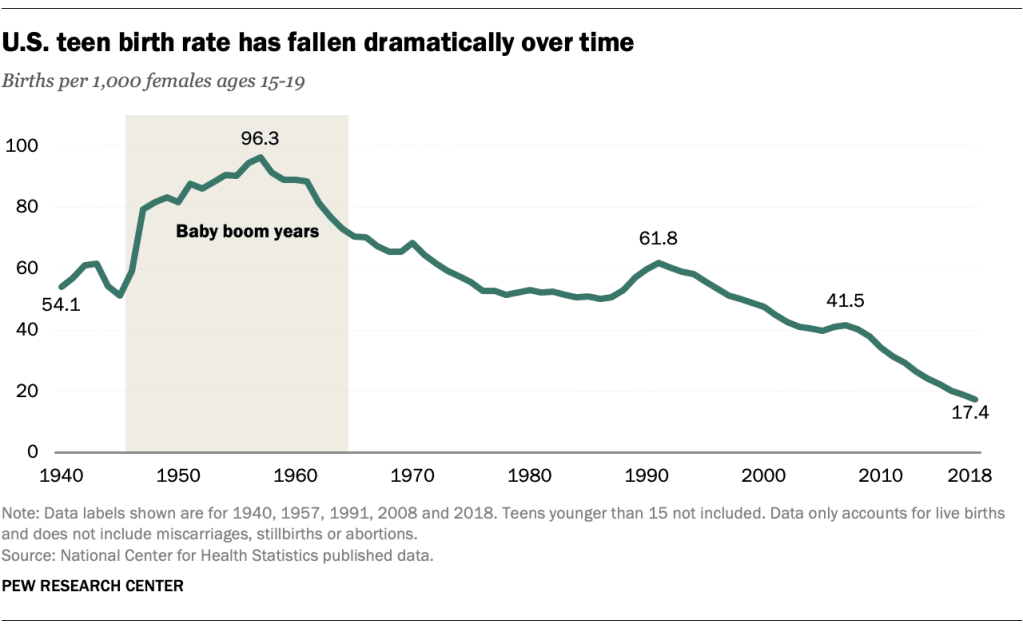
Many Pronatalist arguments stem from anti-feminist sentiment; for example, many Christians believe that there is a large number of women who would prefer to stay home and have children than to join the workforce. However, some Republican statements about reproduction seem not only anti-feminist but actually loony. In our post on declining population rates, we pointed out that the teen birth rate in the U.S. has dropped by nearly a factor of 6 from 1950 until the present, as shown in Fig. II.2. This is due to better sex education for teens, the availability of birth control and, until the 2022 Dobbs ruling of the Supreme Court, access to abortion. We feel that the decline in teen births is a positive development – delaying motherhood until one finished high school or college would improve the economic prospects for these women and their eventual children, and would enable them to start families once their economic conditions were settled. So we were surprised to see that in Fall 2024, three red-state Attorneys General (Andrew Bailey from Missouri, Kris Kobach of Kansas and Raul Labrador of Idaho) argued before Judge Matt Kacsmaryk in Texas that decreased teen births in their states constituted “a sovereign injury to the state in itself.” The injuries included “losing a seat in Congress or qualifying for less federal funding” if their state’s population was reduced by having fewer teen births. The AGs argued that the FDA had harmed their states by approving the drug mifepristone, which is one of the drugs most commonly used to induce abortion.
The AGs further argued that their states are “the legal parent or guardian of many minor girls,” e.g., girls in foster care or juvenile detention. They claimed that if these young women are able to access abortifacients, they could evade the state’s intention to use these girls as baby mills (shades of the Handmaid’s Tale) and hence increase the population in their districts.
More recently, the Trump Administration is considering a number of different proposals, all designed to increase the birth rate in America. One of these is to institute a “baby bonus” of $5,000 which would be presented to women after they deliver a child. A second would provide tax credits to families that would increase with every additional child. Such “focus on the family” programs specifically view ‘family’ as a married man and woman; they would thus exclude same-sex couples who adopt children and other non-traditional family structures.
An issue that divides the Pronatalists is the role of in vitro fertilization or IVF as a tool to increase fertility rates. Many conservatives are opposed to IVF methods. IVF methods typically implant sperm in a number of eggs, in order to ensure at least one successful fertilization. After one embryo is inserted in the womb of the mother, the remaining embryos are generally discarded. This is considered murder by those who believe that every fertilized egg is a human. It will be interesting to see if these conservatives change their minds, as Donald Trump has recently become an enthusiastic champion of IVF. He has stated that he wants expanded access to IVF for all Americans, even to provide free in vitro fertilization for all families. Trump now boasts that he will be known as the “fertilization president.” However, at the same time, the Trump administration has eliminated a team at the Centers for Disease Control and Prevention (CDC) that was in charge of research on the safety and effectiveness of fertility treatments. Like so many cuts that have been rammed through during Trump’s second term, the CDC center was established by Congress and there is some question whether closing this center without Congressional approval was legal.
It is also the case that the role of IVF is controversial within the community of anti-abortion activists. For example, after the 2024 Alabama Supreme Court ruling that classified frozen embryos as children, former Vice President Mike Pence revealed that all of his children had been conceived using IVF methods. It will be interesting to see how Republicans view IVF, now that it has been endorsed by Trump. It will be most interesting to see JD Vance’s response to this. In 2017, Vance endorsed a report by the Heritage Foundation that proposed draconian restrictions on IVF procedures. And in 2024, when he was in the Senate, Vance voted against a bill that would have expanded access to IVF. In particular, the Catholic church is conflicted about its stance on IVF. Some Catholics characterize IVF procedures as “clearly and unequivocally judged to be immoral,” and in Feb. 2025 the U.S. Conference of Catholic Bishops stated that IVF “destroys human life.” At the same time, many Catholics have undergone IVF treatments, and of course methods such as IVF are essential for same-sex couples who wish to have children that share some of their own DNA.
Another Pronatalist is entrepreneur Elon Musk. When Musk is not busy making himself rich (he is reputed to be the wealthiest man in the world), or taking a chain saw to the American bureaucracy as head of the Department of Government Efficiency (DOGE), Musk appears to be single-handedly attempting to increase the birth rate in the U.S. It is claimed that Musk has at least 14 children by at least 4 different women. He has stated that he believes declining fertility rates are more of a threat to the world than climate change. Some of Musk’s children were conceived in the normal way while others were conceived using IVF. Figure II.3 shows Elon Musk with one of his children, X Æ – xii. As part of Trump’s focus on families, several members of his administration have brought their children along when conducting business in Washington; Fig. II.3 shows Musk with his son X Æ – xii while at the White House.

Elon Musk’s production of what is essentially a harem is rather unusual; however, his own family history shows a somewhat aberrant parenting culture. His father Errol Musk had two children with his own stepdaughter Jana Bezuidenhout. Errol also claimed that he never registered South African emerald mines that he owned because “If you registered … the Blacks would take everything from you.” After Ashley St. Clair gave birth to what she claimed was Musk’s 13th child, Musk stated that he had given Ms. St. Clair $2.5 million and was providing an additional $500 K per year. So this appears to be the going rate for a woman to have a child with Musk. Musk’s many children are housed at a compound in Austin, Texas. It is uncertain how MAGA devotees view Musk’s highly unusual family dynamics. His situation differs radically from the husband-and-wife nuclear family so admired by conservatives. Also, apart from his exceptional record of procreation, Musk does not seem to be very active in the Pronatalist movement.
Next we share a couple of capsule biographies of prominent people among the Pronatalist community. As we will see, these people have rather different motivations, and their stance on issues differs. We investigate their actions and provide some speculation on why they are endorsing these positions.
Simone and Malcolm Collins:
Simone and Malcolm Collins, shown in Fig. II.4 with one of their children, are among the best-known Pronatalist couples. They are currently managing directors of the travel agency Travelmax. They are the founders of Pronatalist.org, which is a non-profit aimed at “promoting and supporting high birth rates,” and whose website announces that “Economic and social collapse is on the way.” Malcolm Collins claims that his personal goal is to have between seven and thirteen children – currently, they have four children and Simone is pregnant with a fifth. However, Malcolm jokes that Simone wants to continue having children “Until they pull out her uterus.” All their children have been conceived using in vitro fertilization (IVF) methods, which puts them at odds with the many MAGA supporters strongly opposed to IVF. Although Simone Collins has difficulty in conceiving, a primary motivation for their use of IVF is to subject many of their embryos to preimplantation genetic screening.

Malcolm and Simone select embryos that have the most desirable genetic traits. They used a company called Genomic Prediction to produce data on their embryos, and then used a second company called SelfDecode to rate the embryos on what they called “mental-performance adjacent traits,” which avoid tendencies such as stress, chronically low mood, brain fog, mood swings, fatigue, anxiety and ADHD. The embryo rated highest among their IVF embryos on a spreadsheet of scores was implanted and became their third child, Titan Andronicus. However, it should be noted that scientists examining these procedures report that one can only select embryos for minimal average increases, e.g., an average increase in height of about 2.5 cm, and a cognitive increase of about 2.5 IQ points, with large variance; also on average, children that are taller will likely have lower IQ and vice versa.
The Pronatalist movement has been populated and bankrolled by a significant number of techno-capitalist billionaires such as Elon Musk and Peter Thiel. Indeed, the Collinses were underwritten by libertarian Peter Thiel. Their wealth ensures that they have no concerns about issues that are of paramount importance to working-class Americans, such as the lack of parental leave and child care, the costs of medical care for mother and child, the unaffordability of housing, and the high cost of raising a child.
The Collinses are not dealing with the normal human impulse to provide some small contribution to society during their lifetime. They aspire to much more lofty goals. Malcolm Collins is quoted as saying “As long as each of our descendants can commit to having at least eight children for just 11 generations, the Collins bloodline will eventually outnumber the current human population. If we succeed, we could set the future of our species.” The use of in vitro fertilization, together with state- of-the-art genomic technology, provides a tool to pick the “most promising” embryos for their children. One wonders whether the Collinses would approve if their descendants choose to rig the game further by using CRISPR editing techniques to generate “designer babies” with the properties they desire edited into their DNA.
Not surprisingly, the Collins method for choosing children has led to comparisons with assembly-line methods for cloning children first featured in Aldous Huxley’s Brave New World. Indeed, Malcom Collins contrasts his vision of intelligent, free-thinking citizens to conformist, dull-witted humans they call “husks.” Husks, according to the Collinses, are those who “halt the process of creative destruction”, and hence “stop being meaningfully human.” In fact, they have created their own religion called the Religion of the Future Police. Unlike several primitive societies that practice ancestor worship, the Collins religion is focused on future generations. And they speculate in a blatantly eugenicist way that the Future Police “might exterminate those humans who fail to further the long-term good of the species.” OK, if that is not a giant red flag not only for the future but the present, then we don’t know what is! The Collinses scary techno-future vision appears to us to combine the worst features of Brave New World, genomic technology and eugenics.
Many advocates of Pronatalism appear to be motivated by cultural notions from the religious right. However, Simone and Malcolm Collins diverge from evangelical Christians in several instances. For example, they describe themselves as atheists, even though they consider the Bible as ‘divinely inspired scripture.’ They obviously support IVF procedures, and they have expressed support for “legit trans” transgender individuals (whatever that means).
The Collinses are enthusiastic about spreading their Pronatalist and techno-futuristic ideals. They established the Collins Institute School for the Gifted, a course in home-schooling that stresses math and coding skills, and instruction in creating successful e-mail campaigns. They have also set up a match-making service to pair “alpha adults,” and they have authored The Pragmatist’s Guide to Crafting Religion. Part of the appeal of the Collins family for MAGA supporters is that their focus is on increasing numbers of white babies (and for evangelicals, white Christian babies). Their focus on selecting the healthiest and most intelligent embryos invites comparison with eugenics arguments updated to include modern genetic screening. However, Malcolm and Simone argue that their methods are being used only for their own children and are not prescriptive for all Americans.
Simone Collins has suggested that Trump institute a “National Medal of Motherhood,” to be conferred on women who have six or more children. Presumably Ms. Collins got her idea from similar programs launched in Hitler’s Germany and Stalin and Putin’s Russia. The Nazis were obsessed with the idea of increasing the number of ‘Aryan’ Germans. Figure II.5 shows the three levels of the Honor Cross of the German Mother: a bronze cross for four children; a silver cross for six children; and a gold cross for eight children. The medals were paired with financial incentives to have many children. A somewhat surprising result was that fertility rates under the Nazis never reached the levels achieved during the preceding Weimar Republic. Perhaps getting millions of young German men killed in wars of aggression was not an optimal strategy for increasing fertility.

Medals for having large families were also awarded during Stalin’s tenure at the USSR. In July 1944, Josef Stalin created the Order of Maternal Glory, and medals were produced signifying that a woman had birthed and raised several children. The third-class medal signified seven children, the second-class medal was awarded for eight children, and the first-class medal for women who raised at least nine children. Those medals are shown in Fig. II.6. Somehow, we are not comforted by the knowledge that the “National Medal of Motherhood” awards proposed by the Collinses were patterned after similar medals awarded to women in the Third Reich or in Soviet Russia.

In 2022, Russian president Vladimir Putin revived the custom of awarding medals to women with large families. The Mother Heroines medal is awarded to Russian women who have five or more children. The recipients also receive a cash award of 1 million rubles (about $15,825).
Gabriel and Brittany Hugoboom:
Gabriel and Brittany Hugoboom, shown in Fig. II.7, are entrepreneurs whose companies are prominent in the Pronatalist movement. They founded a glossy magazine called Evie, which is a publication that features articles on sex together with photos of alluring young women. In this sense it invites comparison with publications such as Cosmopolitan. On the other hand, Evie also features articles that call into question the safety of birth control. An example of such articles is Why Are So Many Feminists Silent About The Very Real Dangers Of Birth Control? Other topics that are covered in Evie deal with criticisms of no-fault divorce and IVF. The publication of misleading articles on birth control leads the Hugobooms to describe their magazine as the “conservative Cosmo.” We reviewed recent attacks on birth control in our blog post The Birth Control Disinformation Campaign.

Another Hugoboom company is a “menstrual cycle-based wellness app” called 28. This wellness app was initially funded by venture capitalist Peter Thiel. It divides a woman’s menstrual cycle into four phases and provides material on hormonal changes in each phase of the cycle, together with workouts and nutrition information. These are all claimed to be supported by the most up-to-date research on women’s health. The 28 app also tells a woman when she is most likely to be ovulating. This is based on algorithms and averages of women’s menstrual cycles. However, various critics have stressed that predictions from the 28 app should not be used in family planning and that women who are trying to get pregnant, or to avoid a pregnancy, need to rely on additional information about their own personal cycles. We reviewed various apps designed to tell when a woman is ovulating in our post on Birth Control Disinformation Campaigns.
One of the prominent “conservative feminists”, or “trad wives,” is Hannah Neeleman. She and her husband Daniel Neeleman, son of the founder of JetBlue airlines, and their eight children live on their 328–acre Ballerina Farm in Kamas, Utah that was purchased for nearly $3 million in 2018. The couple post videos of life on their farm, which is highlighted by cooking dishes on their $20,000 Aga cast-iron stove. Figure II.8 shows Ms. Neeleman on the cover of Evie magazine, in a retro “raw milkmaid” dress offered for sale on both the Evie and Ballerina Farm websites. Two weeks after giving birth to her eighth child, Ms. Neeleman competed in the Mrs. World beauty pageant as Mrs. American. The Neelemans have over 10 million followers on Instagram. To us, Mrs. Neeleman appears to be a ‘trad wife’ Martha Stewart – seemingly effortlessly working on a farm, creating gourmet dishes from scratch using a cast-iron stove, all while raising eight children and winning beauty pageants. Her critics point out that the couple’s wealth allows them the luxury of raising a large family. It is also the case that they are planning to create a 14-acre agritourism site on their farm.

III. how various countries have addressed their low fertility rates
As essentially every developed country now has a fertility rate below the replacement value of 2.1 children per woman on average, as shown in Fig. I.1, many countries have adopted methods designed to increase the birthrate. We reviewed a number of these attempts in our post on declining fertility. Seeing how many countries have failed to boost their fertility rates allows us to speculate that population-boosting programs being considered by the Trump administration are likely to fail. We will assess these proposed programs in the following Section.
Hungary:
Hungary is of particular interest because, like the U.S. at present under Donald Trump, Hungary is an authoritarian regime ruled by Viktor Orbán. Furthermore, Hungary is notable for its hostility towards immigrants, with 95% of their inhabitants opposing immigration of ‘outsiders.’ Accordingly, the Orbán government has adopted a series of measures designed to increase the fertility rate. These include the following:
- Salary Support: The Hungarian governmentprovides both family allowances and a family tax benefit.
- Tax Benefits: Mothers with four or more children are completely exempt from income taxes.
- Marriage Support: Newlywed couples receive a monthly stipend for 24 months.
- Housing Benefits: Married couples receive a credit for housing that increases with the number of children they expect to have. They also receive a tax rebate for house purchases.
- Transportation Support: Families with three or more children receive a subsidy to purchase a car. Young children accompanied by adults do not pay for public transport.
- Maternity and Parental Benefits: Mothers receive a one-time benefit when they have a child. Parents receive additional paid vacation days.
- Free or Reduced Support for Children: The state provides free childhood vaccinations, and free school textbooks. There is additional support for children who are ill or in disadvantaged conditions.
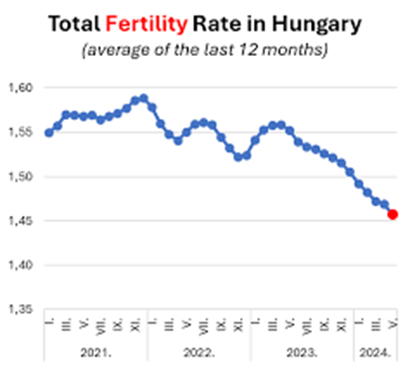
Hungary spends roughly 4% of its GDP on these programs, designed to increase the fertility rate and to raise it above the 2.1 replacement rate. After the first round of family-friendly benefits were passed in 2011, the fertility rate increased significantly from a low starting point. In 2019, the fertility rate was 1.55 and rising; at this point, many countries pointed to Hungary’s apparent success and praised these policies as the key to achieving the replacement rate. However, as shown in Fig. III.1, beginning in 2022 the Hungarian fertility rate began to drop. It is currently 1.38, one of the lowest rates in Western Europe. And there is evidence that this rate is continuing to decrease.
The dramatic recent drop in the Hungarian fertility rate has sparked strong reactions from several parties. Supporters of Viktor Orbán claim that opponents of traditional family structures are the enemy. At the 2023 Budapest Demographic Summit, right-wing psychologist Jordan Peterson stated that “The proper encapsulating structure around the infant are united and combined parents, man and woman. All alternatives to that are worse … Single people, divorced people, gay people, deviate from that.” And University of Leiden philosopher Andreas Kinneging maintained that “Our task is to figure out what is the role of men and what is the role for women, and which roles best correspond to their respective nature. One of them works and one of them takes care of the children.” Conservative supporters of Orbán believe that the recent downturn in fertility is temporary; they say that COVID and the Russian invasion of Hungary’s neighbor Ukraine have caused insecurity that will wane, and that the fertility rate will soon rebound.
Others are decidedly more pessimistic and feel that the drop in fertility is likely to continue. They point to the increasing secularization of Hungarians, concern about climate change, and the high cost of raising children as factors that are unlikely to abate soon. They also point out that Orbán’s popularity is dropping and Hungarian family policies are strongly attached with his regime. We feel that the take-away here is that even with a significant fraction of the Hungarian GDP devoted to family-friendly incentives, they have not succeeded in reaching a fertility rate of 1.60, much less the replacement rate of 2.1. This would suggest that the much smaller financial stipends being considered by MAGA officials are highly unlikely to significantly raise the fertility rate. It is also the case that optimism and a sense of security are important criteria in determining whether a family will have additional children. At the moment, both of these qualities appear to be lacking in Hungary and in the United States.
Sweden:
Sweden is an interesting example, as for nearly a century the Swedes have been aware of the possibility of population decline, and have instituted family-friendly policies ever since the publication of Crisis in the Population Question by Gunnar and Alva Myrdal in 1934. The Swedes provided “free health care for pregnant mothers and generous family allowance payments.” Such policies helped raise the Swedish birth rate from 1.7 in 1935, just following the Great Depression, to a high of 2.5 before birth rates fell after the rollout of the birth control pill.
Figure III.2 shows the Swedish fertility rate from 1970 to 2018. The red curve shows the fertility rate for Swedish nationals, while the grey curve shows the rate for immigrants in Sweden and the gold curve shows the total fertility rate. The fertility rate follows closely the cycles of economic prosperity and recession. By 2010, total fertility rates had risen to nearly 2.0, due to a package of expanded parental leave policies, paid leave for parents with sick children, and family allowance benefits for each child. Beginning in 2010 fertility rates began dropping during the worldwide economic recession; however, they have ticked up in recent years with the current rate 1.84 children per woman on average.
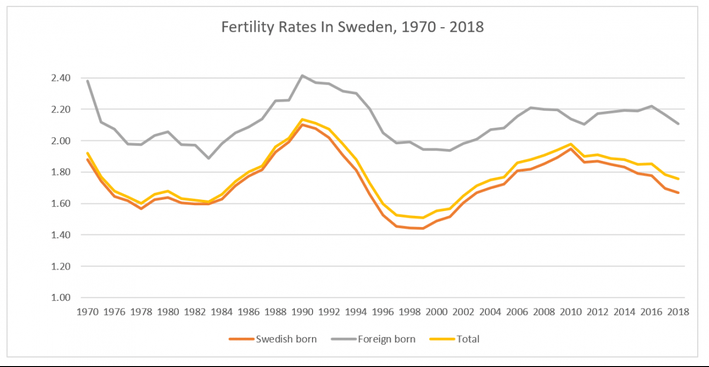
The experience in Sweden shows that wide-ranging parental support programs can have a positive impact on fertility rates. However, the fertility rate drops when the economy turns down, since these programs become too expensive to maintain at full strength. Other cultural trends incentivize couples to have fewer children. The Swedish experience suggests that it is extremely difficult to boost fertility rates above replacement, and to keep them there.
South Korea:
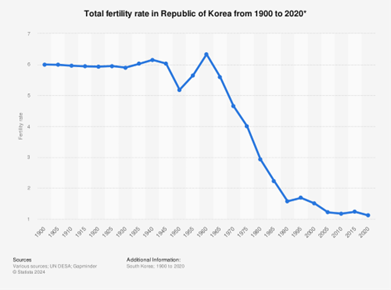
The South Korean experience represents a cautionary tale as their fertility rate is the lowest in all of the Organization for Economic Cooperation and Development (OECD) countries. In 1940 the Korean fertility rate was 6 births per woman, as shown in Fig. III.3, which follows the fertility rate from 1900 – 2020. But following the introduction of the birth control pill, South Korean fertility rates dropped extremely rapidly. During the rapid economic expansion following the Korean War, South Korea failed to provide retirees with generous pension plans. More recently the government also raised the mandatory retirement age; this meant that older citizens worked for longer periods, which removed entry-level jobs for younger workers. In addition, pregnant female workers tended to be laid off by their employers. All of these policies provided disincentives for women to marry and for families to have more children. The mean age at which South Korean women first get married is now up to 30.
One reason for the continued decline in the fertility rate was the fact that Korean men were not inclined to help participate in child rearing and housework. More or less equal participation by men and women in child rearing is one practice that can boost fertility rates, as we’ll discuss further in the next section. In 2023, the fertility rate in South Korea reached a low of 0.72 births per woman. However, the South Korean government instituted a number of family-friendly incentives, including child-rearing stipends that amounted to $350 million. In 2024, the fertility rate increased slightly to 0.75, and the government is determined to raise the fertility rate to 1.0 by 2030. As we discussed in our blog post on low fertility rates, the situation in South Korea will produce some wrenching changes in coming years. There will be far fewer young people in the workforce, which will greatly decrease income that could be used to support their aging population. It will also decrease the Korean gross domestic product, and it will be very difficult for them to support a large military force. South Korea remains the “canary in the coalmine,” a cautionary example of what happens when fertility rates reach disastrously low levels.
Israel:
Fertility rates in Israel are the highest in OECD countries. In 2024, the average fertility rate in Israel was 2.90, a rate well above replacement. However, Israel is made up of a number of different ethnic and religious groups that have very different fertility rates. In 2020, as shown in Fig. III.4, fertility rates for Christians, Druze (a religious minority found mainly in Northern Israel) and secular Jews were around 2.0; however, fertility rates for Israeli Muslims were about 3, those for religious Jews around 4, and those for Haredi Jews (the ultra-Orthodox Jewish community, highly represented in the Jews in the West Bank) were 6.4.
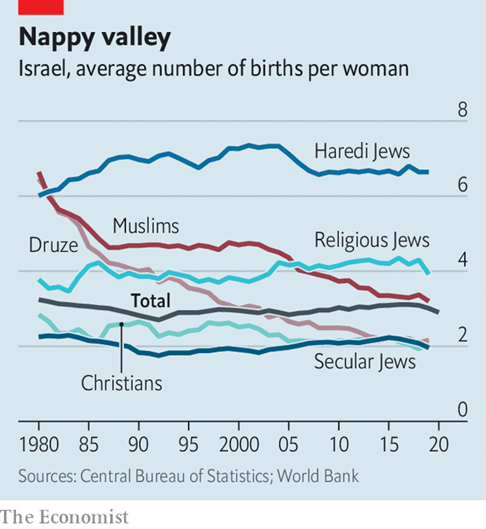
The Haredim have exceptionally high fertility rates – at present, higher than almost any country in the world. Their fertility rates stem from very strong family values, strong adherence to traditional customs, and the tendency to live in separate small (non-urban) communities. Another reason for their exceptional fecundity is very strong nationalistic tendencies. The Haredim generally want to dominate West Bank society and annex the West Bank and Gaza to greater Israel. As long as the Haredim maintain fertility rates so much greater than those in the remainder of Israel, they will represent a bloc that makes up a progressively larger fraction of the Israeli population, with increasing political clout. Because of their focus on family units and on their religious tenets, the Haredim are sometimes compared to the Mormons. However, the fertility rates of the Haredim are essentially double those of the Mormons, so there are probably only simplistic comparisons between those groups. The political goals of the Haredim are quite likely driving their current fertility rates. It is hard to see that the U.S. can draw any conclusions from the Israeli experience that would increase our own fertility rates.
With the exception of Israel, fertility rates in all other developed countries are below the replacement value of 2.1 and are dropping in nearly all of these countries. Some countries such as Sweden have been pursuing family-friendly social policies for a century; and their fertility rate is still about 1.8. In the next Section we will assess the recent proposals for increasing the fertility rate by those aligned with the Trump Administration. From our comparisons with policies adopted by other developed countries, we will conclude that the possibility that these measures will raise the U.S. fertility rate above replacement is very small.
IV. why maga pronatalist policies are likely to fail
What we learn from the history outlined in Section III of government attempts to improve fertility rates in other countries is that government policies tend to have either small and often temporary incremental positive effects or large and inadvertent negative effects. Government policies cannot undo the two huge demographic and cultural shifts that have led to the worldwide decline in fertility rates: increased urbanization and the empowerment of women. Some governments may try to take power away from women by such drastic actions as banning hormonal contraception, limiting female education, or even taking away women’s voting rights, but in democratic countries such attempts are more likely to take power away from the offending governments.
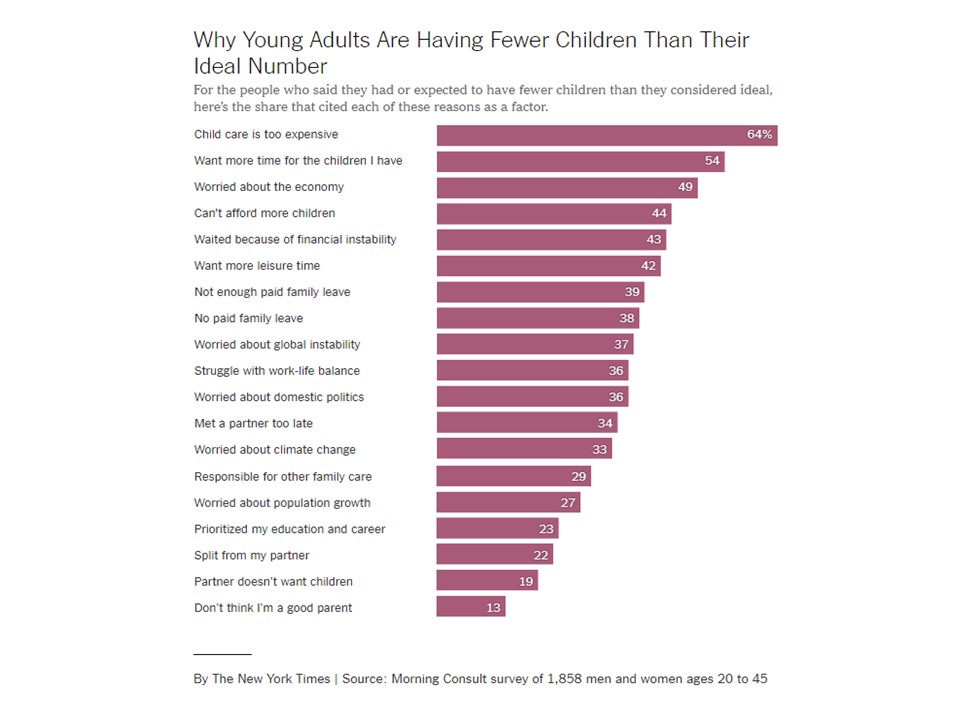
It is useful to listen to young couples about the factors that actually guide their family size decisions. The steady decline in American birth rates that began at the start of the global recession in 2007 led the New York Times and Morning Consult to carry out a survey of couples’ attitudes in 2018. They asked 1,858 U.S. men and women between the ages of 20 and 45 to articulate their reasons for planning smaller families than they consider ideal, or for choosing not to have children at all. The nineteen most common responses are shown in Fig. IV.1. The most common reason for personal choices to limit family size is the growing expense of raising a child and of child care, while most U.S. families’ earning power has remained stagnant and a growing number of potential parents are saddled with ballooning college loan debts. But concerns about the future of the economy, domestic and global instability, climate change, and other human-caused problems also play significant roles, along with a generational change in personal priorities. Also prominent are recognitions about the time commitment needed to raise more children, along with the absence of reasonable paid family leave policies in the U.S. Nowhere among prominent considerations for young couples does “patriotic duty” show up.
There is nothing in the policies that Donald Trump is considering adopting from Pronatalist suggestions that addresses these concerns in any meaningful way. One of the proposals that Trump claims to like is offering a $5,000 “baby bonus” to every American mother after she gives birth. But $5,000 is a tiny drop in the bucket compared to the costs of raising an American child. An analysis by the Brookings Institution indicates that “the average middle-income family with two children will spend $310,605 to raise a child born in 2015 (latest information) up to age 17 in 2032.” If the parents pay for college for the child, add another few hundred thousand dollars. Young couples are very unlikely to be swayed in their decisions by a $5,000 baby bonus. Furthermore, Elon Musk, in his quest to father as many children with as many women as he can, appears to be setting a wildly different scale for how much it costs to induce women to carry and raise his child. Musk’s 13th child, this one with 26-year-old Ashley St. Clair, cost him $2.5 million plus $500,000 a year, according to Musk’s own account.
Another policy suggestion drafted by Pronatalists Malcolm and Simone Collins for the White House Domestic Policy Council would bestow a “National Medal of Motherhood” to mothers with six or more children. This idea seems borrowed from earlier authoritarian regimes; both Hitler (the Cross of Honor of the German Mother) and Stalin (Medal of Motherhood 1st Class) had similar medals for multi-offspring mothers who survived the leaders’ vicious purges. Yet another proposal under consideration would set aside a third of government-sponsored Fulbright Scholarships for people who are married with children, a policy certain to invite a new wave of affirmative action lawsuits. These proposals are not nearly as generous as the “Family Protection Action Plan” instituted by Orbán in Hungary, and that plan shows no evidence that it will halt Hungary’s fertility slide, currently at a rate of 1.38, down from 1.55 at the time Orbán’s recent expansion of the plan was launched.
There is no apparent consideration being given by the Trump administration to policies that would directly address women’s concerns expressed in the survey in Fig. IV.1, for example, to make child care more available and affordable or to provide generous paid family leave policies, such as those in effect in Sweden and Norway. Even without such explicitly family-friendly policies, governments could still boost fertility rates somewhat by providing economic stability and fostering optimism for the future. But Trump’s domestic and foreign policies are doing precisely the opposite. His poorly justified tariffs imposed on every other country (including islands with no human inhabitants!) are threatening the entire world with the triple whammy of high inflation, increasing unemployment, and economic recession, a combination known as stagflation. The high degree of uncertainty about the future economic outlook will cause even more young couples to hesitate about having more children. Trump’s militant opposition to addressing or even acknowledging climate change and his apparent willingness to ignore citizens’ guaranteed rights and the rule of law discourage parents considering whether to bring more children into the world. His apparent preference for dictators over our long-time allies raises legitimate concerns about the future stability of the U.S. The extensive loss of maternity care providers and the increased maternal and infant mortality rates in Trump-supporting states that have adopted draconian anti-abortion laws are making women in those states more insecure about their chances of surviving childbirth.
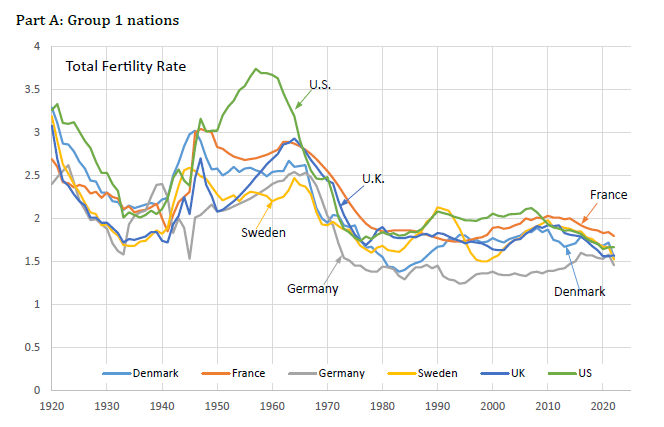
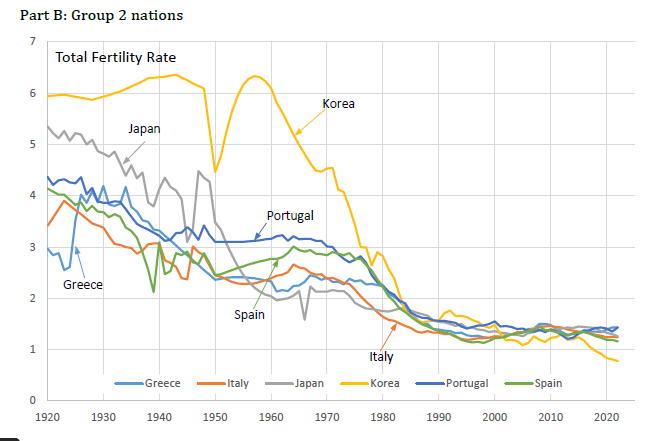
MAGA attitudes about masculinity are likely to depress U.S. fertility rates further. In 2024 Harvard economist Claudia Goldin wrote a working paper entitled Babies and the Macroeconomy for the National Bureau of Economic Research. In the paper she analyzed fertility rates in twelve OECD (Organization for Economic Cooperation and Development) countries that broke down into two groups that have had quite distinct experiences, as illustrated in Fig. IV.2. Group 1 nations – U.S., U.K., France, Sweden, Germany, and Denmark – have seen their 21st century fertility rates mostly hover between 1.5 and 2.0, despite substantial policy differences. Group 2 nations – Greece, Spain, Portugal, Italy, Japan, and South Korea – have fared substantially worse, with 21st century rates uniformly below 1.4 and as low as 0.75 in Korea. The primary distinguishing feature of Group 2 countries in Goldin’s analysis is that, despite their rapid economic growth during the late 20th century, men in those countries have clung to older traditions, where household and child rearing tasks remain largely women’s responsibilities: “What women require of men’s time to raise a family and be members of a modern labor market may exceed the time their more tradition-bound spouses, or future spouses, are willing to offer.”
The difference in fertility rates between Goldin’s Group 1 and Group 2 nations is strongly correlated with male willingness to contribute to household and child rearing chores, as illustrated in Fig. IV.3. The measure of male willingness for the U.S. falls substantially short of the levels in Sweden and Denmark but is still much higher than in the Group 2 countries. But a large part of the MAGA “mystique” is the message that American men need to be more macho and more insistent on avoiding what is seen as “women’s roles” in relationships and marriage. The Pronatalist movement wants to re-establish gender inequality via more traditional, patriarchal marriages in which women stay at home to have and raise babies while they are submissive to their breadwinner men. They may consider Donald Trump an ideal example of fatherhood, as he once told an interviewer about raising children: “I’ll supply funds, and she’ll take care of the kids.” Trump, Vance, and the Pronatalists want to grow more white, Christian men to wield the country’s power. These views may have worked in the 1950s but the Quiet Revolution of female empowerment has changed cultures permanently and governments will have to adapt to the new reality.

In the absence of a viable government strategy to raise American fertility rates, some on the Christian right have undertaken a campaign of birth control disinformation we have written about in an earlier post. Their intention is to scare young women away from the birth control pill and other hormonal contraceptives and toward more traditional (rhythm) and less reliable methods of regulating family size. “Accidental” births do contribute to the fertility rate. But that method, as well as the policies Trump is considering, face the additional challenge of preferentially targeting white Christian women to have more babies, lest white Christians continue on a path toward minority status in the U.S. Israel has managed to see a selective fertility increase for Jews by attracting many ultra-religious immigrants to the West Bank. Perhaps American Christians will decide to follow the Israeli example by attracting ultra-religious Christian immigrants to raise large families on expansive rural farms funded by Peter Thiel. Their current suggestions are not going to do much good. It’s difficult to solve a problem without acknowledging its root causes.
V. summary
In this post we have reviewed the MAGA Pronatalist movement. We discussed the groups who are proposing to boost the American fertility rate at least to the replacement rate of 2.1 children per woman on average, while at the same time shutting down opportunities for immigrants to enter the U.S. The U.S. fertility rate in 2019 was 1.7 which, in Fig. IV.3, lies above the average line for OECD countries when plotted against the difference between the unpaid hours spent on child rearing by females compared with males. But the reason for this is that the American fertility rate was raised by the (formerly) welcoming attitude of the U.S. towards immigrants. At present, the U.S. is closing its borders to immigrants, while attempting to deport millions of undocumented residents of the country (and also deporting some residents who possessed green cards or other permitted status). The MAGA Pronatalists don’t want more immigrant babies even though such babies would eventually contribute to the workforce; they prefer more white, Christian babies.
In Section II, we profiled some of the prominent upper-class American Pronatalist proponents. They hold rather disparate views on relations between men and women: Malcolm and Simone Collins seem to have some feminist views on relations between couples; Elon Musk seems to regard his efforts at procreation as a monetary exchange with his many child-bearers; the Evie magazine published by the Hugobooms combines a focus on female sexuality with retrograde misinformation about the safety and reliability of birth control. Outside of these groups, evangelical Christians often maintain misogynistic views of the proper roles of males and females in a marriage, and they are sharply split regarding attitudes towards in vitro fertilization, which the Collinses, for example, strongly advocate.
In Section III we reviewed the lack of success resulting from efforts to increase the fertility rate in nearly all developed countries. We showed that countries such as Hungary and South Korea have directed substantial sums towards increasing the birth rate – Hungary has devoted more than 4% of their GDP towards these family-friendly policies. The failure of these efforts strongly suggests that the rather small monetary amounts of family support suggested by the Trump Administration will fail to increase the U.S. fertility rate by any significant amount.
A recent article by consultant Rachel Janfaza emphasizes reasons why the MAGA Pronatalist push is almost certain to fail. While Fig. IV.1 summarizes results of a New York Times – Morning Consult survey on the priorities of young Americans towards having and raising children, Ms. Janfaza reports on other surveys that arrive at very similar results. For example, a 2025 Harvard Institute of Politics Youth Poll found that less than half of Americans under 30 said that having a child was important to them; and having a child came in last in the preferences for those interviewed in the Harvard poll. Policy initiatives that do not pay any attention to the large shift in cultural attitudes about family size since the mid-20th century Baby Boom have little chance to succeed in raising fertility rates.
There is also a significant gender gap in how young adults view their situation. An NBC News Stay Tuned poll in April 2025 found that 45% of young men approved of Trump’s performance as president, compared to 24% of young women. And a December 2024 American Enterprise survey of young people found that 73% of college-educated single women say they are unlikely to date a Trump supporter. This gender gap strongly suggests that the large number of MAGA Pronatalists who support traditional roles, where wives don’t work and are expected to submit to their husband’s views on gender relations, will find it difficult to pair up with women holding the same views. But this is only one reason why the Pronatalist proposals seem doomed to fail. Another reason is that the $5,000 “baby bonuses” proposed by the Pronatalists represent a tiny fraction of the more than $300,000 average cost of raising a child through high school. The MAGA Pronatalist financial incentives are a tiny fraction of what has been provided by Hungary, with the very disappointing results shown in Fig. III.1. As pointed out in Section IV of this post, one of the most powerful incentives to raise the birth rate would be a society where young people felt a sense of optimism about American present and future prospects. However, Donald Trump’s economic and political actions to date suggest exactly the opposite. Trump’s tariffs are producing conditions that lead toward “stagflation” – a toxic combination of rising inflation, increasing unemployment and economic recession. Furthermore, Trump’s economic policy appears to be a scheme whereby the President will regularly announce some economic “success,” coupled with large, arbitrary changes in tariff policy. This chaotic behavior will only increase the uncertainty faced by couples trying to assess their future economic circumstances. When this unpredictable economic policy is combined with the male chauvinistic attitudes of many Pronatalists, it strongly suggests that their efforts to raise the American fertility rate are doomed to failure.
references:
DebunkingDenial, Ramifications of the Accelerating Worldwide Baby Bust, https://debunkingdenial.com/ramifications-of-the-accelerating-worldwide-baby-bust-part-i-data-and-causes/
C-J. Lim, Trump Gives Himself a New, Disturbing Nickname: “The Fertilization President,” MSNBC, March 27, 2025, https://www.msnbc.com/top-stories/latest/trump-fertilization-president-womens-history-month-white-house-rcna198342
H. Demissie and K. Faulders, Trump Administration Looking at $5,000 ‘Baby Bonus’ to Incentivize Public to Have More Children, ABC News, April 23, 2025, https://abcnews.go.com/Politics/trump-administration-5000-baby-bonus-incentivize-public-children/story?id=121094707
Wikipedia, One-Child Policy, https://en.wikipedia.org/wiki/One-child_policy
J. Campbell, Africa is the Fastest Urbanizing Place on the Planet, Council on Foreign Relations, Sept. 12, 2018, https://www.cfr.org/blog/africa-fastest-urbanizing-place-planet
Our World in Data, Fertility Rate, https://ourworldindata.org/fertility-rate
C. Goldin, The Quiet Revolution That Transformed Women’s Employment, Education, and Family, Richard T. Ely Lecture, https://pubs.aeaweb.org/doi/pdfplus/10.1257/000282806777212350
J.D. Sciubba, US Births Drop Again, https://jennifersciubba.substack.com/p/us-births-drop-again
D.M. Ely and B.E. Hamilton, Trends in Fertility and Mother’s Age at First Birth in Rural and Metropolitan Counties: United States 2007—2017, National Center for Health Statistics, Oct. 2018, https://www.cdc.gov/nchs/products/databriefs/db323.htm
A. Gonzalez-Barrera and P. Connor, Around the World, More Say Immigrants Are a Strength than a Burden, Pew Research Center, March 14, 2019, https://www.pewresearch.org/global/2019/03/14/around-the-world-more-say-immigrants-are-a-strength-than-a-burden/
C. Trepany, Elon Musk, JD Vance and Why ‘Pronatalism’ is Having a Moment Right Now, USA Today, April 23, 2025, https://www.usatoday.com/story/life/health-wellness/2025/04/23/elon-musk-pronatalism-jd-vance-trump-birth-rates/83215748007/
J. Winter, J.D. Vance’s Sad, Strange Politics of Family, The New Yorker, July 25, 2024, https://www.newyorker.com/news/daily-comment/j-d-vances-sad-strange-politics-of-family
P. Marley, Vance Once Advocated that Children Get Votes that Parents Could Cast, Washington Post, July 25, 2024, https://www.washingtonpost.com/politics/2024/07/24/jd-vance-parents-kids-voting/
M. Astor, Vance Sticks by Pet-Eating Claims and Says He’s Willing to ‘Create Stories,’ New York Times, Sept. 15, 2024, https://www.nytimes.com/2024/09/15/us/politics/jd-vance-springfield-pets.html
H.J. Gomez, Tim Ryan and J.D. Vance Attack Each Other Over ‘Great Replacement’ Theory in Final Ohio Senate Debate, NBC News, Oct. 17, 2022, https://www.nbcnews.com/politics/2022-election/tim-ryan-jd-vance-attack-great-replacement-theory-final-ohio-senate-de-rcna52621
Wikipedia, Great Replacement Conspiracy Theory, https://en.wikipedia.org/wiki/Great_Replacement_conspiracy_theory
M.K. Dennie, Republican Attorneys General to Court: We Demand More Pregnant Teens, Balls and Strikes, Oct. 21, 2024, https://ballsandstrikes.org/law-politics/mifepristone-lawsuit-republican-ags-more-pregnant-teens/
C. Kitchener, White House Assesses Ways to Persuade Women to Have More Children, New York Times, April 21, 2025, https://www.nytimes.com/2025/04/21/us/politics/trump-birthrate-proposals.html
S. McCammon, Trump Administration Cuts Team in Charge of Researching IVF, NPR, April 7, 2025, https://www.npr.org/2025/04/07/nx-s1-5352870/trump-administration-cuts-team-in-charge-of-researching-ivf
R. Tait, JD Vance Endorsed Anti-IVF Report That Contradicts Trump’s New Stance, The Guardian, Sept. 3, 2024, https://www.theguardian.com/us-news/article/2024/sep/03/jd-vance-trump-ivf-abortion-heritage-foundation
J.M. Haas, Begotten Not Made: A Catholic View of Reproductive Technology, United States Conference of Catholic Bishops, https://www.usccb.org/issues-and-action/human-life-and-dignity/reproductive-technology/begotten-not-made-a-catholic-view-of-reproductive-technology
Catholics for Choice, Catholics for Choice and IVF, Feb. 20, 2025, https://www.catholicsforchoice.org/resource-library/ivf/
Wikipedia, Elon Musk, https://en.wikipedia.org/wiki/Elon_Musk
Wikipedia, Errol Musk, https://en.wikipedia.org/wiki/Errol_Musk
Wikipedia, Simone and Malcolm Collins, https://en.wikipedia.org/wiki/Simone_and_Malcolm_Collins
Pronatalist, https://pronatalist.org/
E. Karavani, et al., Screening Human Embryos for Polygenic Traits Has Limited Utility, Cell 179, 1424 (2019), https://pubmed.ncbi.nlm.nih.gov/31761530/
Genomic Prediction, https://www.lifeview.com/
Understand Your Genes. Transform Your Health, https://selfdecode.com/?nab=1
J. Evans, The Religion of the Future Police, Dec. 16, 2022, https://www.philosophyforlife.org/blog/the-religion-of-the-future-police
Billionaires Like Elon Musk Want to Save Civilization by Having Tons of Genetically Superior Kids. Inside the Movement to ‘Take Control of Human Evolution,’ Business Insider, https://www.businessinsider.com/pronatalism-elon-musk-simone-malcolm-collins-underpopulation-breeding-tech-2022-11
DebunkingDenial, Brave New World, https://debunkingdenial.com/still-relevant-after-all-these-years-part-ii/
Collins Institute, https://collinsinstitute.org/
S. Collins and M. Collins, The Pragmatist’s Guide to Crafting Religion: A Playbook for Sculpting Cultures that Overcome Demographic Collapse & Facilitate Long-Term Human Flourishing (Omniscion Press, 2023), https://www.amazon.com/dp/B0BSLDF2FW
Experiencing History, Nazi Motherhood Medals, https://perspectives.ushmm.org/item/nazi-motherhood-medals
DebunkingDenial, The Birth Control Disinformation Campaign, https://debunkingdenial.com/the-birth-control-disinformation-campaign/
R. Walton, The 28 App is a Fresh Approach to Menstrual Health – But It Shouldn’t Replace Your Fertility Awareness Method, Natural Womanhood, Feb. 29, 2024, https://naturalwomanhood.org/28-app/
Wikipedia, Ballerina Farm, https://en.wikipedia.org/wiki/Ballerina_Farm
Wikipedia, Family Policy in Hungary, https://en.wikipedia.org/wiki/Family_policy_in_Hungary
Budapest Demographic Summit in 2023, https://budapestidemografiaicsucs2023.hu/en
T.P. Carney, Hungary’s Government is Trying to Make More Babies – It’s Not Going So Great, Washington Examiner, April 11, 2025, https://www.aei.org/op-eds/hungarys-government-is-trying-to-make-more-babies-its-not-going-so-great/
Wikipedia, Crisis in the Population Question, https://en.wikipedia.org/wiki/Crisis_in_the_Population_Question
In Israel, Birth Rates are Converging Between Jews and Muslims, The Economist, Aug. 18, 2022, https://www.economist.com/middle-east-and-africa/2022/08/18/in-israel-birth-rates-are-converging-between-jews-and-muslims
C.C. Miller, Americans are Having Fewer Babies. They Told Us Why, New York Times, July 5, 2018, https://www.nytimes.com/2018/07/05/upshot/americans-are-having-fewer-babies-they-told-us-why.html
M. Welch and I. Sawhill, Future Estimated Annual Expenditures of Raising a Child, Assuming a Higher Inflation Rate of 4 Percent After 2020, Brookings Institution, Aug. 2022, https://www.brookings.edu/wp-content/uploads/2022/08/Brookings_Cost-to-raise-a-child_inflation-adjusted-2.pdf
T. Parker, How Much Does It Cost to Raise a Child in the U.S.?, Investopedia, Jan. 22, 2025, https://www.investopedia.com/articles/personal-finance/090415/cost-raising-child-america.asp
A. Caldwell, Elon Musk Reveals He Gave $2.5 Million to the Mother of One of His Children Despite Doubting His Paternity: “I Refuse to Find Out,” Marca, Feb. 4, 2025, https://www.marca.com/en/lifestyle/us-news/2025/04/02/67ed1b3646163ff2af8b4586.html
U.K. National Holocaust Museum, Gold Mother’s Cross, https://www.holocaust.org.uk/gold-mothers-cross
Cabinet, Medal of “Motherhood” (Central Asia), https://www.cabinet.ox.ac.uk/medal-motherhood-central-asia-0
M. Goldberg, MAGA Natalism is Doomed to Fail, New York Times, April 21, 2025, https://www.nytimes.com/2025/04/21/opinion/trump-fertility-birthrate-sexism.html
O. Mitchell, US Defends Tariffs on Remote Island of Penguins and Seals, BBC, April 7, 2025, https://www.bbc.com/news/articles/ce84jr5mvnno
Wikipedia, Stagflation, https://en.wikipedia.org/wiki/Stagflation
DebunkingDenial, Live Free AND Die: Why Republican Voters are Dying Younger than Democratic Voters, https://debunkingdenial.com/live-free-and-die-why-republican-voters-are-dying-younger-than-democratic-voters/
C. Goldin, Babies and the Macroeconomy, National Bureau of Economic Research, Feb. 2025, https://www.nber.org/papers/w33311
N. Bajaj, Pronatalism on the Rise to Counter Growing Push for Gender Equality, The Overpopulation Project, https://overpopulation-project.com/pronatalism-on-the-rise-to-counter-growing-push-for-gender-equality/
R. Janfaza, You Can’t Bribe and Shame Your Way to More Babies, Washington Post, May 7, 2025, https://www.washingtonpost.com/opinions/2025/05/07/republicans-baby-boom-gen-z-natalism/
Harvard Youth Poll, Spring 2025, https://iop.harvard.edu/youth-poll/50th-edition-spring-2025
B. Kamisar and B. Bowman, Young Men and Women are Taking the ‘Gender Gap’ to Staggering New Levels, NBC News, April 27, 2025. https://www.nbcnews.com/politics/elections/young-men-women-are-taking-poll-gender-gap-staggering-new-levels-rcna202672
D.A. Cox and K.E. Hammond, Romantic Recession: How Politics, Pessimism, and Anxiety Shape American Courtship, American Survey Center, Jan. 29, 2025, https://www.americansurveycenter.org/research/the-state-of-american-romance-how-politics-and-pessimism-influence-dating-experiences/
 Debunking Denial