
Update December 19, 2024: Will Duffy’s ‘Final Experiment’
Pastor Will Duffy from Colorado had discussions with various Flat-Earthers, specifically about how their theory dealt with Antarctica. Figure 1 shows a “Flat Earth” model, with the Sun moving around a flat Earth disc with the North Pole at its center. As we will show in our following post about Flat Earth or FE ‘theories,’ Flat Earth models are required to posit a number of rather crazy, far-fetched and unnecessarily complicated hypotheses about the Earth. However, Antarctica presents many of the thorniest problems for the Flat Earth crew.

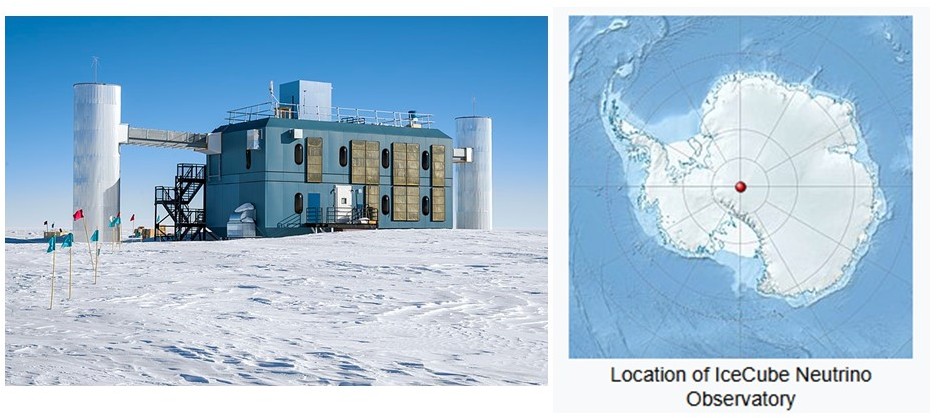
First, from Fig. 1 we see that according to Flat Earth Theory, it should not be possible to travel to and across Antarctica. So according to the Flat Earthers, expeditions that crossed Antarctica must either be mistaken or faked; the same goes for flights to or over Antarctica. One group of Flat Earthers claims that there are NASA troops stationed at the beginning of the “ice wall,” to prevent citizens from scaling the wall (and possibly falling off the disc??). Flat Earthers also claim that the 1959 Antarctic Treaty forbids civilians from traveling to that continent, and they assert that the treaty is designed to keep people from understanding the “true” nature of Antarctica. The claim that civilians cannot travel to Antarctica must be news to numerous teams of research scientists who have established laboratories on that continent. Figure 2 shows one of these, the Ice Cube Neutrino Observatory established at the South Pole by a team of physicists led by the University of Wisconsin. Another fact that provides difficulties for Flat Earthers is the fact that several cruise lines offer cruises to Antarctica.
A major problem with Flat Earth theory is how to deal with 24-hour Sun that circles Antarctica during the height of its summer season (e.g., December). As can be seen from Fig. 1, although Flat Earth theory can accommodate 24-hour Sun over the North Pole during its summer, there seems to be no way that Flat Earth theory can account for a 24-hour Sun over Antarctica during its summer period. Of course, a spherical Earth that is tilted with respect to the Sun and which spins about its axis provides a natural explanation for a 24-hour Sun that circles overhead during the South Polar summer. Pastor Duffy spoke with a number of Flat Earthers, all of whom agreed that Flat Earth theory could not account for the Sun to circle overhead during 24 hours of daylight in the Antarctic summer.
One did not have to go to the South Pole to view this phenomenon, it would only be necessary to travel to a point at, say, 80o S Latitude to test this. So pastor Duffy arranged for a trip to Antarctica in December of 2024. If the expedition members observed 24-hour sunlight with the Sun circling overhead, then the Flat Earthers would be required to admit that they were wrong. For this reason, Duffy called this the ‘Final Experiment’ to test Flat Earth theory. Duffy’s initial idea was to book a flight for himself, one Flat Earther and one ‘Globe Earther’ (i.e., sane scientist). The Globe Earther was chosen by a poll among defenders of the spherical Earth, and particularly those who are active in opposing FE claims. The original ‘Glober’ chosen was Dave McKeegan, a respectable scientist who regularly debates Flat Earthers.
The group was to fly on a plane with Antarctic Logistics Expeditions or ALE. ALE has regularly scheduled flights that depart from Punta Arenas in far southern Chile, and fly to the Mount Ellsworth area in West Antarctica. Duffy raised enough funds to send himself and two others to Antarctica on an ALE flight. Thus, none of the participants would have to pay for their flights. It seemed like a reasonable test of Flat Earth theory. However, as one might have guessed, it was not easy to find Flat Earthers who would agree to participate in this test. First, to some Flat Earthers it would not be possible to land a plane in Antarctica, which for some Flat Earthers is simply a massive ice wall surrounding the flat planet Earth. Also, many Flat Earthers did not want to be the one member of this expedition who tried to convince their FE colleagues that, yes, they had experienced 24 hours of daylight with the Sun circling overhead in all directions.
So, eventually the trip morphed into an expedition with Duffy, three Flat Earthers and eleven ‘Globe Earthers’ who debunk Flat Earth claims. The Flat Earthers were Jeran Campanella, Sean Griffin and Austin Whitsitt. The ‘Globe Earthers’ were Dave McKeegan, Craig from the group Fight the Flat Earth, Michael McToon, Wolfie6020, Creaky Blinder, Globey McGlobeface, WheresWally, Bob the Science Guy, SciManDan, Professor Dave Farina, and Planarwalk (obviously, a number of these are aliases, but you can look them up on their Web pages).
As they approached the date of the trip, the Flat Earthers became progressively more nervous and paranoid. This is not surprising – what would be amazing is if they actually believed the Flat-Earth rubbish they promulgate. The Flat Earthers did not want to be filmed without their permission, and demanded that the ‘Globers’ not post videos of them after the expedition without their permission. It appears that pastor Duffy worked very hard to accommodate the various demands from both sides.
Below is a video from “respectable” scientist Dave McKeegan regarding the question of whether there is 24-hour sunlight during the Antarctic summer. It also shows how a tilted, spinning Earth globe gives rise to the Sun apparently circling overhead during the 24-hour daylight period. This was posted before the Final Experiment expedition, of which McKeegan was a representative of the ‘Globe Earthers’ who maintain that the Earth is a roughly spherical globe (by the way, people have known this for over 2,000 years).
Here is a link to the official Web site for The Final Experiment. It describes in detail the purpose of the trip and the itinerary. It also contains a few videos of preparations leading up to the expedition itself. Will Duffy is very patient and outlines the trip in great detail. And Duffy should be given credit for managing to keep everyone together and actually pull off this expedition, without all of the participants from one side backing out of the commitment.
Next are some articles and videos from the actual Final Experiment trip, which took place from Dec. 14 – 18, 2024. The participants had to make their way to Punta Arenas in Chile, and then board the ALE flight to Antarctica. The group flew due South from Punta Arenas to the Antarctic landing site. The first is an article containing videos from an Australian news source. This article includes live streams from the group in Antarctica. In some of the videos, Flat Earthers in the party agree that they are in Antarctica and that they see 24-hour Sun circling overhead.
Below is a YouTube video from ‘SciManDan,’ a British ‘Globe Earther’ named Daniel Rourke who accompanied pastor Duffy’s Final Experiment trip. He produced this 20-minute video. It begins with a time-lapse 24-hour video taken by Dave McKeegan, which clearly shows that not only does the Sun not set during this period, but the path of the Sun is a circle over the heads of the members of the expedition. And by the way, the Moon also appears to move in circles overhead, just as what would be expected for a spherical spinning and tilted Earth. McKeegan also live-streamed during the making of this video, in order to prove that he was not faking the video. SciManDan then shows the effect that the video had on the Flat Earth community. He shows live comments from Flat Earthers Campanella and Whitsitt (more about their comments shortly) who were part of the expedition. All of the expedition participants agreed that they observed the Sun circling overhead and never setting.
SciManDan then shows various members of the Flat Earth community attempting to deal with the Final Experiment videos. By the way, when they reached Antarctica both Dave McKeegan and Michael McToon stayed up for 24 hours straight, in order to ‘prove’ to any doubters that the Sun did not set while they were asleep. The Flat Earth community has to deal with snarky comments from the Globe Earthers on the expedition; however SciManDan’s video shows that many defenders of Flat Earth (who are referred to by members of the sane scientific community via the derogatory term ‘Flerfs’) are going to have to regroup and cook up more nutty ‘explanations’ for why the expedition participants saw the 24-hour circling Sun.
So, what can we conclude from all of this? Of course, the result was what every legitimate scientist would predict: the continent of Antarctica exists; during the South Polar summer, there is daylight for 24 hours; during this time both the Sun and the Moon appear to move in circles overhead. The Flat Earthers on the trip admit that they observed this. Note that there is considerable discord among the FE community regarding these videos. A few claim that the video is ‘fake,’ and that the video is clearly using a ‘green screen’ fake background. However, other Flat Earthers who were not on the expedition claim that the video is legitimate and that no ’green screen’ was being used. By the way, if this were the case then the Flat Earth participants on the expedition would have to be lying about their experiences.
We were most impressed with famed Flat Earther Jeran Campanella. Not only did he agree to seeing 24-hour Sun on Antarctica, with the Sun moving in circles above the observers, but he said “Sometimes you are wrong in life. I thought there was no 24-hour sun. In fact, I was pretty sure of it. I honestly believed there was no 24-hour sun… I honestly now believe there is. That’s it. What does it mean? You’ll have to figure it out. To me, it means that the AE [Azimuthal equidistant map of Figure 1] map no longer works.” Mr. Campanella concluded, “I admit that I was wrong. I will have to go back and re-evaluate this.” This is a remarkable admission, and it greatly increased our regard for Mr. Campanella.
Flat Earther Austin Whitsitt also agreed that he observed 24-hour sunlight and the Sun circling overhead. However, he said “I have heard that there are ways that the Flat Earth might produce this effect.” As one might have expected, the Flat Earth proponents will now re-group and attempt to cook up some incredibly far-fetched ‘explanation’ for this effect. Note that before the expedition, all the Flat Earthers that Will Duffy talked to insisted that there was no way that Flat Earth ‘theory’ could explain the 24-hour Sun circling overhead during the South Pole summer. Although we doubt that the Will Duffy expedition and its observation of 24-hour Sun during the Antarctic summer will really kill off Flat Earth theory, it will certainly present additional challenges for this world view.
By the way, the Flat Earth ‘theory’ controversy vs. the spherical globe provides an excellent example of Occam’s Razor, named after the 14th century English logician. Occam’s Razor states that when one has competing explanations for the same phenomena, the simplest explanation is likely to be the correct one. Our following blog post demonstrates that Flat Earth ‘theory’ is in fact fiendishly complicated, compared with the much simpler spherical globe model. In fact, the only way that Flat Earth theory can account for the observations of spherical Earth from satellites and the Space Station is to insist that either no orbiting satellites exist, or that observations of Earth from space are somehow totally wrong. Surely the explanation that satellites are observing a spherical spinning Earth is by far the simplest!
Source Material:
Abhinay Singh, Watch: Flat Earth myth debunked after YouTuber’s Rs 31 Lakh Trip to Antarctica, NDTV Dec. 20, 2024, https://www.ndtv.com/offbeat/watch-flat-earth-myth-debunked-after-youtubers-rs-31-lakh-trip-to-antarctica-7291594
The Final Experiment Antarctica (official Website for the ‘Final Experiment’ trip in Dec. 2024), https://www.the-final-experiment.com/
Tom Hale, Flat-Earthers Travel to Antarctica to Test Theories, But are Quickly Humbled, IFL Science, https://www.iflscience.com/flat-earthers-travel-to-antarctica-to-test-theories-but-are-quickly-humbled-77254
Flat Earth You Tuber Admits Mistake After Trip to Antarctica, Jerusalem Post Dec. 20, 2024, https://www.jpost.com/science/science-around-the-world/article-834244
Frank Chung, Flat-Earthers Admit Defeat After Seeing 24-Hour Antarctica Sun: “Sometimes You are Wrong.” New York Post Dec. 19, 2024, https://nypost.com/2024/12/19/lifestyle/flat-earthers-admit-defeat-after-seeing-24-hour-antarctica-sun-sometimes-you-are-wrong/
SciManDan, The Final Experiment Has Obliterated Flat Earth, https://www.youtube.com/watch?v=dEc86p1vgLM
Wikipedia, Ice Cube Neutrino Observatory, https://en.wikipedia.org/wiki/IceCube_Neutrino_Observatory
Tim Londergan, February 6, 2020
Introduction to Flat-Earth Theory
Among the various science denial issues we deal with on this site, most are more important, but none quite as confounding, as the social-media-boosted revitalization of beliefs in a flat Earth. In contrast to the other issues we cover, Flat-Earth believers are not driven, nor purposely misled, by people with clearly identifiable political, economic or religious agendas. They have to reject coherent and non-controversial scientific explanations for a very wide range of phenomena, including all of modern astronomy and cosmology, and such everyday experiences as the rising and setting of the sun, twice-daily tides, gravity, the seasons, lunar eclipses, etc. They have to decry as fraudulent all photographic images of Earth from space. They have to deny evidence available to nearly everyone from worldwide air travel. They strive to carry out their own flawed “experiments” to demonstrate the planet’s alleged flatness. And they are forced to attribute debunking of their ideas to a vast worldwide conspiracy.
But since their movement appears to be gaining more media exposure, I decided to take a look at the history and status of flat-Earth theories. I was not sure what to expect, although I did not have high expectations. The theory of gravitation is an absolutely essential element of physics and astrophysics. In addition, our entire understanding of the history and evolution of the Earth relies on the fact that the Earth is a spheroid that rotates on its axis once each day, and revolves around the Sun with a period of one year. So it seemed unlikely to me that I would find anything that might cause me to doubt that the Earth is a rotating and revolving spheroid. But I found a host of material (primarily Web sites) that reviewed Flat-Earth theories, both pro and con.
Of the pro-Flat-Earth Web sites, the one I found most useful is Flat Earth: Frequently Asked Questions, on Flat Earth Wiki. Another useful summary was Eric Dubay’s booklet called 200 Proofs Earth is Not a Spinning Ball. Another important resource was the 1864 book by Samuel Rowbotham (Parallax), Zetetic Astronomy: Earth Not a Globe.
I will divide other interesting publications into two categories. The first were articles that provided capsule bios of Flat-Earth believers. An interesting article was Looking for Life on a Flat Earth, by Alan Burdick, from the May 30, 2018 edition of The New Yorker. A second was Alexis Kleinman’s online article Meet The People Who Believe the Earth is Flat, from Mic in August 2016. A comprehensive book was Flat Earth: The History of an Infamous Idea, by Christine Garwood. It provides a chronological history of Flat-Earth arguments and the major actors in the Flat-Earth community from the 19th century until about 2005.
The second category were Web sites that debunked the pseudo-scientific claims made by Flat-Earthers. There are many such articles on the Web, two of which were particularly useful. The first was an impressive collection that summarized hundreds of reasons why Flat-Earth conjectures are unscientific and totally wrong. This was called Debunking Flat Earth Misconceptions, and can be found here. We will use several of their impressive graphics in our review. The second was by Jos Leys, called Flat Earth Nonsense. Leys has produced several videos that show convincingly why Flat-Earth ideas make no sense and conflict with scientific observations.
Our post is organized in the following manner. In Part I, we will first review the rebirth of Flat-Earth ideas in the 19th century. Then we will outline the beliefs of one group of Flat-Earthers (there is more than one group, and they differ in some respects). We will conclude by reminding the reader of the theory of gravity, and we will emphasize the centrality of the gravitational field to astronomy and cosmology.
In Part II we will discuss a few of the many problems and paradoxes confronting Flat-Earth Theory. In Part III we will list some characteristics of people who profess to believe in Flat-Earth Theory.
Many ancient societies believed that the Earth was flat. For example, in Mesopotamian mythology the Earth was believed to be a flat disc floating on water, surrounded by a hemisphere of stars. Various Greek philosophers, particularly Pythagoras, are credited with proposing that the Earth was a sphere. In Pythagorean philosophy, much attention was paid to geometric structures, and the sphere occupied a central position by virtue of its perfect symmetry. A major advance came from Aristotle (384- 322 BCE), who assembled a list of arguments that the Earth was a globe. First, he noted that stars which were visible in Egypt and Cyprus were not visible in more northern countries. He also noted that as one traveled south, southern constellations appeared higher in the sky. Next, Aristotle argued that all over the Earth, bodies are attracted to the center. So “by compression,” matter on Earth should tend towards a spherical shape. Finally, during a lunar eclipse one sees a round shadow move across the Moon, and Aristotle concluded that this was the shadow cast by a spherical Earth positioned directly between the Sun and Moon.
The modern rebirth of Flat-Earth theory was developed by Samuel Birley Rowbotham (1816 – 1884) and others during the middle of the 19th century. We will review Rowbotham and his career, and a few of his arguments that the Earth was flat and stationary.
I.1: Samuel Rowbotham: Godfather of Flat-Earth Theory
The first modern Flat-Earther, and the model for the Flat-Earthers who followed him, was Samuel Birley Rowbotham. He was a fairly mysterious British fellow who was born in 1816 and died in 1884. At roughly 30 years of age, Rowbotham was managing a socialist commune that had been originally founded by Robert Owen, in the county of Cambridgeshire. As this area of Britain was predominantly flat, Rowbotham carried out some experiments to measure (or debunk) the curvature of the Earth.
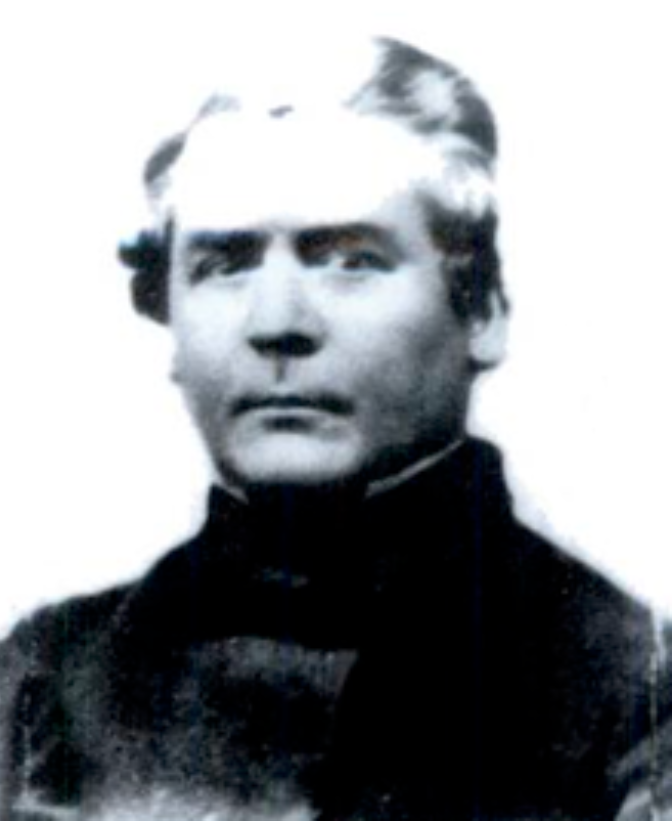
One of his experiments involved a measurement along a straight stretch of water called the Bedford Level. In winter Rowbotham lay on the ice and sighted along the water with a telescope. Over this 6-mile distance, the Earth should have curved by approximately 24 feet. So Rowbotham should not have been able to see anything less than 24 feet high over that distance. However, he announced that he could see people skating. This led him to the belief that the Earth was not round but flat. We will later review the flaws in Rowbotham’s measurements over water.
Next, Rowbotham read several Bible passages. As a socialist it would have been natural for Rowbotham to be an atheist, but his subsequent theories about the Earth relied heavily on his interpretation of Biblical statements. Rowbotham adopted a fundamentalist viewpoint that the Earth “lay at the centre of the universe, was less than six thousand years old, was created in six twenty-four-hour days and was rapidly approaching destruction by fire.” He further concluded that the Earth was a flat disc with the North Pole as its center.
Furthermore, Rowbotham hypothesized that this disc was surrounded by a giant wall of ice. Presumably this would keep the water from falling off the edge of the disc; however, this hypothesis eliminated the South Pole altogether. In Rowbotham’s picture, the Sun and Moon travel in circles above and around the North Pole. Astronomers calculated that the Sun was roughly 93 million miles from Earth, while the Moon was over 800,000 miles from Earth (at this time, those distances were somewhat uncertain). However, in Rowbotham’s picture they were incredibly small and close to Earth. In Rowbotham’s picture, the Sun and Moon orbited above the flat Earth in opposing circles. According to Rowbotham, both of these celestial bodies were of roughly equal size, and the Sun was no more than 700 miles above Earth. The stars were located in a hemispherical dome above the flat Earth, and Rowbotham estimated that the radius of that dome was roughly 1,000 miles above Earth.
In 1864, under the pseudonym Parallax, Rowbotham published a book Zetetic Astronomy: Earth Not a Globe. He assembled a set of arguments why the Earth was not spherical, but flat. The first of these were Biblical references that appear to indicate that ancient Hebrews thought of Earth as flat (we will cite several relevant Biblical passages in part III).
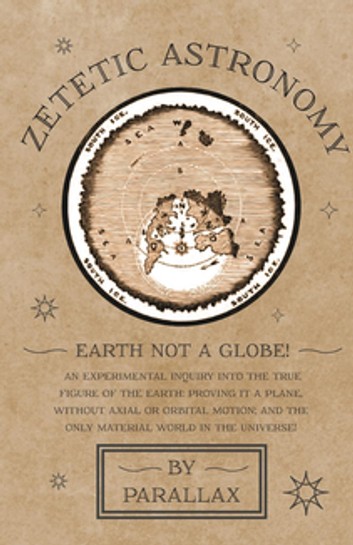
Parallax included a series of mocking statements to reassure the reader that it was common sense to conclude that the Earth was not moving. Zetetic Astronomy also included sarcastic comments addressed to those who maintained that the Earth was rotating once a day about its axis, or that Earth was revolving around the Sun once every year. A third set of arguments discussed measurements that Rowbotham and others had carried out, leading them to conclude that Earth was flat and stationary. Zetetic Astronomy also included quotes from other scientists or pseudo-scientists. In some cases the scientists were misquoted, or Rowbotham misinterpreted what they said. In other cases he provided statements from cranks, or people who thought they had overturned natural laws. Rowbotham concluded with quotes from sailors, soldiers, explorers, or others who were convinced that the Earth was flat.
Rowbotham appears to have operated under several different aliases. In addition to his real name, Rowbotham used the pseudonym “Parallax” both for his writings and for his public lectures. He also sold “snake-oil” medicines that claimed to cure any number of ailments under the name “Dr. Samuel Birley,” and he was also known as “S. Goulden.” Birley argued that the most common cause of death was “general ossification or choking up of the body by ‘earthy matter,’ most commonly phosphate and sulphate of lime.” So Birley recommended diets that avoided these substances, and he also concocted ‘miracle cure’ tonics that he claimed would cure most ailments and prolong life.
Under the alias Parallax, Rowbotham gained a certain amount of fame for his public lectures claiming to prove that the Earth was flat. By all accounts he was witty and engaging, and his sarcasm was rather effective. He had answers to nearly all rejoinders that the Earth was a sphere, and several scientists who unwisely took him up on offers to debate found it difficult to defend their positions against the crafty Parallax.
One of Rowbotham’s maxims was that people should not take anyone’s word for scientific propositions, but should maintain a skeptical attitude and carry out investigations by themselves. If this ‘zetetic’ attitude was followed through in true scientific fashion, this would be an admirable position, even though it limits one to experiments that can be carried out by individuals. So Rowbotham (and the Flat-Earthers who have succeeded him) proudly carried out several measurements challenging central tenets of physics and astronomy. As Parallax, he framed this as a populist challenge to the elite world of science. He wrote, “Bigots may howl; tyrants may frown; hypocrites may sneer; the coward may quail; the indifferent may marvel but the champion of truth, armed in honesty of purpose, pursues his festal path, invulnerable and victorious.”
Now, it might appear superficially that Flat-Earthers are simply advocating a healthy skepticism. And we are on record that skepticism is an essential element of the scientific method. Unfortunately, Rowbotham’s scientific endeavors contained a host of major flaws. We will focus on two of his errors. First, he stressed the importance of “common sense” in drawing conclusions. An important principle in Rowbotham’s scientific toolkit was that “common sense” notions are most probably correct. As we know, many seminal advances in astronomy and physics resulted from the overturning of “common sense.” An important example was the realization that the Earth was rotating on its axis and revolving around the Sun. A second “common sense” notion was that a body would come to rest unless a force was acting upon it. A third common sense conclusion was that the Sun and Moon must be the same size, because they are commensurate in perceived size.
The pseudo-scientific experiments carried by Rowbotham and fellow Flat-Earthers were also fatally flawed, because the purpose of their measurements was not to test their hypotheses but rather to verify their predetermined conclusion that the Earth was flat. Thus, they would accept any result, no matter how flawed the measurement, as long as it supported their prior belief; conversely, any result that contradicted their prejudices would be “explained away,” often by dubious arguments.
Take the tests of the Earth’s curvature. These often involved sighting across bodies of water with a telescope. We know several potential sources of error in such measurements; refraction of light can play a significant role, and atmospheric conditions are also important. For example, the refraction (or bending) of light in heated air adjacent to Earth’s surface is responsible for mirages. A legitimate scientist would labor to understand these effects, work to minimize them, and would progressively improve the accuracy of their instruments, with the aim of producing accurate and reproducible results. Not so the “Zetetics;” if they obtained the desired result they accepted it; and if the result contradicted their beliefs, they rejected it. This is the definition of denial; remember Neil deGrasse Tyson’s remark “A skeptic questions the science and embraces the evidence; a denier questions the science, and rejects the evidence.”
Here is an example of Flat-Earth denial. Rowbotham/Parallax offered large sums of money to anyone who would challenge him in a test of the Earth’s curvature. Of course, he had no intention of paying up. On one occasion he participated in a public test where a telescope was set up across a body of water looking at Eddystone Lighthouse, 14 miles distant. Scientists maintained that, due to the curvature of the Earth, only the lantern of the lighthouse would be visible at that distance. When the test was carried out, only half the lantern was visible. But Rowbotham, instead of conceding defeat, announced that the sighting confirmed that the Earth was indeed flat!
The book by Parallax discusses the motion of a ball thrown “directly upwards” from a train moving at constant velocity (in the absence of air resistance). Parallax incorrectly asserts that when the ball returns to Earth, it will land far behind the train,. This is completely incorrect; to an observer on the ground, the ball has the same horizontal velocity as the train, thus the ball will return to the same spot on the train from which it was thrown. Parallax used this bogus example to “prove” that the Earth cannot be moving (if you throw a ball straight up, it comes back straight down – but Parallax incorrectly claimed that if the Earth rotates, the ball would land in a different place). So, the conclusion that the Earth does not rotate or move was based on a lack of understanding of relative velocity. Parallax’s ignorance of the laws of physics leads him to a false conclusion.
In similar fashion, Rowbotham maintained that the Moon must emit its own light. This was based on a series of errors. First, Rowbotham claimed that if the Moon’s “light” was simply reflected from the Sun, it would have to exhibit the characteristics of light reflecting from a mirror. Here Rowbotham confused specular reflection (from a smooth surface such as a mirror) and diffuse reflection from such everyday objects as a piece of white paper. Rowbotham also stressed that during a lunar eclipse, the Moon turned a reddish color. He concluded this was evidence of a very hot body glowing red, as if from an internal ‘furnace.’ We now understand how the ‘blood Moon’ arises in a lunar eclipse, by refraction of the Sun’s light as it passes through the Earth’s atmosphere (where blue light is preferentially scattered out of the light’s path, just as at sunset) and is reflected from the Moon.
With a few exceptions, modern Flat-Earthers simply repeat the claims and errors in the work by Parallax. Furthermore, many of their citations come from the 19th century or even earlier. In Rowbotham’s day, it was much easier to advocate that the Earth was flat. Photography had been introduced only recently. There were no airplanes, and even the sport of ballooning was relatively new. There were no rockets, no satellites, no manned space-flight, no International Space Station, no modern telescopes (either land-based or in space). There was no Internet, no international data archives, no smartphones, no GPS. But even in the mid-19th century, it was still difficult to maintain that the Earth was a flat plane, with a gigantic ice wall surrounding it and no South Pole, and with an extremely small Sun and Moon circling at amazingly close distances.
One would imagine that continued belief in a flat Earth would be almost unthinkable today. And indeed, for a mainstream scientist, it is astonishing that anyone can maintain these beliefs. As we will see, this requires a stubborn dismissal of every proof of a spherical Earth, combined with acceptance of a host of conspiracy theories. I have not been able to find anyone on the science faculty at a reputable institution who subscribes to Flat-Earth theory. It is nothing short of amazing that modern Flat-Earthers still hold fast to Rowbotham’s bogus beliefs. We will discuss this in greater detail in the following parts.
I.2: The Flat-Earth Picture of Earth and Heavenly Bodies
I enjoyed Christine Garwood’s book Flat Earth: The History of an Infamous Idea. It provides an extensive review of the genesis of this idea in the 19th century. It then follows the Flat-Earthers up to the 2nd decade of the 21st century. There is not one, but several “Flat Earth” groups. As their name implies, all of them maintain that the Earth is not round, but flat. Furthermore, they maintain that the Earth is stationary – it does not rotate on its axis once a day, and it does not revolve around the Sun. There are different assertions about the shape and size of the Earth. The most common one is that the Earth is a disc, and that “Antarctica” is not a continent, but instead a massive ice wall surrounding the edge of the disc. A less common assertion is that the Earth is an infinite plane. Finally, in the 19th century some Flat-Earthers believed that the Earth was a rectangle with four corners.
We will focus on the most common assertion, that the Earth is a flat disc. Below is a sketch of a proposed Flat Earth. In this configuration, the North Pole is in the center of a flat Earth, with a wall of ice surrounding the ‘South Pole’ area. This is an 1897 flat-Earth map. This is basically the flat-Earth version that we will discuss in this review.

A similar Flat-Earth hypothesis, by Prof. Orlando Ferguson, had the same structure as the 1897 map, with North Pole in the center and a wall of ice surrounding the circular disc. However, in this map the Earth is a basin with a rim containing the ice wall. Prof. Ferguson also has the Sun and Moon sprouting out of the North Pole on arc-shaped arms. Those bodies revolve in circles above the Earth. Ferguson’s world is square. He adds four corners that lie outside the ice wall, with an angel at each corner. The angels are added in agreement with a Biblical phrase (Revelations 7): “Four angels standing at the four corners of the Earth, holding back the four winds.”

One type of argument employed by Flat-Earth advocates (and taken directly from Samuel Rowbotham) is the appeal to “common sense.” They assert that the Earth is obviously flat, and it is obviously at rest. Indeed, these arguments were considered compelling to ancient cultures. Flat-Earthers also emphasize that one should not believe any statement that they have not personally tested.
Flat-Earthers dispute several fundamental claims of physics and astronomy. The scientific description is that the Earth spins on its axis, making one complete rotation per day. Furthermore, the Earth is one of the planets of our solar system, with each planet revolving around the Sun, making one complete revolution every planetary year. Finally, the solar system is moving with respect to our galaxy, the Milky Way. To Flat-Earthers, these statements are simply unbelievable. They claim that this motion is not possible, and they invent several paradoxes that, to them, invalidate claims of the Earth’s motion. Like the 19th-century Flat-Earth theorists, they spend much time ridiculing the very idea that the Earth is not flat and not at rest.
As Neil deGrasse Tyson said, “Skeptics question the science.” But as we have mentioned, skepticism can harden into denial when people deny the results of reproducible evidence. And as we will show, Flat-Earth Theory is arguably the mother of all denial.
Where are the Sun and Moon in the flat-disc model of a stationary Earth? In the model that we discuss, they circle above the Earth. Today, Flat-Earthers claim that both the Sun and Moon are about 3,000 miles above the Earth. Hence both of these bodies are incredibly smaller than is believed by mainstream scientists, and much closer to Earth (the Moon is 238,900 miles from Earth, on average, while the Sun is 93 million miles from Earth). Furthermore, the Sun and Moon are the same size – this is another argument from “common sense.” In the sky, the Sun and Moon appear to be commensurate in size, so common sense dictates that this must be correct. The figure below shows the Flat-Earth picture, with the Sun and Moon circling above Earth.
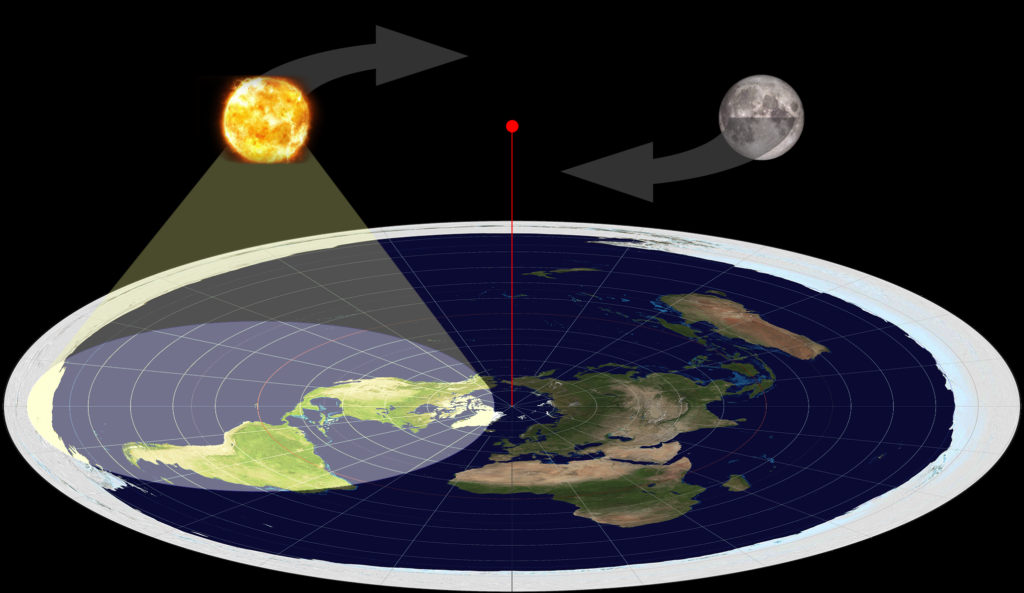
It will be immediately evident that if the Sun were really only 3,000 miles above the Earth, it should illuminate the entire planet; this introduces a paradox, since when it is noon on one side of the Earth, it is midnight at a longitude 180 degrees away. So Flat-Earthers maintain that the Sun’s rays do not spread out equally in all directions, but that the Sun shines like a “searchlight,” illuminating only a cone directly below it. The orbits of Sun and Moon vary over the course of the year, which is supposed to explain the seasons. However, it is difficult in this picture to explain how the Sun and Moon rise and set over the horizon. Furthermore, it is hard to understand how both poles can experience periods of 24-hour sunlight in mid-summer and long unbroken stretches of darkness in mid-winter.
So what about the stars in a model with a flat and stationary Earth? Flat-Earthers believe that the stars are fixed in a “celestial sphere” whose center axis is the north celestial pole (very close to Polaris, the North Star). The entire celestial sphere rotates around the Earth once every day, and its radius is roughly 4,000 miles. The celestial sphere is shown in Fig. I.6 below.
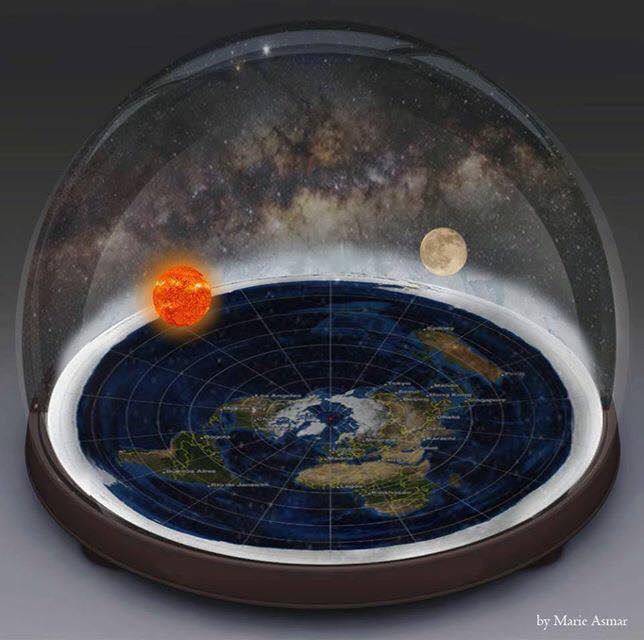
So, if the Earth is a flat, stationary disc with Sun and Moon the same (very close) distance away, and the stars fixed in a celestial sphere (also extremely small), then what happens to gravity? In the Flat-Earth version that we critique, gravity does not exist. Then why do things fall to Earth when we drop them? Flat-Earthers claim that this is simply buoyancy — things that are more dense than air sink towards Earth, while things that are less dense rise. By the way, this hypothesis is completely incapable of explaining why things fall or rise. An apple released in the space station does not fall, despite the fact that the apple is more dense than the air. And without gravity, there is no coherent explanation for the motion of the planets with respect to the Sun.
However, the Flat Earth Society (another group of Flat-Earth advocates) claims that we experience ‘gravity’ because the entire Earth disc (together with Sun, Moon and celestial sphere) is moving upwards at a constant acceleration g = 9.8 m/s2. This is, of course, a classic Earth-centric viewpoint. It cannot account, for example, for the fact that the acceleration associated with gravity is much smaller on the surface of the Moon. But if you also reject as a conspiracy theory all evidence that spacecraft and astronauts have orbited and landed on the Moon, this fact does not trouble you.
Simple math will show that if the Earth started at rest and accelerated at a constant rate g, then the Earth would reach the speed of light (c = 300 million meters/second) in 1 year. However, here the Flat Earth Society invokes Einstein’s Special Theory of Relativity to ‘show’ that Earth’s velocity would asymptotically approach the constant c. But if the velocity of Earth approaches a constant, the acceleration will decrease, and will asymptotically approach zero. Furthermore, since the effective mass of an object increases as its speed increases, maintaining a constant acceleration requires an increasingly larger force. As the velocity approaches the speed of light, the force required to accelerate the Earth goes to infinity. We won’t belabor this point, because it is not worth arguing about any Flat-Earth claim, as it is not possible to convince Flat-Earthers that they are deluded. As we will see, when faced with a paradox, Flat-Earthers will adopt any improbable argument to “correct” the situation.
I.3: A Brief Review of Gravity
In science, an effective hypothesis allows us to understand issues beyond the one for which it was postulated. In that regard, Isaac Newton’s Theory of Universal Gravitation is one of the most successful hypotheses of all time. First, Newton deduced that any two massive bodies attract one another with a force that is proportional to the product of the masses of the bodies, and inversely proportional to the square of the distance between their centers. The direction of the gravitational force is along the line joining the centers of the two masses. Furthermore, by Newton’s Third Law of Motion, the gravitational force exerted by mass m1 on mass m2 is equal in magnitude and exactly opposite in direction to the force exerted by m2 on m1. The gravitational force is shown schematically in the figure below.
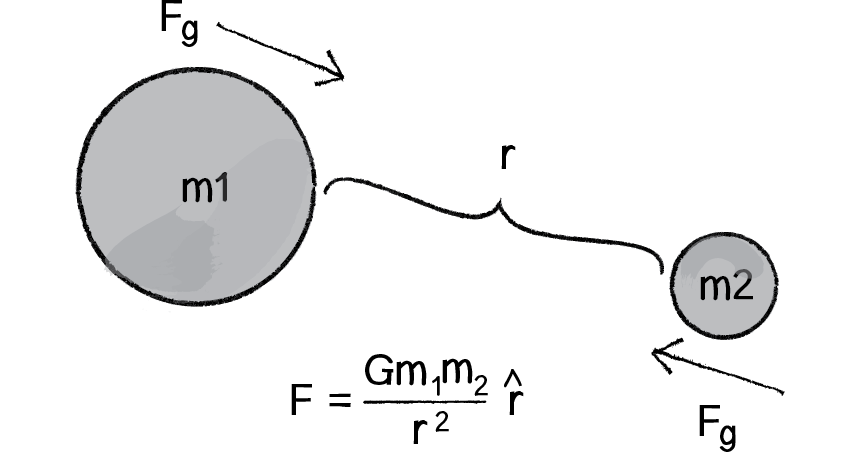
Newton proved that for a spherically symmetric distribution of mass, the gravitational force acts as though all the mass was concentrated at a single point, the center of the object. Since to a good approximation the Earth is spherically symmetric, the Earth’s gravitational force on any object located at or above the surface of the Earth points directly towards the Earth’s center.
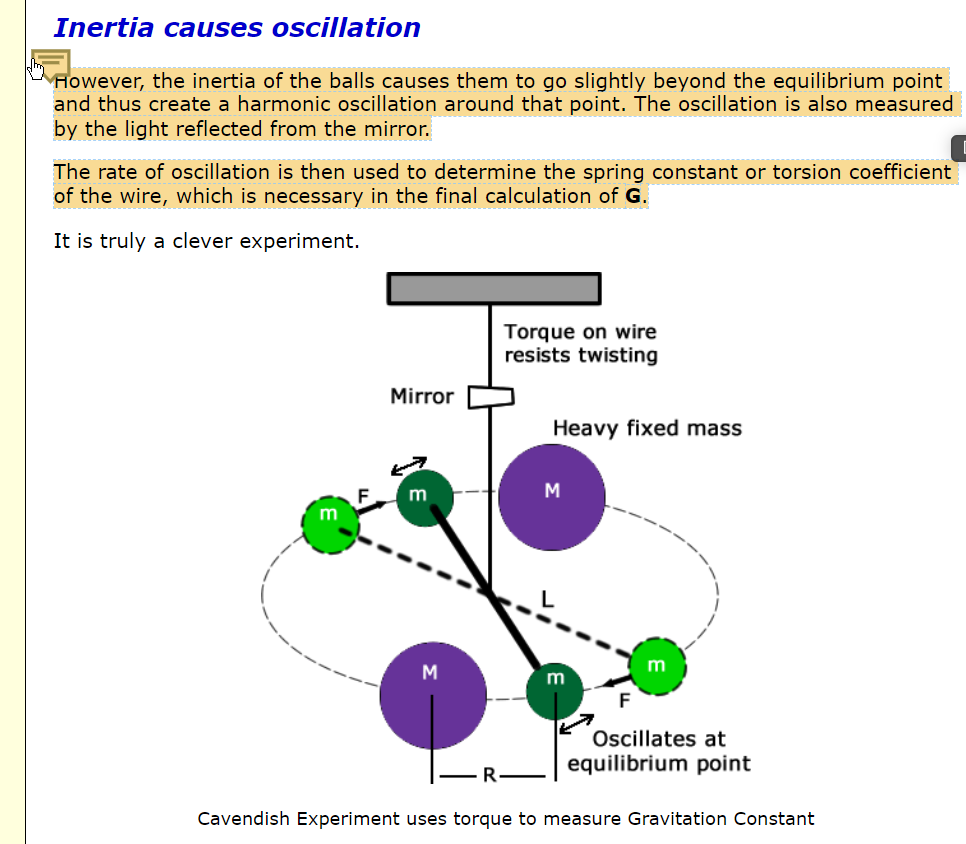
Flat-Earthers are fond of claiming that no one has ever measured the gravitational force between two bodies. This is manifestly false; the first measurements were made by Henry Cavendish in 1797, and a schematic of his apparatus is shown in Fig. I.8. Two small masses m are hung from a fiber, and are attracted to two large fixed masses M. The attractive gravitational force causes the fiber to rotate, and the magnitude of the force can be deduced from the amount of rotation of the fiber. Flat-Earthers often cite various problems with the Cavendish measurement; however, this experiment has been repeated many times with progressively more advanced techniques, and it reproduces all the details of Newton’s gravitational force.
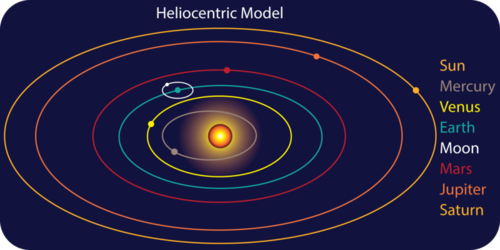
The first consequence of the Universal Law of Gravitation was that the force of gravity from the Earth on objects at the Earth’s surface, which causes objects to fall with acceleration g = 9.8 m/s2, is the same force that attracts the Moon to the Earth. In the heliocentric picture of the Solar System, every planet feels a gravitational attraction to every other planet, and also to the Sun. However, since the mass of the Sun is much greater than the mass of any other planet, to first order we can neglect the influence of those planets and approximate that each planet is attracted only by the Sun’s gravitational force.
We now know that an ellipse is the most general orbit for a body under the influence of a force that is inversely proportional to the square of distance (this can be proved mathematically). A circular orbit is defined by a single quantity, its radius; an elliptical orbit can be defined by two quantities, e.g., the semi-major axis and the semi-minor axis. An ellipse is shown below, with the semi-major axis (horizontal) and semi-minor axis (vertical) listed.

An ellipse will have two “focal points” on the semi-major axis, equidistant to the left or right of the center. We can prove that under the influence of the gravitational force (and considering only two-body forces), every planet will undergo an elliptical orbit about the Sun, with the Sun at one focal point. Fig. I.9 shows the elliptical orbit of a satellite about a star; and Fig. I.10 shows several planets in elliptical orbits about the Sun.
So, Newton’s theory of gravity predicts that every mass m on the surface of the Earth will experience a gravitational force pointing towards the center of the Earth and with magnitude F = mg. By Newton’s Second Law, if gravity is the only force that acts on the mass, the acceleration of a body towards the Earth will be a = F/m = g. Thus, in the absence of forces such as air resistance, all bodies at the Earth’s surface will accelerate towards the Earth at the same acceleration g. In the presence of air resistance, objects like a feather and an apple fall to Earth at very different rates. However, if we place those objects in a vacuum tube, both the feather and apple will accelerate at exactly the same rate, g. This is shown in Fig. I.11 below, with time-lapse photos showing the trajectories of a feather and an apple released simultaneously in an evacuated tube.

Now, Newton’s theory of universal gravity, modified by Einstein’s theory of general relativity, describes the gravitational interaction between all masses. It is the dominant force in astronomy, since most large bodies have essentially zero net electric charge and hence no electrostatic forces. So, the theory of gravity describes the motion of all large masses in the universe relative to one another.
With the advent of large telescopes and detectors mounted on satellites, we have discovered many distant galaxies. We can determine the motion of these distant galaxies relative to our Solar System through spectroscopy. Stars emit light (electromagnetic or EM radiation) over a range of frequencies, and different gases in those stars emit light at specific, known frequencies determined by the energy levels in the atoms and molecules of those gases. But those frequencies are shifted when the light is observed on Earth, depending on whether the star is moving towards or away from us. This shift is a manifestation of the same Doppler effect that is familiar when we hear the whine of a race-car engine shift in tone between times when it is approaching us and receding from us. Thus we can determine the direction and speed of distant galaxies by measuring those frequency shifts. Those measurements are all consistent with the notion of a universe expanding in a manner consistent with Einstein’s General Relativity, the modern theory of gravitation.
Gravity is also the mechanism that initiates the birth of stars. Through the self-organizing property of the attractive gravitational force, large clouds of hydrogen gas coalesce and become progressively more dense. The central areas of highest density increase in temperature until the central temperature reaches about 10 million degrees Celsius. At that point, the kinetic energy of the protons that form hydrogen nuclei is sufficiently high that protons are able to overcome their electrostatic repulsion and fuse into helium nuclei. In the fusion process, a large amount of energy is generated. This energy is converted into EM radiation that is released from the star. The star will reach equilibrium when the inward gravitational force causing the star to collapse is just balanced by the radiation force pushing outward. We know how much energy the Sun emits per second as a result of these fusion reactions, and if it were truly only 3,000 miles from Earth, the Earth would be so intensely hot that it could not be inhabited (also, since the Sun’s radius is over 400,000 miles, the Earth would be inside the Sun).
Gravity attracts matter (in this case, gas) from all directions, so the star will generally have a spherical shape. The same is true for solid planets like the Earth. Rocky matter will gravitationally self-attract, once again from all directions. The shape that has the greatest volume for a given surface area is a sphere. Using gravity to self-assemble matter into a disc would not result in a stable configuration.
The Flat-Earthers, on the other hand, have no idea how stars are born or how their energy is generated. They have even less idea why the Sun would act like a “searchlight,” shining its light only on a small cone. And they cannot explain why they believe that the Moon generates its own light (of course, they must reject all images of the Moon from powerful telescopes, photos of the Moon taken by both unmanned and manned spacecraft, and Moon rocks brought back to Earth by the Apollo astronauts).
Einstein’s general theory of relativity shows that Newton’s gravitation theory needs to be modified. One new result of the general theory of relativity is that light is bent by the gravitational field of a mass. For light that travels to us from very large distances, and passes near large masses (e.g., galaxies or massive clouds), the light does not travel in a straight line, but bends, much as it would in an optical lens. Scientists use this ‘gravitational lensing’ to observe images of stellar objects that would otherwise be hidden behind closer objects in space. We can observe and measure this bending of light, and the general theory of relativity allows us to determine the distribution of matter through which the light passed.
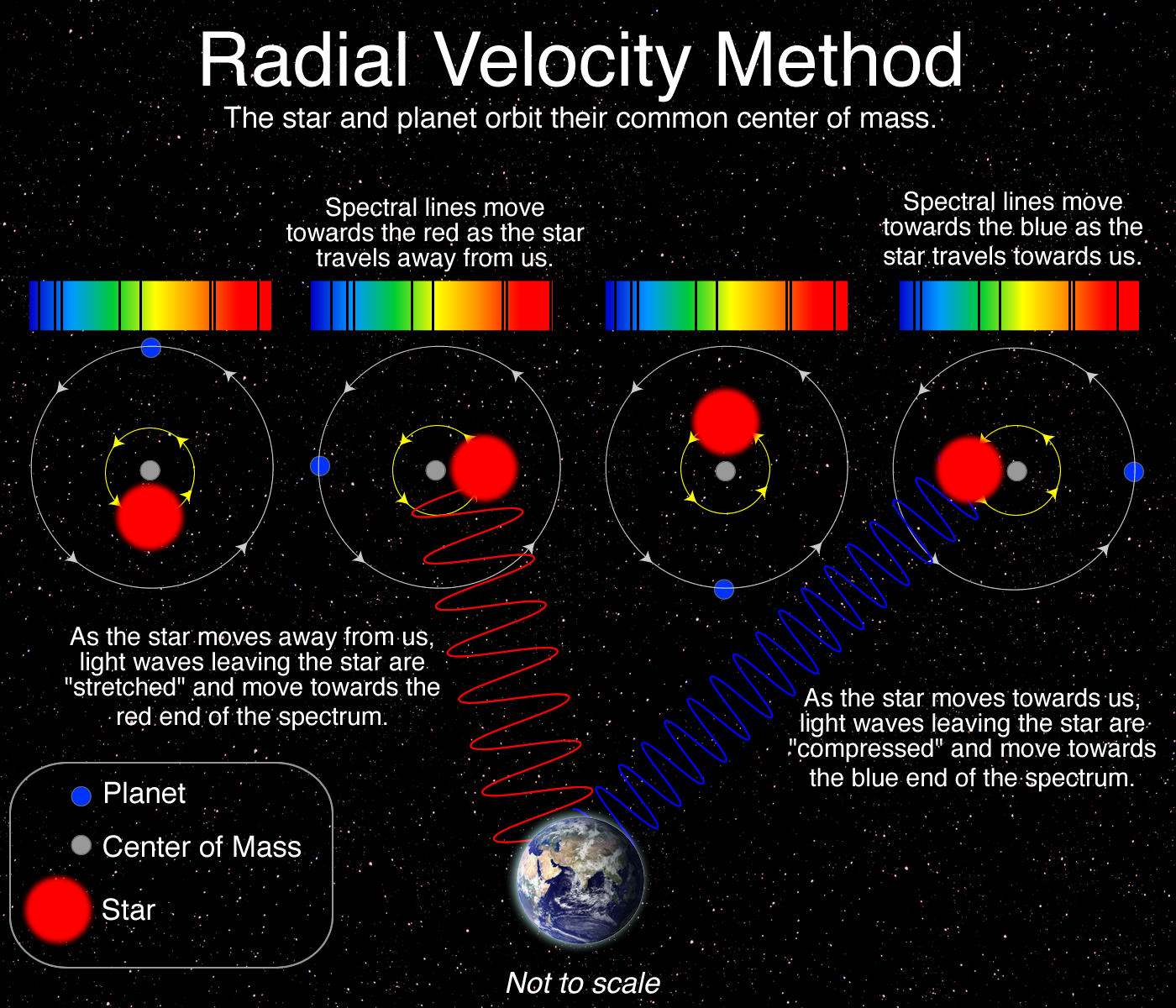
In the last few decades we have been able to find new planets (called ‘exoplanets’) circling distant stars. Those exoplanets are attracted to their parent stars by gravity. One method of detection is to observe the star ‘wobbling’ periodically, as the planet revolves around it. This is shown in Fig. I.12 below. By Newton’s Third Law, when a planet revolves around a star, both the planet and the star experience equal and opposite gravitational forces (as shown in Fig. I.7). So both the star and planet revolve about their mutual center of mass. Now, for the Earth and Sun, to a very good approximation we can neglect the motion of the Sun because it is so much more massive than Earth. But if we imagine a planet and star whose masses are more equal, then we could see the star ‘wobble’ as the planet revolves around it. We can observe this wobble by detecting changes in the Doppler shift of EM radiation emitted by the star. To date, over 4,000 exoplanets have been detected by either detecting this wobble, or by observing other periodic changes in the EM radiation received from the star. To Flat-Earthers, since stars are simply “points of light,” they must reject the existence of exoplanets (they must also reject the existence of moons orbiting around other planets) .
We inserted this digression to demonstrate the incredible power of the theory of gravitation. It is the unifying principle behind our knowledge and understanding of phenomena on Earth, the motion of planets in our solar system, the evolution of stars, and the behavior of distant galaxies. Note that in Flat-Earth theory, there are no distant galaxies. In fact, Flat-Earthers do not even acknowledge the existence of our own galaxy, the Milky Way, not to mention the solar system.
What about other celestial objects? Once again, there are slight differences between different Flat-Earth groups. One group adopts a system advocated by Tycho Brahe, the 16th century astronomer. In Tycho’s cosmology, the Earth was stationary and the Sun revolved about the Earth; however, the other planets revolved around the Sun. In the Flat Earth cosmology that we will review, there are no planets. The planets are simply “wandering stars.” Therefore, they are also located on the celestial sphere, but while ‘normal’ stars occupy fixed positions on the celestial sphere, the planets “wander” around. Before the advent of the heliocentric model, this wandering motion was described by Ptolemy’s epicycles (but even in Ptolemy’s day, scientists believed that the Earth was round).
So, let’s pause and consider what a radical leap backwards is required by Flat-Earth theory. Ever since Aristotle (384 – 322 BCE) most learned thinkers accepted that the Earth was a sphere. And Eratosthenes (276 – 194 BCE) used the notion that the world was round plus some geometry to extract a quite reasonable value for the Earth’s radius (we will discuss Eratosthenes’ experiment in more detail in Part II). Flat-Earthers comprehend almost nothing about the developments in physics and astronomy since the Renaissance, and especially during the past century, so they simply reject what they fail to understand when it does not comport with their extreme, unjustified viewpoint.
Flat Earth Theory not only returns us to an era prior to ancient Greek civilization, but it does away with most of the heavenly bodies. The planets? They are just wandering stars. The Milky Way galaxy? Gone – the Milky Way is just a large collection of stars assembled on the celestial sphere. Other galaxies? Non-existent. Stars? Simply “points of light.” And what about the Moon? In the 19th century Samuel Rowbotham, as ‘Parallax,’ poured scorn on scientists who maintained that they could discern landscape features on the Moon (craters, mountains, chasms, etc) that were reminiscent of geologic features found on Earth. Those scientists concluded that the Moon was composed of solid rock. Rowbotham claimed this was simply wild speculation and that to unprejudiced observers, the Moon’s surface looked more like clouds and bubbles. Furthermore, Rowbotham asserted that the Moon was self-luminous, generating its own light; he also speculated that the Moon might be transparent. All of this resulted from his misunderstanding of the properties of reflection, and from early (and faulty) observations of the Moon’s properties.
Here is a recent quote from Eric Dubay, one of the more prominent contemporary Flat-Earthers, contrasting properties of the Sun and Moon: “The Sun’s light is golden, warm, drying, preservative and antiseptic, while the Moon’s light is silver, cool, damp, putrefying and septic. The Sun’s rays decrease the combustion of a bonfire, while the Moon’s rays increase combustion. Plant and animal substances exposed to sunlight quickly dry, shrink, coagulate, and lose the tendency to decompose and putrefy; grapes and other fruits become solid, partially candied and preserved like raisins, dates, and prunes; animal flesh coagulates, loses its volatile gaseous constituents, becomes firm, dry, and slow to decay. When exposed to moonlight, however, plant and animal substances tend to show symptoms of putrefaction and decay. This proves that Sun and Moon light are different, unique, and opposites as they are in the geocentric flat model.”
Well, this is all nonsense – it reads like something out of an astrology text, or from medieval mythology. What is the origin of this tripe? As far as we can tell it appears to be a paraphrase from David Wardlaw Scott’s 1901 book Terra Firma: The Earth Not a Planet, Proved from Scripture, Reason, and Fact. Dubay’s quote also assumes that the Moon generates its own light, rather than simply reflecting light from the Sun.
Flat-Earth theory could be labeled an “Earth exceptionalism” doctrine. While other heavenly bodies such as Sun and Moon are spherical, and the stars are simply mysterious points of light, the Earth is a stationary disc. For those Flat-Earthers (perhaps a large majority nowadays) motivated by a fringe sect of Christian religious fundamentalism, this restores Earth to its “rightful” place as the center of the universe. This puts them in opposition to “mainstream” cosmology where the Earth rotates around a star that is in a corner of the Milky Way galaxy; where the Milky Way is one of billions of galaxies, each of which contains billions of stars; and where many of those distant stars have planets orbiting them.
You should be able to make a long list of potential problems with Flat-Earth theory. In Part II of this series, we will review just a few of the difficulties faced by Flat-Earth theory. The Web site Debunking Flat Earth Misconceptions catalogs many more problems with Flat-Earth models. In fact, they debunk nearly all the errors in Eric Dubay’s booklet 200 Proofs Earth is Not a Spinning Ball. Debunking Flat Earth Misconceptions is an entertaining site with professional graphics; we use several graphics from that site and we highly recommend it.
 Debunking Denial